
Symposia schedule
Speaker Slots Download Program (Version June 26th)
Show only
| CID | Type | Code | Presenting author | Contribution title | Time | Hall |
|---|---|---|---|---|---|---|
| 1.546 | Invited | CB-001-I | Jackson, T. | PROTON-COUPLED ELECTRON TRANSFER REACTIONS BY METAL-HYDROXO COMPLEXES | Mon, 09:25 | Hall 2+4 |
| 1.352 | Invited | BM-011-I | Hadjikakou, S. | HYBRID METALLODRUGS TARGETING BREAST TUMOR CANCER PROLIFERATION | Mon, 09:25 | Hall 1 |
| 1.839 | Invited | CB-021-I | Jiao, L. | OBSERVATION OF β-CARBON ELIMINATION IN ALKENYL-PALLADIUM COMPLEXES | Mon, 09:25 | K2 |
| 1.936 | Invited | MG-031-I | Webster, R. | CATALYTIC AND STOICHIOMETRIC TRANSFORMATIONS OF PHOSPHAALKYNES AND DEWAR-1,3,5-TRIPHOSPHABENZENE | Mon, 09:25 | K3 |
| 1.743 | Invited | ES-041-I | Jarzembska, K. | PHOTOCRYSTALLOGRAPHY AS A TOOL FOR MONITORING SOLID-STATE PROCESSES | Mon, 09:25 | K4 |
| 408 | Invited | ND-051-I | Collet, E. | MULTISCALE PHASE NUCLEATION DRIVEN BY PHOTOINDUCED POLARONS IN A CHARGE-TRANSFER MATERIAL | Mon, 09:25 | Room 200 |
| 1.056 | Invited | CB-061-I | Long, D.-L. | POLYOXOMETALATES AS CATALYSTS IN REDOX REACTIONS | Mon, 09:25 | Room 207 |
| 163 | Invited | SM-071-I | Beves, J. | VISIBLE-LIGHT RESPONSIVE METALLOSUPRAMOLECULAR CAGES | Mon, 09:25 | Room 107 |
| 1.972 | Invited | MM-081-I | Arrigoni, F. | COMPUTATIONAL INSIGHTS INTO NATURAL AND BIOMIMETIC HYDROGENASE SYSTEMS | Mon, 09:25 | Room 105+106 |
| 1.380 | Invited | ND-091-I | Jensen, K. | STRUCTURE CHARACTERIZATION OF METAL OXO CLUSTERS IN SOLUTION USING TOTAL SCATTERING – FROM CLUSTERS TO MATERIALS | Mon, 09:25 | Room B+C+D |
| 880 | Oral | CB-002-O | Tamhankar, M. | NON-INNOCENT ALUMINIUM(III) COMPLEXES: PLATFORMS FOR PROTON AND ELECTRON TRANSFER | Mon, 09:45 | Hall 2+4 |
| 1.378 | Oral | BM-012-O | Ang, W.H. | COMBINATORIAL COORDINATION CHEMISTRY FOR DISCOVERY OF THERAPEUTIC ORGANOTRANSITION METAL COMPLEXES | Mon, 09:45 | Hall 1 |
| 241 | Oral | CB-022-O | Kundu, S. | DECODING REDUCTIVE TRANSFORMATIONS OF NITRITE AT METAL(II): LINKS TO NITRIC OXIDE (NO) AND NITROXYL (HNO) | Mon, 09:45 | K2 |
| 1.374 | Oral | MG-032-O | Balázs, G. | PHOSPHORUS-BASED INORGANIC COBALT SANDWICH COMPLEXES | Mon, 09:45 | K3 |
| 767 | Oral | ES-042-O | Willans, R. | K2[Ir(OH)6]: AN ISOLABLE INTERMEDIATE IN THE REFINING OF COMPLEX CHLOROIRIDATE MIXTURES INTO SYNTHETICALLY USEFUL IRIDIUM(III) COORDINATION COMPLEXES | Mon, 09:45 | K4 |
| 1.258 | Oral | ND-052-O | Delaporte, S. | ELECTRONIC PROPERTIES AND VALENCE TAUTOMERISM IN TRINUCLEAR METAL COMPLEXES | Mon, 09:45 | Room 200 |
| 479 | Oral | CB-062-O | Sheet, N. | UNRAVELLING THE Nb LOCAL STRUCTURE IN THE Nb-BETA ZEOLITE VIA EXAFS ANALYSIS | Mon, 09:45 | Room 207 |
| 853 | Oral | SM-072-O | Hardie, M. | HOST-BASED METAL-ORGANIC CAGES | Mon, 09:45 | Room 107 |
| 1.229 | Oral | MM-082-O | Kardam, V. | N-DEALKYLATION BY IRON–PEROXO COMPLEXES: A DFT STUDY | Mon, 09:45 | Room 105+106 |
| 905 | Oral | ND-092-O | Kasagiri, T. | POROUS IONIC CRYSTALS BASED ON POLYOXOTHIOMETALATES | Mon, 09:45 | Room B+C+D |
| 902 | Oral | CB-003-O | Thorogood, J.M. | ELECTROCHEMICAL OXIDATION OF MAGNESIUM PORPHYRINS: MIMICKING P680 REACTIVITY | Mon, 10:00 | Hall 2+4 |
| 1.390 | Oral | BM-013-O | Blaszczak, E. | EXPLORING THE ANTICANCER POTENTIAL OF ORGANOMETALLIC Ir(III), Ru(II) AND Os(II) COMPLEXES WITH A FOCUS ON FERROPTOSIS | Mon, 10:00 | Hall 1 |
| 1.453 | Oral | CB-023-O | Burri, L. | NITRILE ACTIVATION IN PLATINUM-BASED LIGAND BACKBONE MANIPULATION | Mon, 10:00 | K2 |
| 360 | Oral | MG-033-O | Nikonov, G. | BASE-STABILIZED PHOSPHINIDENES | Mon, 10:00 | K3 |
| 1.401 | Oral | ES-043-O | Facchetti, G. | ENANTIOSELECTIVE ACCESS TO L-CARNOSINE VIA ONE-POT CATALYTIC PROTOCOL | Mon, 10:00 | K4 |
| 376 | Oral | ND-053-O | Cirera, J. | PREDICTING SPIN-CROSSOVER TRANSITION TEMPERATURES FROM ELECTRONIC STRUCTURE | Mon, 10:00 | Room 200 |
| 996 | Oral | CB-063-O | Stewart, M. | 3,5-BIS(2-PYRIDYL)PYRAZOLYL: A DITOPIC LIGAND FOR BIMETALLIC CATALYSIS | Mon, 10:00 | Room 207 |
| 1.397 | Oral | SM-073-O | Lee, J. | STRUCTURAL DIVERSITY AND ASSEMBLY OF AZOLE-BASED METAL COMPLEXES | Mon, 10:00 | Room 107 |
| 1.331 | Oral | MM-083-O | Tircsó, G. | ENHANCING RELAXIVITY FOR Mn(II)-BASED MRI PROBES USING MACROMOLECULAR PLATFORMS | Mon, 10:00 | Room 105+106 |
| 1.020 | Oral | ND-093-O | Lichtenberg, A. | THE DESIGN OF ACTINIDE (Th, U) COORDINATION COMPOUNDS AS MOLECULAR PRECURSORS FOR CVD OF ACTINIDE-BASED THIN FILMS | Mon, 10:00 | Room B+C+D |
| 2.090 | Invited | CB-004-I | Sen Gupta, S. | BIO-INSPIRED HIGH-VALENT IRON COMPLEXES FOR C–H FUNCTIONALIZATION: INSIGHTS INTO HYDROGEN ATOM TRANSFER MECHANISMS | Mon, 10:15 | Hall 2+4 |
| 1.419 | Invited | BM-014-I | Ciurli, S. | Ni(II) BINDING RESHAPES THE ENERGY LANDSCAPE OF HypA TO PROMOTE NICKEL TRAFFICKING IN Helicobacter pylori | Mon, 10:15 | Hall 1 |
| 1.429 | Invited | CB-024-I | Tan, G. | ACHIEVING ORBITAL QUASI-DEGENERACY IN MONOCOORDINATE MAIN-GROUP COMPOUNDS | Mon, 10:15 | K2 |
| 462 | Invited | MG-034-I | Sasamori, T. | PHOSPHINE-STABILIZED PHOSPHENIUM/STIBENIUM IONS INCORPORATED INTO A [2]FERROCENOPHANE FRAMEWORK | Mon, 10:15 | K3 |
| 840 | Invited | ES-044-I | Schutte-Smith, M. | CONNECTING MOLECULAR BEHAVIOUR TO REAL-WORLD FUNCTION AND SUSTAINABILITY | Mon, 10:15 | K4 |
| 1.148 | Invited | ND-054-I | Boskovic, C. | SPIN CROSSOVER IN COBALT AND IRON COMPLEXES OF AMINOPHENOLATE DERIVED LIGANDS | Mon, 10:15 | Room 200 |
| 1.949 | Invited | CB-064-I | Serre, Ch. | NEW INSIGHTS INTO METAL(IV) METAL-ORGANIC FRAMEWORKS PHOTOCATALYSTS | Mon, 10:15 | Room 207 |
| 1.714 | Invited | SM-074-I | Chand, D. | LIGAND ISOMERISM IN SINGLE/MULTI CAVITY DISCRETE COORDINATION CAGES | Mon, 10:15 | Room 107 |
| 1.910 | Invited | MM-084-I | Kraemer, T. | REACTIVITY OF LOW-VALENT GROUP 13 COMPOUNDS | Mon, 10:15 | Room 105+106 |
| 2.260 | Invited | ND-099-I | Bo, C. | NEW COMPUTATIONAL INSIGHTS INTO THE SPECIATION AND FORMATION OF POLYOXOMETALATES | Mon, 10:15 | Room B+C+D |
| 1.996 | Keynote | CB-005-K | Meyer, F. | INTRINSIC LIGAND EFFECTS ON ELECTRONIC STRUCTURES AND H-ATOM ABSTRACTION REACTIVITY OF ORGANOMETALLIC OXOIRON(IV) INTERMEDIATES | Mon, 11:00 | Hall 2+4 |
| 2.145 | Keynote | BM-015-K | Rompel, A. | POLYOXOMETALATES AT THE BIOLOGY INTERFACE: FROM SOLUTION CHEMISTRY TO CELLULAR FUNCTION | Mon, 11:00 | Hall 1 |
| 2.086 | Keynote | CB-025-K | Xi, Z. | INTERCONVERSION BETWEEN END-ON AND SIDE-ON CHROMIUM-HYDRAZIDO COMPLEXES IN NITROGEN FIXATION PROCESS | Mon, 11:00 | K2 |
| 2.219 | Keynote | MG-035-K | Velian, A. | PHOSPHINE-LIKE REACTIVITY OF BLACK PHOSPHORUS NANOSHEETS | Mon, 11:00 | K3 |
| 1.963 | Keynote | ES-045-K | Wendt, O.F. | IRIDIUM CATALYSED HYDROGEN TRANSFER REACTIONS FOR HYDROGEN STORAGE AND MORE | Mon, 11:00 | K4 |
| 1.122 | Keynote | ND-055-K | Weber, B. | HYSTERESIS AND TRAPPING EFFECTS IN IRON(II) AND IRON(III) SPIN CROSSOVER COMPLEXES | Mon, 11:00 | Room 200 |
| 1.981 | Keynote | CB-065-K | Duan, C. | CONFINED METAL-ORGANIC CAPSULE FOR MULTI-PHOTON MULTI-ELECTRON CATALYSIS | Mon, 11:00 | Room 207 |
| 1.180 | Keynote | SM-075-K | Mukherjee, P. | CHEMICAL TRANSFORMATIONS IN MOLECULAR VESSELS | Mon, 11:00 | Room 107 |
| 1.836 | Keynote | MM-085-K | Swart, M. | REACTIVE INTERMEDIATE FORMATION IN NON-HEME IRON COMPLEXES | Mon, 11:00 | Room 105+106 |
| 1.022 | Keynote | ND-094-K | Mathur, S. | METAL ALKOXIDES AS MOLECULAR GATEWAYS TO FUNCTIONAL METAL OXIDE MATERIALS FOR ENERGY APPLICATIONS | Mon, 11:00 | Room B+C+D |
| 1.246 | Oral | CB-006-O | Ehtisham, M. | PREDICTING STEREOSELECTIVITY IN γ-LACTONIZATION THROUGH A SIMPLE COMPUTATIONAL MODEL OF THE REACTANT COMPLEX | Mon, 11:30 | Hall 2+4 |
| 1.420 | Oral | BM-016-O | Merlino, A. | PROTEIN METALATION BY VANADIUM COMPOUNDS: A CRYSTALLOGRAPHER’S PERSPECTIVE | Mon, 11:30 | Hall 1 |
| 703 | Oral | CB-026-O | Joyce, J. | REASSIGNING THE Fe-HYDRIDE STRUCTURE OF Mo-NITROGENASE'S N2 BINDING INTERMEDIATE: A QM/MM STUDY | Mon, 11:30 | K2 |
| 1.055 | Oral | MG-036-O | Coburger, P. | ONIUM-SUBSTITUTED DIPHOSPHACYLOBUTADIENYL COMPLEXES: MODULAR ACCESS AND UNIQUE REACTIVITY | Mon, 11:30 | K3 |
| 969 | Oral | ES-046-O | Rosca, D.-A. | COMPRESSING THE SPIN LADDER: UNDERSTANDING ELECTRONIC STRUCTURE FOR REACTIVITY CONTROL IN EARTH-ABUNDANT TRANSITION-METAL CATALYSIS | Mon, 11:30 | K4 |
| 506 | Oral | ND-056-O | Chang, H.-C. | MOLECULAR LATTICE ENGINEERING FOR VALENCE TAUTOMERISM | Mon, 11:30 | Room 200 |
| 1.206 | Oral | CB-066-O | Zhao, L. | CONSTRUCTION OF CONFINED COORDINATION CAPSULES FOR CASCADE CATALYSIS | Mon, 11:30 | Room 207 |
| 196 | Oral | SM-076-O | Lewis, J. | DESIGN PRINCIPLES FOR LOW SYMMETRY COORDINATION CAGES | Mon, 11:30 | Room 107 |
| 848 | Oral | MM-086-O | Stier, M. | MODELING REDOX PROCESSES IN METALLOPROTEINS: OXIDATIVE DEACTIVATION OF ACONITASE | Mon, 11:30 | Room 105+106 |
| 1.232 | Oral | ND-096-O | Minato, T. | STRUCTURAL TRANSFORMATION OF A MANGANESE OXO CLUSTER WITHIN POLYOXOMETALATES BY THERMAL TREATMENT | Mon, 11:30 | Room B+C+D |
| 270 | Oral | CB-007-O | Garcia-Bosch, I. | MULTI-PROTON MULTI-ELECTRON TRANSFORMATIONS CARRIED OUT BY 3D METAL COMPLEXES BEARING REDOX-ACTIVE LIGANDS | Mon, 11:45 | Hall 2+4 |
| 1.351 | Oral | BM-017-O | Banti, Ch. | SILVER(I)-ANTIBIOTIC-LOADED PHEMA CONTACT LENSES AS THERAPEUTIC HYDROGELS | Mon, 11:45 | Hall 1 |
| 1.328 | Oral | CB-027-O | Nielsen, M. | HYBRID CATALYSIS FOR VALORIZATION OF BIOMASS AND CO2 | Mon, 11:45 | K2 |
| 373 | Oral | MG-037-O | Macdonald, C. | PHOSPHORUS(I), PHOSPHORUS(III) AND PHOSPHORUS(V) CHEMISTRY OF AN NCN PINCER LIGAND | Mon, 11:45 | K3 |
| 347 | Oral | ES-047-O | van der Vlugt, J.I. | IRON AGE 2.0 – CHEMO- AND ENANTIOSELECTIVE C-H AMINATION | Mon, 11:45 | K4 |
| 933 | Oral | ND-057-O | Sekine, Y. | SUPRAMOLECULAR CONTROL OF ELECTRON-TRANSFER-COUPLED SPIN TRANSITIONS IN MOLECULAR PRUSSIAN BLUE ANALOGUES | Mon, 11:45 | Room 200 |
| 567 | Oral | CB-067-O | Pfund, B. | BEYOND THE LOWEST EXCITED STATE: HIGHER EXCITED-STATE REACTIVITY IN IRON(II) VIA PYRIDINIUM-CABENE COORDINATION | Mon, 11:45 | Room 207 |
| 320 | Oral | SM-077-O | Rit, A. | BRIDGING SUPRAMOLECULAR ORGANOMETALLIC CHEMISTRY AND POROUS ARCHITECTURES | Mon, 11:45 | Room 107 |
| 860 | Oral | MM-087-O | Drosou, M. | MULTIREFERENCE DESCRIPTION OF O–O BOND FORMATION IN A MODEL COBALT OXIDE DIMER | Mon, 11:45 | Room 105+106 |
| 659 | Oral | ND-097-O | Soriano-López, J. | POM/2D NANOCOMPOSITES AS ENERGY MATERIALS | Mon, 11:45 | Room B+C+D |
| 1.363 | Invited | CB-008-I | Warren, T. | PCET IN ELECTROCATALYTIC AMMONIA OXIDATION | Mon, 12:00 | Hall 2+4 |
| 1.364 | Invited | BM-018-I | Tinoco, A. | TUNING THE ANTICANCER PROPERTIES OF THE IRON CHELATOR TRIAPINE VIA NONIRON METALATION AND REDOX ACTIVE MOIETY AND DUAL CHELATOR CONJUGATION | Mon, 12:00 | Hall 1 |
| 499 | Invited | CB-028-I | Wang, D. | TUNNING THE C-H BOND ACTIVATION REACTIVITY OF HIGH-VALENT NON-OXO-COBALT(IV) COMPLEXES USING COORDINATING ANIONS | Mon, 12:00 | K2 |
| 1.116 | Invited | MG-038-I | Reinholdt, A. | UNLEASHING PHOSPHORUS MONONITRIDE | Mon, 12:00 | K3 |
| 253 | Invited | ES-048-I | Broere, D.L.J. | OLD DOGS WITH NEW METAL-LIGAND COOPERATIVE TRICKS | Mon, 12:00 | K4 |
| 1.153 | Invited | ND-058-I | Miyasaka, H. | PROTON-COUPLED CHARGE TRANSFER INDUCING MAGNETIC PHASE TRANSFORMATION IN LAYERED METAL-ORGANIC FRAMEWORKS | Mon, 12:00 | Room 200 |
| 1.974 | Invited | CB-068-I | Pullen, S. | SUPRAMOLECULAR STRATEGIES FOR SELECTIVE CO2 CAPTURE AND CONVERSION FROM AIR | Mon, 12:00 | Room 207 |
| 1.179 | Invited | SM-078-I | McConnell, A. | LIGHT-RESPONSIVE AND SPIN-CROSSOVER CAGES | Mon, 12:00 | Room 107 |
| 289 | Invited | MM-088-I | Orio, M. | EXPLORING COPPER METALLOENZYMES: AN INTERPLAY BETWEEN EPR SPECTROSCOPY AND THEORY | Mon, 12:00 | Room 105+106 |
| 1.457 | Invited | ND-098-I | John, Ł. | FROM CAGE ARCHITECTURE TO BIOMATERIALS: THE ROLE OF MULTIFUNCTIONAL SILSESQUIOXANES | Mon, 12:00 | Room B+C+D |
| 219 | Keynote | BM-130-K | Lim, M.H. | CHEMICAL (BIOINORGANIC) STRATEGIES TO STUDY MULTIPLE FACETS IN DEMENTIA | Mon, 13:10 | K3 |
| 886 | Invited | CB-101-I | Baek, Y. | ORCHESTRATING SEMIQUINONE STABILITY FOR CATALYTIC PROTON-COUPLED ELECTRON TRANSFER | Mon, 13:40 | Hall 2+4 |
| 1.595 | Invited | BM-111-I | Hartinger, Ch. | PROTEIN-BINDING ANTICANCER METAL COMPLEXES: THE GOVERNING PARAMETERS DETERMINING PROTEIN METALATION | Mon, 13:40 | Hall 1 |
| 1.718 | Invited | CB-121-I | Wang, W. | REDUCTION OF NITRIC OXIDE AT IRON–MOLYBDENUM COMPLEXES | Mon, 13:40 | K2 |
| 1.918 | Invited | BM-131-I | Furukawa, Y. | MISFOLDING OF Cu/Zn-SUPEROXIDE DISMUTASE ASSOCIATED WITH NEURODEGENERATIVE DISEASES | Mon, 13:40 | K3 |
| 349 | Invited | ES-141-I | Darkwa, J. | PYRAZOLYL NICKEL AND PALLADIUM COMPLEXES AS CATALYSTS FOR THE SUSTAINABLE PRODUCTION OF ALKYLTOLUENES | Mon, 13:40 | K4 |
| 821 | Invited | ND-151-I | Morgan, G. | SPIN STATE SWITCHING IN IRON(III) COMPLEXES – A THERMAL AND OPTICAL STUDY | Mon, 13:40 | Room 200 |
| 1.355 | Invited | CB-161-I | Pilgrim, B. | METAL-ORGANIC CAGES – MOVING AWAY FROM PLANAR AROMATIC LIGANDS | Mon, 13:40 | Room 207 |
| 1.433 | Invited | SM-171-I | Zhang, M. | MULTICOMPONENT METALLACAGES THROUGH PYRIDYL/CARBOXYLATE HETEROLEPTIC ASSEMBLY | Mon, 13:40 | Room 107 |
| 1.990 | Invited | MM-181-I | Wieduwilt, E. | WHICH FACTORS DETERMINE THE REACTIVITY OF LYTIC POLYSACCHARIDE MONOOXYGENASES? | Mon, 13:40 | Room 105+106 |
| 1.847 | Invited | ND-191-I | Pike, S. | UNDERSTANDING MOLECULE TO MATERIAL TRANSFORMATIONS USING METAL-OXO CLUSTERS | Mon, 13:40 | Room B+C+D |
| 2.253 | Oral | CB-102-O | Wojdyla, Z. | EXPLORING THE SHIFT FROM PROTON-COUPLED TO HYDRIDE-COUPLED ELECTRON TRANSFER | Mon, 14:00 | Hall 2+4 |
| 1.414 | Oral | BM-112-O | Gioppo Nunes, G. | EXPLORING A TRIALKOXO HEXAVANDATE AND ITS PLA-BASED NANOPARTICLES AGAINST BREAST CANCER | Mon, 14:00 | Hall 1 |
| 362 | Oral | CB-122-O | Di Berto Mancini, M. | PHOTOREDOX ENTATIC CATALYSIS IN POROUS MATERIALS | Mon, 14:00 | K2 |
| 194 | Oral | BM-132-O | Lesiów, M. | COPPER-PRESENILIN 1 REDOX CHEMISTRY IN EARLY-ONSET ALZHEIMER’S DISEASE (EOAD) | Mon, 14:00 | K3 |
| 1.063 | Oral | ES-142-O | Luckay, R. | USE OF NEW AMIC ACID LIGANDS FOR THE COORDINATION AND SEPARATION OF BASE METAL IONS | Mon, 14:00 | K4 |
| 1.353 | Oral | ND-152-O | Krüger, H.-J. | COBALT COMPLEXES DISPLAYING CONSECUTIVELY OR SYNCHRONICALLY OCCURING VALENCE-TAUTOMERISM AND SPIN-CROSSOVER PROCESSES | Mon, 14:00 | Room 200 |
| 540 | Oral | CB-162-O | Han, J. | SYNERGISTIC PASSIVE-COOLING HYDROGELS BY COORDINATION DESIGN: ERYTHRITOL CONFINEMENT AND TITANIUM OXIDE-TUNED HEAT FLOW IN CALCIUM IONS-ALGINATE-CELLULOSE SEMI-IPNs | Mon, 14:00 | Room 207 |
| 308 | Oral | SM-172-O | Chan, M.C.W. | DYNAMIC HELICAL METALLOPOLYMERS: CONFORMATIONS, LUMINESCENCE, APPLICATIONS | Mon, 14:00 | Room 107 |
| 991 | Oral | MM-182-O | Alvarado, R. | REVISITING PEARSON’S HSAB PRINCIPLE: THE HARDNESS OF CATIONS AND ANIONS FROM ATOMIC POLARIZABILITIES | Mon, 14:00 | Room 105+106 |
| 944 | Oral | ND-192-O | Errington, J. | COMPLEXES OF {M5O18} MOLECULAR OXIDE LIGANDS | Mon, 14:00 | Room B+C+D |
| 1.121 | Oral | CB-103-O | Sarma, R. | MACHINE LEARNING ACCELERATED BOND DISSOCIATION FREE ENERGY DETERMINATION OF REDOX-ACTIVE MOLECULES INVOLVED IN PCET | Mon, 14:15 | Hall 2+4 |
| 1.268 | Oral | BM-113-O | Wojtala, D. | INCORPORATION OF ALKALOID DERIVATIVES INTO ORGANOMETALLIC COMPOUNDS: A SELECTIVE ASSAULT ON CANCER | Mon, 14:15 | Hall 1 |
| 1.046 | Oral | CB-123-O | Weber, S. | IRON COMPLEXES SUPPORTED BY PNPN SEESAW LIGANDS | Mon, 14:15 | K2 |
| 488 | Oral | BM-133-O | Hecel, A. | FUNCTION-SPECIFIC COORDINATION CHEMISTRY OF COPPER IN BACTERIA HOMEOSTASIS | Mon, 14:15 | K3 |
| 1.400 | Oral | ES-143-O | Malacea, R. | COORDINATION CHEMISTRY OF PHENOXY-AMIDINE AND BIS(PHENOXY-AMIDINE) LIGANDS | Mon, 14:15 | K4 |
| 380 | Oral | ND-153-O | Konar, S. | STIMULI RESPONSIVE SPIN STATE SWITCHING IN PBAS AND MOFs | Mon, 14:15 | Room 200 |
| 599 | Oral | CB-163-O | Joseph Abou-Fayssal, C. | COORDINATION POLYMERS AS CONFINEMENT PLATFORMS FOR HYDROGENATION WITH RHODIUM NANOCATALYSTS | Mon, 14:15 | Room 207 |
| 1.078 | Oral | SM-173-O | Cibian, M. | N-BRIDGED BIS-AMIDINE N-OXIDE LIGANDS AS SYNTHONS FOR MULTIMETALLIC SUPRAMOLECULAR ARCHITECTURES | Mon, 14:15 | Room 107 |
| 1.154 | Oral | MM-183-O | Jaiswal, N. | MULTIFUNCTIONAL SCHIFF BASE METAL COMPLEXES | Mon, 14:15 | Room 105+106 |
| 1.053 | Oral | ND-193-O | Pascual-Borràs, M. | RAPID MECHANOCHEMICAL 17O ENRICHMENT OF POLYOXOMETALATES | Mon, 14:15 | Room B+C+D |
| 1.106 | Oral | CB-104-O | Browne, W.R. | TRANSIENT FORMAL Fe(V)=O SPECIES CAUGHT BY HIGH-SPEED AND CONTINUOUS FLOW SPECTROSCOPY | Mon, 14:30 | Hall 2+4 |
| 990 | Oral | BM-114-O | Scalese, G. | TARGETING DENGUE AND ZIKA VIRUS SERINPROTEASES WITH POLYOXOMETALATES | Mon, 14:30 | Hall 1 |
| 237 | Oral | CB-124-O | Naher, M. | DIVALENT ORGANOCOPPER COMPLEXES: MASKED RADICALS FOR EFFECTIVE ELECTROCHEMICALLY DRIVEN ATOM TRANSFER RADICAL ADDITION (eATRA) | Mon, 14:30 | K2 |
| 1.277 | Oral | BM-134-O | Facchin, G. | PHENANTHROLINE-CONTAINING COPPER COMPLEXES: EXPLORING THE INTERPLAY BETWEEN THE CYTOTOXIC ACTIVITY AND THE CHEMICAL PROPERTIES | Mon, 14:30 | K3 |
| 1.332 | Oral | ES-144-O | Boccalon, E. | GREEN HYDROGEN PRODUCTION FROM BIOMASS VALORIZATION VIA BIOMIMETIC Ir(III) COMPLEXES FEATURING CARBOHYDRATE FUNCTIONALIZED LIGANDS | Mon, 14:30 | K4 |
| 972 | Oral | ND-154-O | Schünemann, V. | LIGHT INDUCED EXCITED SPIN STATES IN SPIN CROSSOVER COMPLEXES EXLORED WITH ULTRA FAST AND ULTRA HIGH RESOLUTION NUCLEAR INELASTIC SCATTERING | Mon, 14:30 | Room 200 |
| 1.044 | Oral | CB-164-O | Wu, C. | LIGAND-COORDINATED METAL CATALYSIS IN PROTEIN, POLYMER, AND LIVING-CELL SCAFFOLDS | Mon, 14:30 | Room 207 |
| 790 | Oral | SM-174-O | Tanaka, Y. | DUAL POST-FUNCTIONALIZATION OF A POLYAROMATIC METALLOTUBE FOR FULLERENE ENGINEERING | Mon, 14:30 | Room 107 |
| 1.439 | Oral | MM-184-O | Stein, M. | STABILITY OF DISULFIDE BONDS IN PROTEINS UNDER REDUCING CONDITIONS | Mon, 14:30 | Room 105+106 |
| 218 | Oral | ND-194-O | Seisenbaeva, G. | COORDINATION CHEMISTRY OF CRITICAL METALS FOR MOLECULAR RECOGNITION TECHNOLOGY | Mon, 14:30 | Room B+C+D |
| 2.215 | Invited | CB-105-I | Nordlander, E. | STEPWISE VS COUPLED ELECTRON PROTON TRANSFER IN ELECTROCATALYTIC PROTON REDUCTION | Mon, 14:45 | Hall 2+4 |
| 1.428 | Invited | BM-115-I | Gandin, V. | NEW COPPER(I) COMPLEXES FOR THERANOSTIC APPLICATIONS: FROM SMALL MOLECULES TO SELF-ASSEMBLED SUPRAMOLECULAR NANOPLATFORMS | Mon, 14:45 | Hall 1 |
| 1.649 | Invited | CB-125-I | Zhang, M.-T. | OXYANIONS ACTIVATION ENABLED BY A DINUCLEAR IRON-NHC (N-HETEROCYCLIC CARBENE) COMPLEX | Mon, 14:45 | K2 |
| 1.103 | Invited | BM-135-I | Lay, P. | VANADIUM(V) SCHIFF BASE/CATECHOLATO COMPLEXES FOR POTENTIAL EFFICACIOUS AND NEUROPROTECTIVE INTRATUMORAL TREATMENT OF BRAIN CANCERS | Mon, 14:45 | K3 |
| 1.008 | Invited | ES-145-I | Grisi, F. | RUTHENIUM CATALYSTS BEARING UNSYMMETRICAL NHC LIGANDS FOR OLEFIN METATHESIS | Mon, 14:45 | K4 |
| 387 | Invited | ND-155-I | Hayami, S. | MOLECULAR SPIN QUBIT BEHAVIOR IN MULTIFUNCTIONAL SPIN CROSSOVER SYSTEMS | Mon, 14:45 | Room 200 |
| 1.976 | Invited | CB-165-I | Zhang, T. | DIRECTIONAL ELECTRON TRANSFER FOR CONFINED PHOTOCATALYSIS WITHIN METAL-ORGANIC FRAMEWORK | Mon, 14:45 | Room 207 |
| 1.222 | Invited | SM-175-I | Crowley, J. | HETEROMETALLIC LOW-SYMMETRY METALLOSUPRAMOLECULAR CAGES: SELF-ASSEMBLY, SWITCHING AND MOLECULAR RECOGNITION | Mon, 14:45 | Room 107 |
| 2.046 | Invited | MM-185-I | Wang, B. | METAL COORDINATION DYNAMICS FOR CATALYSIS OF METALLOENZYMES | Mon, 14:45 | Room 105+106 |
| 1.690 | Invited | ND-195-I | Falaise, C. | SUPER-NERNSTIAN REDUCTION OF POLYOXOMETALATES: UNLOCKING THE CHEMICAL SPACE OF CATIONIC POLYOXOCLUSTERS | Mon, 14:45 | Room B+C+D |
| 1.989 | Keynote | CB-106-K | Krewald, V. | AB INITIO QUANTIFICATION OF THE NUCLEAR DIMENSIONS FOR ELECTRON TRANSFER AND PROTON-COUPLED ELECTRON TRANSFER | Mon, 15:35 | Hall 2+4 |
| 2.195 | Keynote | BM-116-K | Michaud-Soret, I. | THE AMAZING FACETS OF THE FUR REGULATORS & METAL HOMEOSTASIS AND COMPARTIMENTATION IN ANABAENA SP. NITROGEN-FIXING CYANOBACTERIA | Mon, 15:35 | Hall 1 |
| 1.938 | Keynote | CB-126-K | DeBeer, S. | SHINING LIGHT ON BIOLOGICAL NITROGEN FIXATION | Mon, 15:35 | K2 |
| 1.561 | Invited | BM-136-I | Quintanar, L. | METAL-PROTEIN INTERACTIONS IN ALZHEIMER´S DISEASE | Mon, 15:35 | K3 |
| 2.138 | Keynote | ES-146-K | Herres-Pawlis, S. | TAILORED GUANIDINE COMPLEXES FOR SUSTAINABLE POLYMERISATION AND DEPOLYMERISATION | Mon, 15:35 | K4 |
| 992 | Keynote | ND-156-K | Sato, O. | POLARIZATION CONTROL VIA ELECTRONIC-STATE CONVERSION | Mon, 15:35 | Room 200 |
| 2.079 | Keynote | CB-166-K | Cui, Y. | CHIRAL AGGREGATION AND CRYSTALLIZATION | Mon, 15:35 | Room 207 |
| 1.454 | Keynote | SM-176-K | Clever, G.H. | MULTICOMPONENT ASSEMBLY OF COMPLEX MOLECULAR SYSTEMS | Mon, 15:35 | Room 107 |
| 1.058 | Keynote | MM-186-K | Shafaat, H. | UNDERSTANDING HOW HIGHLY COVALENT NICKEL-THIOLATE INTERACTIONS MODULATE THE REACTIVITY OF MODEL METALLOENZYMES | Mon, 15:35 | Room 105+106 |
| 1.416 | Keynote | ND-196-K | Nyman, M. | OXOCLUSTERS FOR ATOM EFFICIENT METAL SEPARATIONS | Mon, 15:35 | Room B+C+D |
| 1.354 | Oral | CB-107-O | Call, A. | STEREOSELECTIVE LACTONIZATION AT NONACTIVATED PRIMARY AND SECONDARY C-H BONDS | Mon, 16:05 | Hall 2+4 |
| 334 | Oral | BM-117-O | Bernkop-Schnürch, A. | FERROPTOSIS-INDUCING IRON(III) COMPLEXES: LIGAND ENGINEERING CONTROLS UPTAKE, REDOX ACTIVITY, AND ANTICANCER EFFICACY | Mon, 16:05 | Hall 1 |
| 714 | Oral | CB-127-O | Gunther, M. | HETEROGENIZED BIOINSPIRED COPPER-BASED DINUCLEAR ELECTROCATALYSTS FOR STRONG C-H BOND ACTIVATION | Mon, 16:05 | K2 |
| 981 | Oral | BM-137-O | Deville, C. | PRODUCTION OF NON-MAINSTREAM RADIOMETALS AT THE HEVESY LABORATORY | Mon, 16:05 | K3 |
| 1.376 | Oral | ES-147-O | Tremlett, W. | FERROCENE DERIVATIVES AS UNIVERSAL ADDITIVES FOR PEROVSKITE SOLAR CELLS | Mon, 16:05 | K4 |
| 955 | Oral | ND-157-O | Magott, M. | PHOTOINDUCED STRUCTURAL TRANSFORMATIONS IN MAGNETIC HEAVY TRANSITION METAL COMPLEXES | Mon, 16:05 | Room 200 |
| 168 | Oral | CB-167-O | Cai, J. | COORDINATION CAPSULES FOR BIOMIMETIC CATALYSIS | Mon, 16:05 | Room 207 |
| 717 | Oral | SM-177-O | Andersson, C. | EFFICIENT REMOVAL OF SHORT-CHAIN PERFLUOROALKYL SUBSTANCES BY A MOLECULAR CAGE HOST | Mon, 16:05 | Room 107 |
| 1.302 | Oral | MM-187-O | Baran, P. | HIGH-TEMPERATURE ANTIFERROMAGNETISM IN TRINUCLEAR COPPER(II) COMPLEXES WITH GUANINE 3-N-OXIDE – MIMICKING MAGNETIC BEHAVIOR IN TYPE 3 COPPER PROTEINS | Mon, 16:05 | Room 105+106 |
| 1.297 | Oral | ND-197-O | White, M. | POLYOXOTHIOMETALATES AS MOLECULAR MEDIATORS IN LITHIUM-SULFUR BATTERIES | Mon, 16:05 | Room B+C+D |
| 1.393 | Oral | CB-108-O | Kupfer, S. | PHOTO-INDUCED ELECTRON TRANSFER WITHIN THE MARCUS PICTURE AND BEYOND | Mon, 16:20 | Hall 2+4 |
| 898 | Oral | BM-118-O | Lord, R. | HETEROBIMETALLIC RUTHENIUM-FERROCENE COMPLEXES AS ANTICANCER AGENTS | Mon, 16:20 | Hall 1 |
| 1.312 | Oral | CB-128-O | Bleher, K. | FROM MECHANISM TO MATERIALS: TRANSLATING BISPIDINE–Cu TOSYLIMIDO CATALYSIS ONTO EPOXYACTIVATED AGAROSE BEADS | Mon, 16:20 | K2 |
| 887 | Oral | BM-138-O | Lebruška, V. | 68-GALLIUM LABELLING OF MACROCYCLIC CHELATORS FOR SIMULTANEOUS IMAGING OF TUMORS AND BONE | Mon, 16:20 | K3 |
| 534 | Oral | ES-148-O | Armenta, P. | RUTHENIUM PADDLEWHEEL COMPLEXES WITH CHELATING EQUATORIAL LIGANDS FOR AMMONIA OXIDATION | Mon, 16:20 | K4 |
| 1.138 | Oral | ND-158-O | Vela, S. | UNDERSTANDING KINETICALLY CONTROLLED SPIN TRANSITIONS IN BISTABLE SPIN CROSSOVER MATERIALS | Mon, 16:20 | Room 200 |
| 828 | Oral | CB-168-O | Fonseca, J. | ASSEMBLY AND CO-ASSEMBLY OF COVALENT ORGANIC FRAMEWORK PARTICLES INTO ORDERED SUPERSTRUCTURES | Mon, 16:20 | Room 207 |
| 407 | Oral | SM-178-O | Hsu, S. | TUNING NUCLEARITY AND CUPROPHILICITY IN COPPER(I) β-THIOKETIMINATE COMPLEXES: FROM SPACER LENGTH TO DENTICITY | Mon, 16:20 | Room 107 |
| 799 | Oral | MM-188-O | Zienkiewicz-Machnik, | PYRAZOLE-BASED POLYDENTATE COMPLEXES OF THE FIRST-ROW TRANSITION METALS AS LOW-WEIGHT BIOMIMETICS | Mon, 16:20 | Room 105+106 |
| 1.037 | Oral | ND-198-O | Iwano, T. | STRUCTURAL DYNAMICS OF LACUNARY POLYOXOMETALATE [γ-SiW10O34(H2O)2]4‒ ACTIVATED WITH H2O2 ELUCIDATED BY IN SITU ATR-IR AND VIBRATIONAL CALCULATIONS | Mon, 16:20 | Room B+C+D |
| 1.303 | Invited | BM-139-I | Storr, T. | MULTIFUNCTIONAL COMPOUNDS THAT INHIBIT AMYLOID-BETA PEPTIDE AGGREGATION | Mon, 16:35 | K3 |
| 780 | Flash | ES-840-F | Satish, G. | GETTING THE GOLD IN: ONE-POT TRANSMETALLATION MEDIATED BY PALLADIUM(II) COMPLEXES | Mon, 16:40 | K4 |
| 719 | Flash | ND-850-F | Kambe, T. | ASSEMBLY OF BOROPHENE-ANALOGOUS LAYERED MATERIALS FOR EMERGENT ELECTRONIC AND IONIC FUNCTIONS | Mon, 16:40 | Room 200 |
| 1.334 | Flash | CB-860-F | Balakrishnan Syamala, A. | ISOLATION OF A 17-ELECTRON FeCp(CO)2 DERIVATIVE | Mon, 16:40 | Room 207 |
| 1.072 | Flash | BM-870-F | Masternak, J. | FROM PHYSICOCHEMICAL PROPERTIES TO BIOACTIVITY: SIMILARITIES AND DIFFERENCES IN CYCLOMETALLATED Rh(III) AND Ir(III) COMPLEXES | Mon, 16:40 | Room 107 |
| 1.281 | Flash | MM-880-F | Hemingway, J. | SYNTHESIS AND STRUCTURE OF A STERICALLY LESS-HINDERED [B2H5]- ANALOGUE WITH A STRONG B-B BOND | Mon, 16:40 | Room 105+106 |
| 1.939 | Flash | ND-890-F | Chrubasik, J. | PRECURSOR DESIGN EN ROUTE TOWARDS THE CHEMICAL VAPOR DEPOSITION OF f-ELEMENT NITRIDES | Mon, 16:40 | Room B+C+D |
| 356 | Flash | ES-841-F | Getty, C. | ELECTRONICALLY-TUNABLE DIRUTHENIUM ELECTROCATALYSTS FOR THE AMMONIA OXIDATION REACTION | Mon, 16:45 | K4 |
| 1.333 | Flash | MG-851-F | Babula, D. | FROM METALS TO REDUCTANTS: MECHANOCHEMICAL ROUTES TO REACTIVE MAGNESIUM REAGENTS | Mon, 16:45 | Room 200 |
| 1.300 | Flash | CB-861-F | Umakoshi, A. | CATALYSIS OF A BRØNSTED SUPERACIDIC OXO–HYDROXO ALUMINA CLUSTER IN WEAKLY POLAR APROTIC SOLVENTS | Mon, 16:45 | Room 207 |
| 2.153 | Flash | BM-871-F | Leung, C.-F. | TRANSFORMABLE CIS–TRANS ISOMERISM OF RUTHENIUM(II) COMPLEXES WITH PHOTOACTIVATED ANTICANCER ACTIVITY | Mon, 16:45 | Room 107 |
| 838 | Flash | MM-881-F | Leroy, J. | REACTIVITY OF GRIGNARD REAGENTS TOWARDS NITRILE IN CONTEXT OF POLYMERIZATION CATALYSIS | Mon, 16:45 | Room 105+106 |
| 655 | Flash | ND-891-F | Edenholm, A. | HOMOLEPTIC NICKEL(I) COMPOUNDS STABILIZED BY LOW VALENT MAIN GROUP METALLO LIGANDS | Mon, 16:45 | Room B+C+D |
| 681 | Flash | ES-842-F | Lenzi, C. | HOMOGENEOUS BIOETHANOL HOMOLOGATION: A MULTI-SCALE STUDY FROM MICROWAVE SYSTEM TO AUTOCLAVE SCALE-UP | Mon, 16:50 | K4 |
| 1.049 | Flash | MG-852-F | Schubert, E. | MODULAR MONO – AND BIMETALLIC Ni COMPLEXATION AT GeII INTERFACES | Mon, 16:50 | Room 200 |
| 734 | Flash | CB-862-F | Kerscher, B. | MASS SPECTROMETRIC ANALYSIS OF ELUSIVE BIMETALLIC COPPER-ALUMINUM CLUSTERS BY CHEMICAL LABELLING | Mon, 16:50 | Room 207 |
| 2.040 | Flash | SM-872-F | Khaleghi Abasabadi, R. | DESIGN OF EXPERIMENTS: A VALUABLE TOOL FOR FINE-TUNING CATALYTIC PERFORMANCES OF Ce-UiO-67 FOR THE ALLYLIC PARTIAL OXIDATION OF CYCLOHEXENE | Mon, 16:50 | Room 107 |
| 1.186 | Flash | MM-882-F | Zankel, T. | DISTINCTION OF fac / mer ISOMERS VIA 57Fe NMR SPECTROSCOPY | Mon, 16:50 | Room 105+106 |
| 1.311 | Flash | ND-892-F | Chang, Ch. | UNUSUAL BONDING INTERACTIONS AND PRONOUNCED CIS-INFLUENCE IN 6-COORDINATE OXOVANADIUM COMPLEXES | Mon, 16:50 | Room B+C+D |
| 1.894 | Keynote | BM-13A-K | Casini, A. | FORWARD-THINKING SUPRAMOLECULAR STRATEGIES FOR BLOOD-BRAIN BARRIER TRANSLOCATION AND PRECISION THERANOSTICS | Mon, 16:55 | K3 |
| 1.321 | Flash | ES-843-F | Sanchez, R. | SYNTHESIS AND CHARACTERISATION OF COBALT-BASED HETEROLEPTIC POLYPYRIDYL PINCER COMPLEXES | Mon, 16:55 | K4 |
| 803 | Flash | MG-853-F | Zhang, H. | A SODIUM ANION COMPLEX: GRAMME-SCALE SYNTHESIS, STRUCTURE, REACTIVITY | Mon, 16:55 | Room 200 |
| 754 | Flash | CB-863-F | Toullec, C. | NEW CATALYTIC PATHWAYS FOR CARBENE INSERTION INTO Si-H AND S-H BONDS CATALYZED BY PHTHALOCYANINE COMPLEXES | Mon, 16:55 | Room 207 |
| 2.189 | Flash | MM-873-F | Dykstra, C. | TIME-RESOLVED OPEN-ACCESS SCIENCE AT THE NEXUS X-RAY SPECTROSCOPY BEAMLINE | Mon, 16:55 | Room 107 |
| 2.060 | Flash | MM-883-F | Bertoloni, R. | ACCURATE QUANTITATIVE EVALUATION OF Ni AND Co UV-VIS SPECTRA CALCULATED BY TD-DFT FUNCTIONALS | Mon, 16:55 | Room 105+106 |
| 654 | Flash | ND-893-F | Dürr, E. | CLUSTER GROWTH OF MOLECULAR COBALT-ALUMINUM COMPLEXES | Mon, 16:55 | Room B+C+D |
| 515 | Flash | ES-844-F | Townrow, O. | STABLE SINGLE-ION SOURCES OF IRON(I) | Mon, 17:00 | K4 |
| 899 | Flash | MG-854-F | Scorzoni, G. | REACTIVITY OF HOMOLEPTIC PENTACOORDINATED Ga(I)-AMIDE COMPLEXES OF Fe IN THE PRESENCE OF AlCp* | Mon, 17:00 | Room 200 |
| 792 | Flash | CB-864-F | Damiano, C. | IMMOBILIZED METAL PORPHYRINS AS RECYCLABLE CATALYSTS FOR ON-WATER CARBENE TRANSFER REACTIONS | Mon, 17:00 | Room 207 |
| 1.299 | Flash | MM-884-F | O'Brien, D.J. | OBSERVING EXCITED STATE PROPERTIES OF RUTHENIUM POLYPYRIDIL COMPLEXES IN THE SOLID STATE | Mon, 17:00 | Room 105+106 |
| 843 | Flash | ND-894-F | Napoli, F.E. | MODELLING FISCHER-TROPSCH RELATED PHASES AND REACTIVITY WITH MOLECULAR CLUSTERS | Mon, 17:00 | Room B+C+D |
| 538 | Invited | CB-201-I | Kodera, M. | CANCER-CELL-SELECTIVE CYTOTOXICITY OF DI- AND TETRA-COPPER COMPLEXES TARGETING MITOCHONDRIA | Tue, 09:25 | Hall 2+4 |
| 1.785 | Invited | ES-211-I | Wenger, O. | FIRST-ROW TRANSITION METAL COMPLEXES IN LUMINESCENCE, PHOTOCATALYSIS AND UPCONVERSION | Tue, 09:25 | Hall 1 |
| 2.015 | Invited | CB-221-I | Casadevall, C. | FROM MOLECULAR TO POLYMERSOME-BASED SYSTEMS FOR PHOTOCATALYTIC CO2 REDUCTION | Tue, 09:25 | K2 |
| 2.077 | Invited | BM-231-I | Collingwood, J. | IRON SPECIATION IN THE HUMAN BRAIN | Tue, 09:25 | K3 |
| 1.711 | Invited | MG-241-I | Hwang, S.J. | LIGAND-DRIVEN MULTIELECTRON REDOX CHEMISTRY OF MAIN GROUP ELEMENTS FOR SMALL MOLECULE ACTIVATION | Tue, 09:25 | K4 |
| 389 | Invited | ND-251-I | Yamashita, M. | MOLECULAR SPIN QUBITS BASED ON MOLECULAR MAGNETS WITH S = 1/2 | Tue, 09:25 | Room 200 |
| 1.962 | Invited | ES-261-I | Boullart, L. | TOWARDS AN E-NOSE: KINETIC SELECTIVITY SENSING WITH MODIFIED METAL-ORGANIC FRAMEWORK ELEMENTS | Tue, 09:25 | Room 207 |
| 327 | Invited | SM-271-I | Jenkins, D. | MULTI-VARIATE METAL ORGANIC NANOTUBES | Tue, 09:25 | Room 107 |
| 1.968 | Invited | MM-281-I | Leskes, M. | POLARIZATION TRANSFER FROM PARAMAGNETIC METAL IONS: A NEW STRUCTURAL TOOL FOR COMPLEX INTERFACES | Tue, 09:25 | Room 105+106 |
| 613 | Invited | MM-291-I | Weinberger, P. | FLUORESCENT IRON(II) SPIN-CROSSOVER COMPLEXES BASED ON N1-SUBSTITUTED TETRAZOLES | Tue, 09:25 | Room B+C+D |
| 1.516 | Oral | CB-202-O | Jin, K. | MODULATING ELECTROCATALYTIC WATER OXIDATION IN NICKEL-BASED MOLECULAR COMPLEXES | Tue, 09:45 | Hall 2+4 |
| 36 | Oral | ES-212-O | Wang, C. | LUMINESCENT DINUCLEAR CHROMIUM(III) COMPLEX WITH STRONG VISIBLE ABSORPTION | Tue, 09:45 | Hall 1 |
| 182 | Oral | CB-222-O | Travis, B. | DEVELOPMENT OF A LIGHT-DRIVEN MULTI-CATALYST CASCADE FOR CARBON DIOXIDE CONVERSION TO METHANOL | Tue, 09:45 | K2 |
| 1.897 | Keynote | BM-232-K | Caravan, P. | DEVELOPMENT AND APPLICATION OF METAL-BASED MOLECULAR IMAGING PROBES FOR NONINVASIVE IMAGING OF NEURODEGENERATIVE DISEASES | Tue, 09:45 | K3 |
| 612 | Oral | MG-242-O | Kalkuhl, T.L. | SNAPSHOTS OF MULTI-METALLIC COOPERATIVITY IN MOLECULAR [GanNi] SYSTEMS | Tue, 09:45 | K4 |
| 474 | Oral | ND-252-O | Aromí, G. | SELF-COOLING MOLECULAR SPIN QUDITS | Tue, 09:45 | Room 200 |
| 643 | Oral | ES-262-O | Clutterbuck, K. | CHIROPTICAL MODULATION WITHIN SUPRAMOLECULAR LANTHANOID ASSEMBLIES | Tue, 09:45 | Room 207 |
| 699 | Oral | SM-272-O | Booth, S. | FLEXIBILITY IN PILLARED TRIAZOLATE 3D-LINKER MOFs | Tue, 09:45 | Room 107 |
| 854 | Oral | MM-282-O | Rønne-Nielsen, T.K. | MONITORING COPPER SPECIATION AND DYNAMICS DURING NH3-SCR REACTION USING IN-SITU EPR | Tue, 09:45 | Room 105+106 |
| 722 | Oral | MM-292-O | Salmon, L. | OPTIMIZED SPIN CROSSOVER COMPLEX-BASED COMPOSITE MATERIALS FOR MOTION/ACTUATION | Tue, 09:45 | Room B+C+D |
| 1.047 | Oral | CB-203-O | Aparicio, E. | SYNTHESIS AND CHARACTERIZATION OF NEW Mn COMPLEXES AND THEIR APPLICATION IN THE ASYMMETRIC DIRECTED OXIDATION OF NON-ACTIVATED C-H BONDS | Tue, 10:00 | Hall 2+4 |
| 778 | Oral | ES-213-O | Murayama, Y. | CONSTRUCTION AND EVALUATION OF PHOTORESPONSIVE COORDINATION ASSEMBLIES VIA MULTIPOINT HYDROGEN-BOND-DRIVEN SELF-ASSEMBLY | Tue, 10:00 | Hall 1 |
| 495 | Oral | CB-223-O | Suarez Antuna, I. | HOST-GUEST CONFINEMENT OF THE [Mn(bpy)(CO)3(CH3CN)]+ CATALYST IN A SILICON-BASED CAGE FOR SELECTIVE AQUEOUS CO2 TO CO ELECTROREDUCTION | Tue, 10:00 | K2 |
| 2.070 | Oral | MG-243-O | Slesarchuk, N. | FLUORINATED ansa-AMINOBORONIC DERIVATIVES CATALYZE sp2 C-H BORYLATION WITH PINACOLBORANE | Tue, 10:00 | K4 |
| 603 | Oral | ND-253-O | Janetzki, J. | CANTILEVER TORQUE MAGNETOMETRY OF Ni(II) COMPLEXES: A PLATFORM FOR CHARACTERIZING MOLECULAR QUBITS | Tue, 10:00 | Room 200 |
| 473 | Oral | ES-263-O | Amali, S.J. | MICROWAVE ASSISTED SYNTHESIS OF LANTHANOID 2D METAL-ORGANIC FRAMEWORKS | Tue, 10:00 | Room 207 |
| 813 | Oral | SM-273-O | Endo, K. | INTERPLAY BETWEEN COORDINATION AND ORGANIC POLYMERIZATIONS TO BUILD MOF–COF HYBRID STRUCTURES WITH ENHANCED CHEMICAL STABILITY AND CRYSTALLINITY | Tue, 10:00 | Room 107 |
| 963 | Oral | MM-283-O | Carter, K. | CRYSTAL FIELD ENGINEERING IN f-ELEMENT POLYOXOMETALATE COMPLEXES | Tue, 10:00 | Room 105+106 |
| 976 | Oral | MM-293-O | Rezavand, A. | EFFICIENT ATOMISTIC MODELING OF SPIN CROSSOVER MATERIALS | Tue, 10:00 | Room B+C+D |
| 1.178 | Invited | CB-204-I | Wu, G. | MOLECULAR INSIGHTS INTO THE ACTIVITY AND SELECTIVITY OF 3D METAL OXIDE WATER OXIDATION ELECTROCATALYSTS | Tue, 10:15 | Hall 2+4 |
| 82 | Invited | ES-214-I | Troian-Gautier, L. | BEYOND SHORT-LIVED EXCITED STATES: CHARGE AND SPIN MANAGEMENT IN IRON PHOTOSENSITIZERS | Tue, 10:15 | Hall 1 |
| 2.196 | Invited | CB-224-I | Dutta, A. | ELECTROCATALYTIC CO2-TO-METHANOL CONVERSION USING MOLECULARLY DEFINED CATALYSTS | Tue, 10:15 | K2 |
| 1.406 | Oral | BM-234-O | Kadanuru Rajashekar, G.K. | INVESTIGATION OF EQUILIBRIUM, KINETIC, RELAXATION PROPERTIES OF Mn(II) COMPLEXES FORMED WITH PC2A DERIVATIVE LIGANDS | Tue, 10:15 | K3 |
| 1.501 | Invited | MG-244-I | Greb, L. | TERMINAL OXO CHEMISTRY OF P-BLOCK ELEMENTS: TAMED BY STRUCTURAL CONSTRAINTS | Tue, 10:15 | K4 |
| 1.235 | Invited | ND-254-I | Jiang, S.-D. | OPTICALLY DETECTED MAGNETIC RESOANCE OF MAGNETIC MOLECULES | Tue, 10:15 | Room 200 |
| 283 | Invited | ES-264-I | Sørensen, T.J. | NANOCOMPOSITE CHEMOSENSORS USING Eu(III) LUMINSCENCE | Tue, 10:15 | Room 207 |
| 1.816 | Invited | SM-274-I | Matsinha, L. | ADVANCING GAS STORAGE THROUGH SCALABLE MOF MANUFACTURE | Tue, 10:15 | Room 107 |
| 2.186 | Invited | MM-284-I | Richards, E. | SOLVENT DEPENDENT CARBON-TO-METAL HYDROGEN ATOM TRANSFER REACTIVITY OF A SQUARE PLANAR RHODIUM(II) ALKYNYL COMPLEX | Tue, 10:15 | Room 105+106 |
| 415 | Invited | MM-294-I | Berry, J. | METAL-METAL BONDED ELECTROCATALYSTS FOR AMMONIA OXIDATION | Tue, 10:15 | Room B+C+D |
| 894 | Keynote | CB-205-K | Kojima, T. | IMPORTANCE OF SECOND COORDINATION SPHERES OF METAL COMPLEXES IN OXIDATION CATALYSIS | Tue, 11:00 | Hall 2+4 |
| 1.767 | Keynote | ES-215-K | Heinze, K. | MANGANESE, CARBENES AND LIGHT – A SUCCESSFUL TRIPLE | Tue, 11:00 | Hall 1 |
| 1.731 | Keynote | CB-225-K | Marinescu, S. | BIOLOGICALLY INSPIRED PHOSPHINOTHIOLATE SYSTEMS FOR SMALL MOLECULE ACTIVATION | Tue, 11:00 | K2 |
| 2.063 | Keynote | BM-235-K | Meade, Th. | PROGRAMMING Gd(III) COORDINATION CHEMISTRY TO IMAGE THE MOLECULAR HALLMARKS OF AGING | Tue, 11:00 | K3 |
| 1.147 | Keynote | MG-245-K | Khan, S. | COINAGE METALS MEET LOW-VALENT GROUP 14 ELEMENTS | Tue, 11:00 | K4 |
| 1.372 | Keynote | ND-255-K | Ruben, M. | ISOTOPOLOGUE COORDINATION CHEMISTRY: NUCLEAR-SPIN ENGINEERING IN AEu(III) COMPLEXES FOR OPTICALLY-DETECTED NMR (OD-NMR) | Tue, 11:00 | Room 200 |
| 646 | Keynote | ES-265-K | Yam, V.W.-W. | CONTROL OF EXCITED STATES, NANOSTRUCTURES AND FUNCTIONS THROUGH MOLECULAR DESIGN AND SUPRAMOLECULAR ASSEMBLY | Tue, 11:00 | Room 207 |
| 1.865 | Keynote | SM-275-K | Mínguez Espallargas, G. | MOLTEN MOLECULAR SYNTHESIS: AN ALTERNATIVE ROUTE TO UNCONVENTIONAL MOFs | Tue, 11:00 | Room 107 |
| 245 | Keynote | MM-285-K | Jeschke, G. | SPECIES-SELECTIVE OBSERVATION OF CATALYTIC PROCESSES BY ELECTRON PARAMAGNETIC RESONANCE SPECTROSCOPY | Tue, 11:00 | Room 105+106 |
| 1.973 | Keynote | MM-295-K | Meyer, K. | ACCESSING SUPER-OXIDIZED IRON: ELECTRONIC STRUCTURE CONTROL ACROSS NITRIDO AND OXIDO COMPLEXES WITH TUNABLE N-HETEROCYCLIC CARBENE LIGANDS | Tue, 11:00 | Room B+C+D |
| 419 | Oral | CB-206-O | Buss, J. | O-O BOND FORMATION AND CLEAVAGE AT BIO-INSPIRED BIMETALLIC CORES | Tue, 11:30 | Hall 2+4 |
| 1.076 | Oral | ES-216-O | Steffen, A. | NIR-TRIPLET EMISSION IN D10 Cu(I) AND Pd(0) CARBENE COMPLEXES | Tue, 11:30 | Hall 1 |
| 528 | Oral | CB-226-O | Abudayyeh, A.M. | ENHANCED CO2 ELECTROREDUCTION BY A RHENIUM CATALYST | Tue, 11:30 | K2 |
| 1.344 | Oral | BM-236-O | Holz, R. | SULFUR MOBILIZATION FOR IRON–SULFUR CLUSTER ASSEMBLY IN THE SUF PATHWAY OF STAPHYLOCOCCUS AUREUS | Tue, 11:30 | K3 |
| 966 | Oral | MG-246-O | Martin, C. | CARBORANE SUBSTITUTED BORON LEWIS SUPERACIDS | Tue, 11:30 | K4 |
| 548 | Oral | ND-256-O | Strandfelt, A. | CHEMICAL-ENVIRONMENT INDUCED DECOHERENCE IN MOLECULAR 4f QUBITS | Tue, 11:30 | Room 200 |
| 970 | Oral | ES-266-O | R. Gamarra, S. | IN-PLANE POROUS 2D MOF FOR COLORIMETRIC VOC DETECTION | Tue, 11:30 | Room 207 |
| 1.269 | Oral | SM-276-O | Röß-Ohlenroth, R. | FUNCTIONALITY FINE-TUNING IN 1,2,3-TRIAZOLATE-BASED COORDINATION FRAMEWORKS | Tue, 11:30 | Room 107 |
| 1.176 | Oral | MM-286-O | Ye, S. | EPR CHARACTERIZATONS OF SYSTEMS FEATURING ORBITALLY NEARLY DEGENERATE GROUND STATES | Tue, 11:30 | Room 105+106 |
| 849 | Oral | MM-296-O | Robb, M. | EXPLORING THE BAROCALORIC CAPABILITY OF NITROPRUSSIDE-BASED SPIN CROSSOVER FRAMEWORKS | Tue, 11:30 | Room B+C+D |
| 683 | Oral | CB-207-O | Madabeni, A. | SPECTROSCOPIC AND THEORETICAL RESOLUTION OF THE CATALYTIC CYCLE OF TYROSINASE | Tue, 11:45 | Hall 2+4 |
| 844 | Oral | ES-217-O | Koshevoy, I. | LUMINESCENT PHOSPHINE-PHOSPHINITE/-PHOSPHINATE COINAGE METAL COMPLEXES | Tue, 11:45 | Hall 1 |
| 552 | Oral | CB-227-O | Vettori, M. | HETEROGENIZATION OF A WATER-SOLUBLE MANGANESE MOLECULAR COMPLEX UNLOCKS HIGHLY EFFICIENT CO2 ELECTROREDUCTION TO FORMATE | Tue, 11:45 | K2 |
| 2.059 | Keynote | BM-237-K | Rouault, T. | IRON REGULATORY PROTEIN 2 DEFICIENT ANIMALS OVEREXPRESS FERRITIN, WHICH LEADS TO FUNCTIONAL IRON DEFICIENCY, IMPAIRED MITOCHONDRIAL ATP PRODUCTION AND IMPAIRED NEURONAL FUNCTION | Tue, 11:45 | K3 |
| 874 | Oral | MG-247-O | Hicks, J. | REVERSIBLE HYDROGEN ACTIVATION BY TRAPPED SILICON ANIONS | Tue, 11:45 | K4 |
| 967 | Oral | ND-257-O | Shushkov, P. | SPIN RELAXATION IN MOLECULAR QUBITS | Tue, 11:45 | Room 200 |
| 1.045 | Oral | ES-267-O | Kühne, I. | FOLLOWING THE THIN FILM GROWTH OF SQUARE-PLANAR Ni(II) COMPLEXES | Tue, 11:45 | Room 207 |
| 877 | Oral | SM-277-O | Akine, S. | CLOSED TRIS(SALEN) METALLO-CAGES FOR GUEST UPTAKE/RELEASE CONTROL AND CHIRALITY CONTROL | Tue, 11:45 | Room 107 |
| 1.142 | Oral | MM-287-O | Abdiaziz, K. | SPECTROELECTROCHEMICAL EPR AND MÖSSBAUER METHODS FOR IDENTIFYING REVERSIBLE REDOX ACTIVE IRON OXIDE STRUCTURES IN FENC CATALYSTS | Tue, 11:45 | Room 105+106 |
| 520 | Oral | MM-297-O | Ishii, T. | SYMMETRY-PRESERVED SUPERATOMIC ORBITALS IN Ih ALUMINUM CLUSTERS: SEPARATING ELECTRON COUNT AND NUCLEAR GEOMETRY VIA THE SHELL POTENTIAL | Tue, 11:45 | Room B+C+D |
| 1.820 | Invited | CB-208-I | Roemelt, M. | USING QUANTUM CHEMISTRY TO ELUCIDATE THE ELECTRONIC STRUCTURE OF HIGH VALENT METAL OXO COMPLEXES WITH REDOX-ACTIVE LIGANDS | Tue, 12:00 | Hall 2+4 |
| 931 | Invited | ES-218-I | Cadranel, A. | HIGH-ENERGY MLCT STATES FOR SOLAR-ENERGY CONVERSION | Tue, 12:00 | Hall 1 |
| 1.752 | Invited | CB-228-I | Sarkar, B. | DIIRON COMPLEXES OF FUSED BIPORPHYRINS AS ELECTROCATALYSTS FOR CO2 REDCUTION | Tue, 12:00 | K2 |
| 1.736 | Invited | MG-248-I | Cui, C. | REACTVITY OF N-HETEROCYCLIC BORYL-SUBSTITUTED DISILYNE AND DILITHIODISILENE | Tue, 12:00 | K4 |
| 379 | Invited | ND-258-I | Demir, S. | FLUOFLAVINE AND TETRAAZANAPHTHALENE RADICAL-BRIDGED LANTHANIDE SINGLE-MOLECULE MAGNETS | Tue, 12:00 | Room 200 |
| 614 | Invited | ES-268-I | Wettstein, L. | RED LIGHT-GATED CHARGE TRANSFER ENABLES ON-DEMAND CHEMICAL RESPONSE IN CARBON NANOTUBE-TITANIA HYBRIDS | Tue, 12:00 | Room 207 |
| 519 | Invited | SM-278-I | Macreadie, L. | EXPANDING MOF FLEXIBILITY THROUGH THREE-DIMENSIONAL LINKER DESIGN | Tue, 12:00 | Room 107 |
| 658 | Invited | MM-288-I | Bruzzese, P. | MAGNETO-STRUCTURAL CORRELATIONS OF ATYPICAL COPPER HYPERFINE SIGN IN TETRAGONAL COPPER COMPLEXES THROUGH ADVANCED HYPERFINE SPECTROSCOPY | Tue, 12:00 | Room 105+106 |
| 732 | Invited | MM-298-I | Schneider, S. | FROM METAL OXOS TO METALLONITRENES AND -CARBENES | Tue, 12:00 | Room B+C+D |
| 366 | Keynote | BM-330-K | Faller, P. | DETECTION OF EXCHANGEABLE Cu(II)-POOLS RELATED TO NEURODEGENERATION BY Ln(III)-LUMINESCENCE, MRI CONTRAST AGENT AND F-NMR | Tue, 13:10 | K3 |
| 1.205 | Invited | CB-301-I | Cho, J. | O2-DERIVED MANGANESE(III)-HYROXO COMPLEXES: PROTONATION-TUNED REDOX POTENTIALS AND OXIDATION REACTIVITY | Tue, 13:40 | Hall 2+4 |
| 1.888 | Invited | ES-311-I | Jakubikova, E. | REVISITING METAL-LIGAND INTERACTIONS IN TRANSITION METAL POLYPYRIDINES | Tue, 13:40 | Hall 1 |
| 1.994 | Invited | CB-321-I | Nova, A. | CATALYST AND AMINE DESIGN IN THE CO2 TO METHANOL REACTION | Tue, 13:40 | K2 |
| 2.008 | Invited | BM-331-I | Hureau, C. | THE ETIOLOGICAL AND THERAPEUTIC SIGNIFICANCE OF ATCUN PEPTIDES IN ALZHEIMER’S DISEASE | Tue, 13:40 | K3 |
| 616 | Invited | MG-341-I | Lee, E. | CARBENE-DERIVED STABLE AND MULTI-REDOX ORGANIC RADICALS: 1,2-DICARBONYL AND AMINYL PLATFORMS FOR ADVANCED FUNCTIONAL APPLICATIONS | Tue, 13:40 | K4 |
| 1.077 | Invited | ND-351-I | Rentschler, E. | CHIRAL SMMs FOR MOLECULAR SPINTRONICS | Tue, 13:40 | Room 200 |
| 1.789 | Invited | BM-361-I | Reid, G. | EXPLORING METAL-MACROCYCLIC SCAFFOLDS FOR BINDING FLUORINE-18 | Tue, 13:40 | Room 207 |
| 2.067 | Invited | SM-371-I | Ghosh, S.K. | Critical Minerals Extraction by MOFs+ for a Sustainable Future | Tue, 13:40 | Room 107 |
| 2.198 | Invited | MM-381-I | Cox, N. | MEASURING NANOMETER DISTANCES IN PROTEINS AND RIGID RULERS BETWEEN 19F AND Gd3+ USING 19F-ENDOR | Tue, 13:40 | Room 105+106 |
| 1.703 | Invited | ND-391-I | López, X. | POLYOXOTHIOMETALATES IN SILICO: ELECTRONIC AND DYNAMIC PROPERTIES OF [XW12O28S12]n– SYSTEMS WITH X = P, Si, AND Al | Tue, 13:40 | Room B+C+D |
| 977 | Oral | CB-302-O | Cao, N. | MECHANISTIC INSIGHTS INTO PEROXIDE-ACTIVATED Cu(I) COMPLEXES FOR C–H BOND OXIDATION REACTIONS | Tue, 14:00 | Hall 2+4 |
| 426 | Oral | ES-312-O | Yoshida, M. | SECONDARY COORDINATION SPHERE MODIFICATION STRATEGY FOR THERMOCHROMIC AND HIGHLY LUMINESCENT MANGANESE(II) COMPLEXES | Tue, 14:00 | Hall 1 |
| 959 | Oral | CB-322-O | Portiolli Franco, M. | COMPUTATIONAL INSIGHTS INTO CO2 TO ACETATE VIA MANGANESE-CORROLE ELECTROCATALYSIS | Tue, 14:00 | K2 |
| 947 | Oral | BM-332-O | Pražáková, M. | MANGANESE(II) MACROCYCLIC COMPLEXES UNDER THE SPOTLIGHT: SYNTHESIS AND IN-DEPTH EVALUATION AS MRI CONTRAST AGENTS | Tue, 14:00 | K3 |
| 1.165 | Oral | MG-342-O | Kim, Y. | AIR- AND WATER-STABLE SULFIDE RADICAL CATIONS | Tue, 14:00 | K4 |
| 1.190 | Oral | ND-352-O | Liao, P.-Y. | REVERSIBLE THERMALLY DRIVEN PHASE TRANSITIONS FOR MAGNETIC-OPTICAL MODULATION IN LANTHANIDE COMPLEXES | Tue, 14:00 | Room 200 |
| 1.016 | Oral | BM-362-O | Costa-DeDios, M. | NEW H₂MACROPA DERIVATIVES FOR SELECTIVE COMPLEXATION AND RADIOPHARMACEUTICAL APPLICATIONS | Tue, 14:00 | Room 207 |
| 454 | Oral | SM-372-O | Devic, Th. | COMBINING HIGH-OXIDATION STATE CATIONS AND THIOLATE NON INNOCENT LIGANDS TO BUILD REDOX-ACTIVE MOFs | Tue, 14:00 | Room 107 |
| 1.042 | Oral | MM-382-O | Santana, V.T. | WHAT LOW-FREQUENCY POWDER EPR MISSES: FREQUENCY-DEPENDENT SPIN DYNAMICS IN WEAKLY COUPLED S = ½ ARRAYS | Tue, 14:00 | Room 105+106 |
| 1.104 | Oral | ND-392-O | Knope, K.E. | METAL-OXO CLUSTER CHEMISTRY AS A PLATFORM FOR RARE EARTH SEPARATIONS | Tue, 14:00 | Room B+C+D |
| 856 | Oral | CB-303-O | Al Riyami, B. | Ru(II) AND Ir(III) NILE RED COMPLEXES: PROMISING PHOTOSENSITIZERS FOR PDT | Tue, 14:15 | Hall 2+4 |
| 1.100 | Oral | ES-313-O | Aravena, D. | RADIATIVE AND NON-RADIATIVE DEACTIVATION IN COPPER(I) TADF EMITTERS | Tue, 14:15 | Hall 1 |
| 857 | Oral | CB-323-O | Volkova, I. | CATALYSIS BY [N2S2]-COORDINATED COMPLEXES OF RING-OPENING COPOLYMERISATION OF EPOXIDE/ANHYDRIDE | Tue, 14:15 | K2 |
| 1.197 | Oral | BM-333-O | Bates, A. | ADAMANTYL-SUBSTITUTED VANADIUM(V) SCHIFF BASE–CATECHOLATE COMPLEXES WITH ANTIPROLIFERATIVE ACTIVITY AGAINST GLIOBLASTOMA | Tue, 14:15 | K3 |
| 922 | Oral | MG-343-O | Romain, C. | EXPLOITING NON-INNOCENT ALUMINIUM(III) CATALYSTS IN POLYMERISATION | Tue, 14:15 | K4 |
| 765 | Oral | ND-353-O | Pedersen, K. | PERSISTENT COMPENSATED FERRIMAGNETISM IN THE MOLECULAR FRAMEWORK Cr(pyrazine)3 | Tue, 14:15 | Room 200 |
| 878 | Oral | BM-363-O | Kimchi, L. | TOWARDS IMPLEMENTATION OF A THERANOSTIC PAIR OF ANTIMONY RADIOISOTOPES FOR CANCER TREATMENT AND IMAGING | Tue, 14:15 | Room 207 |
| 885 | Oral | SM-373-O | Tsutsumi, S. | GATE-OPENING CO2 ADSORPTION AND VAPOCHROMIC BEHAVIOR IN A FLEXIBLE SILVER(I)–DIAZAFLUORENE METAL–ORGANIC FRAMEWORK | Tue, 14:15 | Room 107 |
| 1.251 | Oral | MM-383-O | Novikov, V. | SPIN-IN-A-BOTTLE: ENCAPSULATION STRATEGIES FOR CONTROLLING DECOHERENCE IN CHROMIUM COMPLEXES | Tue, 14:15 | Room 105+106 |
| 1.323 | Oral | ND-393-O | Wilson, H. | NONAQUEOUS FORMATION MECHANISM OF ZIRCONIUM AND HAFNIUM OXO CLUSTERS | Tue, 14:15 | Room B+C+D |
| 607 | Oral | CB-304-O | Haviv, E. | GUEST TRANSITION METAL IN HOST KEPLERATE NANOCAPSULES AS SUPRAMOLECULAR INORGANIC FUNCTIONAL MIMICS OF MONOOXYGENASE ENZYMES | Tue, 14:30 | Hall 2+4 |
| 960 | Oral | ES-314-O | Boidachenko, K. | BIPHENYL-2,2’-DIYL-DICYANIDOPLATINATE(II)-BASED HYBRIDS AS CHIRAL SHG-ACTIVE LUMINESCENT FERROELECTRICS | Tue, 14:30 | Hall 1 |
| 260 | Oral | CB-328-O | Roodt, A. | BRIDGING TIME RESOLVED KINETICS WITH IN VIVO DRUG DELIVERY: PROOF-OF-CONCEPT FROM Pt DIOLEFIN COMPLEXES? | Tue, 14:30 | K2 |
| 81 | Oral | BM-334-O | Da Costa Ferreira, A.M. | INHIBITORY ACTIVITY OF SOME IMINE- AND HYDRAZONE-DERIVATIVES TOWARD AMYLOID-β PEPTIDES AGGREGATION | Tue, 14:30 | K3 |
| 316 | Oral | MG-344-O | Kim, S. | PROXIMITY-ENFORCED ORBITAL SPLITTING ENABLES PREPARATION OF REDOX-ACTIVE MAIN-GROUP COMPOUNDS | Tue, 14:30 | K4 |
| 477 | Oral | ND-354-O | Sañudo, E.C. | 2D GADOLINIUM NANOSHEETS AS ORDERED ARRAYS OF QUBITS | Tue, 14:30 | Room 200 |
| 1.013 | Oral | BM-364-O | Kenrick, R. | MULTIMERIC RADIOTRACERS INCORPORATING MULTIPLE COPIES OF A PSMA-TARGETING PEPTIDE | Tue, 14:30 | Room 207 |
| 1.362 | Oral | SM-374-O | Sasitharan, K. | WHEN FRAMEWORKS BREATHE: SOFT MOFs FOR LIGHT-DRIVEN, SELF-COOLING ENERGY STORAGE | Tue, 14:30 | Room 107 |
| 1.124 | Oral | MM-384-O | Teutloff, Ch. | CHALLENGES WITH METAL ION COMPLEXES: ELUCIDATING THE ELECTRONIC STATE BY MULTIFREQUENCY EPR | Tue, 14:30 | Room 105+106 |
| 694 | Oral | ND-394-O | Blanchard, S. | CHARGE PHOTOACCUMULATION ON HYBRID DAWSON POLYOXOMETALATES AND CATALYTIC APPLICATIONS | Tue, 14:30 | Room B+C+D |
| 97 | Invited | CB-305-I | Liao, R.-Z. | COMPUTATIONAL MODELING OF THE OXYGEN CYCLE CATALYZED BY TRANSITION METAL COMPLEXES | Tue, 14:45 | Hall 2+4 |
| 1.779 | Invited | ES-315-I | Vlček, A. | FEMTOSECOND STIMULATED RAMAN SPECTROSCOPY IN TRANSITION-METAL PHOTOPHYSICS: THE CASE OF Re(I), Ru(II), and Fe(II) – BIPYRIDYL PHOTOSENSITIZERS | Tue, 14:45 | Hall 1 |
| 229 | Invited | CB-325-I | Suman, S. | COBALT CATALYZED COPOLYMERIZATION OF EPOXIDE AND CO2/ANHYDRIDE | Tue, 14:45 | K2 |
| 2.072 | Invited | BM-335-I | Long, N. | IMAGING ACROSS THE BLOOD-BRAIN-BARRIER USING MICROBUBBLES AND FOCUSSED ULTRASOUND | Tue, 14:45 | K3 |
| 573 | Invited | MG-345-I | Planas, O. | ZWITTERIONIC HEAVY MAIN GROUP METAL SPECIES: FUNDAMENTAL ORGANOMETALLICS AND REDOX CATALYSIS | Tue, 14:45 | K4 |
| 441 | Invited | ND-355-I | Barrios Moreno, L.A. | MULTIFUNCTIONAL GUEST-HOSTING TRIPLE-STRANDED HELICATES: FROM ANION RECOGNITION TO QUANTUM INFORMATION APPLICATIONS | Tue, 14:45 | Room 200 |
| 2.117 | Invited | BM-365-I | Imberti, C. | METAL-CENTERED RADIOLABELING REVEALS THE IN VIVO FATE OF A PHOTOACTIVATABLE Pt(IV) AGENT | Tue, 14:45 | Room 207 |
| 1.837 | Invited | SM-375-I | Kaskel, S. | IN SITU TECHNIQUES FOR MONITORING STRUCTURAL DYNAMICS IN METAL-ORGANIC FRAMEWORKS | Tue, 14:45 | Room 107 |
| 1.980 | Invited | MM-385-I | Grimm, B. | HIGH FIELD EPR AND FIRMS CHARACTERIZATION OF SCHIFF-BASE Mn(III) METALORGANIC SPIN-CROSSOVER COMPLEXES | Tue, 14:45 | Room 105+106 |
| 763 | Invited | ND-395-I | Matson, E. | PROTON COUPLED ELECTRON TRANSFER IN POLYOXOMETALATES | Tue, 14:45 | Room B+C+D |
| 1.582 | Keynote | CB-306-K | Fout, A. | COBALT-MEDIATED DIOXYGEN ACTIVATION AND RADICAL REBOUND | Tue, 15:35 | Hall 2+4 |
| 1.861 | Keynote | ES-316-K | McCusker, J. | VIBRONIC COHERENCE AS A MECHANISTIC PROBE OF ULTRAFAST EXCITED-STATE EVOLUTION | Tue, 15:35 | Hall 1 |
| 2.167 | Keynote | CB-326-K | Hevia , E. | EXPLOITING SYNERGIC REACTIVITIES OF S-BLOCK METAL NICKELATES FOR BIMETALLIC CATALYSIS | Tue, 15:35 | K2 |
| 2.078 | Keynote | BM-336-K | Zecca, L. | NEUROMELANIN, IRON AND COPPER IN BRAIN AGING, NEURODEGENERATION AND ITS MAGNETIC RESONANCE IMAGING AS BIOMARKER FOR NEURODEGENERATIVE DISEASES | Tue, 15:35 | K3 |
| 1.925 | Keynote | MG-346-K | Goicoechea, J. | THE CYAPHIDE ION: A BUILDING BLOCK TO NOVEL MOLECULES AND MATERIALS | Tue, 15:35 | K4 |
| 1.409 | Keynote | ND-356-K | Coronado, E. | MOLECULAR MAGNETISM IN QUANTUM TECHNOLOGIES: FROM MAGNETIC MOLECULAR COMPLEXES TO QUANTUM DEVICES | Tue, 15:35 | Room 200 |
| 1.025 | Keynote | BM-366-K | Platas-Iglesias, C. | CRITICAL EVALUATION OF THE POTENTIAL OF MANGANESE COMPLEXES AS ALTERNATIVES TO GADOLINIUM MRI CONTRAST AGENTS | Tue, 15:35 | Room 207 |
| 789 | Keynote | SM-376-K | Zheng, L. | LANTHANIDE-ANTHRACENE COMPLEXES: REGULATING MAGNETIC AND OPTICAL PROPERTIES VIA REVERSIBLE PHOTOCYCLOADDITION | Tue, 15:35 | Room 107 |
| 1.288 | Keynote | MM-386-K | Sessoli, R. | ELECTRIC FIELD CONTROL OF MOLECULAR SPINS FOR QUANTUM INFORMATION | Tue, 15:35 | Room 105+106 |
| 1.879 | Keynote | ND-396-K | Parac-Vogt, T. | POLYOXOMETALATES IN SUPRAMOLECULAR CHEMISTRY: FROM CONTROLLED ASSEMBLY TO FUNCTIONAL MATERIALS | Tue, 15:35 | Room B+C+D |
| 143 | Oral | CB-307-O | Meyerstein, D. | Mg(H2O)62+ A CATALYST OF OXIDATIONS BY PEROXIDES | Tue, 16:05 | Hall 2+4 |
| 986 | Oral | ES-317-O | Chiba, Y. | VISIBLE-LIGHT-SENSITIVE AZOBENZENE PHOTOSWITCHES ENHANCED BY DIPYRRIN-BASED MOLECULAR ANTENNAE | Tue, 16:05 | Hall 1 |
| 1.448 | Oral | CB-327-O | Dahl, J. | DESIGNING BISPHOSPHINE LIGANDS FOR CuH CATALYSIS WITH ACTIVE LEARNING | Tue, 16:05 | K2 |
| 1.330 | Oral | BM-337-O | Mohr, F. | MANEB: STRUCTURE AND TOXICITY OF A METAL-BASED PESTICIDE | Tue, 16:05 | K3 |
| 1.361 | Oral | MG-347-O | Riesinger, Ch. | CATALYTIC C–F BOND GALLYLATION AT A Ga2Ni TRIMETLALIC COMPLEX | Tue, 16:05 | K4 |
| 323 | Oral | ND-357-O | Clemente-León, M. | MULTIFUNCTIONAL HETEROLEPTIC SPIN-CROSSOVER COMPLEXES AND POLYOXOMETALATE-BASED COORDINATION POLYMERS | Tue, 16:05 | Room 200 |
| 1.011 | Oral | BM-367-O | Sommariva-Ucha, N. | TAILORING CHELATOR SOFTNESS TO ENHANCE COMPLEXATION OF NOVEL RADIOISOTOPES FOR NUCLEAR MEDICINE | Tue, 16:05 | Room 207 |
| 1.031 | Oral | SM-377-O | Rodríguez-Camargo, A. | FROM SOLAR ENERGY TO CANCER THERAPY: EXPANDING COVALENT ORGANIC FRAMEWORKS CATALYSIS INTO THE NEAR-INFRARED | Tue, 16:05 | Room 107 |
| 1.221 | Oral | MM-387-O | Al Said, T. | DIRECT DETERMINATION OF LARGE MAGNETIC ANIOSOTROPIES IN TRIPLET METALLO VINYLIDENES AND ARSINIDENES BY THz-EPR SPECTROSCOPY | Tue, 16:05 | Room 105+106 |
| 901 | Oral | ND-397-O | Haraguchi, N. | GROWTH PROCESS OF SILVER SPECIES IN CRYSTALLINE SOLIDS BASED ON POLYOXOMETALATES | Tue, 16:05 | Room B+C+D |
| 1.052 | Oral | CB-308-O | Zhang, H. | NOVEL μ-1,2-PEROXO DICOPPER COMPLEXES FEATURING SQUARE PLANAR Cu(II) SITES: SYNTHESIS, STRUCTURE, AND REACTIVITY | Tue, 16:20 | Hall 2+4 |
| 1.091 | Oral | ES-318-O | Hanan, G. | DEVELOPING NEW PHOTOSENSITIZERS BASED ON TRANSITION METAL IONS FOR GREEN ENERGY APPLICATIONS | Tue, 16:20 | Hall 1 |
| 2.239 | Invited | CB-329-I | Deeth, R. | METAL-LIGAND COVALENCY IN d-BLOCK COMPOUNDS AND HOW BEST TO MODEL IT | Tue, 16:20 | K2 |
| 153 | Oral | BM-338-O | Pavlova, E. | STRUCTURE, ECOTOXICITY, REDOX AND BACTERICIDAL ACTIVITY OF Cu-CONTAINING NANOCRYSTALLINE FERRITES | Tue, 16:20 | K3 |
| 921 | Oral | MG-348-O | Stasch, A. | FACILE AND REVERSIBLE BOND ACTIVATION WITH LOW-COORDINATE MAGNESIUM OXIDE COMPLEXES | Tue, 16:20 | K4 |
| 335 | Oral | ND-358-O | Mironova, O. | THIOCARBOXYLATE HETEROBIMETALLIC PADDLEWHEELS AS VERSATILE QUBITS | Tue, 16:20 | Room 200 |
| 1.313 | Oral | BM-368-O | Kuncová, L. | TRIPYRIDINOPHANES: COORDINATION CHEMISTRY AND ISOMERISM OF LANTHANIDE(III) COMPLEXES | Tue, 16:20 | Room 207 |
| 686 | Oral | SM-378-O | Fateeva, A. | ENGINEERING MOFs WITH POLYPHENOLIC PORPHYRINS: FROM STRUCTURAL VERSATILITY TO REDOX AND PHOTOCATATALYTIC PROPERTIES | Tue, 16:20 | Room 107 |
| 1.337 | Oral | MM-388-O | Kern, M. | EPR-ON-A-CHIP FOR OPERANDO MONITORING OF PARAMAGNETIC SPECIES IN SOLUTION | Tue, 16:20 | Room 105+106 |
| 2.205 | Oral | ND-398-O | Gumerova, N. | SUPERCHAOTROPIC POLYOXOMETALATE CARRIERS FOR INTRACELLULAR DELIVERY OF MEMBRANE-IMPERMEABLE CARGO | Tue, 16:20 | Room B+C+D |
| 230 | Invited | CB-32A-I | Hashmi, A.St.K. | CYANOCARBENE INTERMEDIATES IN GOLD CATALYSIS | Tue, 16:40 | K2 |
| 1.868 | Invited | BM-339-I | Crans, D. | POTENTIAL NEW MECHANISM UNDERLYING COCAINE SUBSTANCE USE DISORDER INVOLVING DUSP5-ASSOCIATED SIGNALING PATHWAYS | Tue, 16:35 | K3 |
| 1.228 | Flash | MG-845-F | Xu, S. | SYNTHESIS AND REACTIVITY OF ZINC RADICALS | Tue, 16:40 | K4 |
| 115 | Flash | CB-855-F | McGettigan, D. | DIRECT ONE SCAN OBSERVATION OF 103Rh NMR SPECTRA IN ALKYL PHOSPHINE COMPLEXES VIA PARAHYDROGEN-INDUCED POLARIZATION | Tue, 16:40 | Room 200 |
| 1.342 | Flash | BM-865-F | Baranova, Z. | IMPORTANCE OF INTRAMOLECULAR HYDROGEN BONDING FOR THE MOLECULAR GEOMETRY OF OXOVANADIUM COMPLEXES WITH PYRAZOLES | Tue, 16:40 | Room 207 |
| 781 | Flash | ES-875-F | Wakamatsu, K. | ENTROPY-DRIVEN SOLVATION ENGINEERING OF POLYOXOMETALATE REDOX SPECIES TOWARD HIGH-PERFORMANCE THERMO-ELECTROCHEMICAL CELLS | Tue, 16:40 | Room 107 |
| 805 | Flash | MM-885-F | Eguchi, N. | DIMENSIONAL ENGINEERING AND SPIN-STATE PROGRAMMING IN METAL–ORGANIC MAGNETS VIA HEISENBERG PLATFORMS, SPIN-CROSSOVER ALLOYING, AND HYDROGEN-REDUCTION | Tue, 16:40 | Room 105+106 |
| 1.318 | Flash | ND-895-F | Dada, A. | PYRIDYL-PHOSPHONATE FUNCTIONALISED POLYOXOMETALATES AS MODULAR PLATFORMS FOR HYBRID CATALYTIC SYSTEMS | Tue, 16:40 | Room B+C+D |
| 496 | Flash | MG-846-F | Swarbrook, A. | THE SYNTHESIS AND REACTIVITY OF BORAZINE TOWARDS MAIN GROUP COMPOUNDS | Tue, 16:45 | K4 |
| 1.007 | Flash | CB-856-F | Ligielli, I. | FUNCTIONALIZED CAACS BEARING 3d METALS (Cu, Fe, Co) SYNTHESIS, CHARACTERIZATION AND CATALYTIC STUDIES | Tue, 16:45 | Room 200 |
| 975 | Flash | BM-866-F | Hofmann, B.J. | COPPER(II) PICOLINAMIDE COMPOUNDS WITH HIGH SELECTIVITY TOWARDS OSTEOSARCOMA | Tue, 16:45 | Room 207 |
| 965 | Flash | ES-876-F | Gutmańska, K. | STRUCTURAL DETERMINANTS OF EMISSION EFFICIENCY IN THIAZOLE-SUPPORTED COPPER(I) AND SILVER(I) COMPLEXES | Tue, 16:45 | Room 107 |
| 1.168 | Flash | MM-886-F | Bance, H. | DEUTERATION OF IRON(II)/TRIAZOLE SPIN-CROSSOVER COORDINATION POLYMERS | Tue, 16:45 | Room 105+106 |
| 1.322 | Flash | ND-896-F | Alnahdi, N. | THE SYNTHESIS OF CARBOXYLATE-DERIVED ASYMMETRIC HYBRID POLYOXOMETALATES | Tue, 16:45 | Room B+C+D |
| 1.027 | Flash | CB-857-F | Mello, L. | PALLADIUM COMPLEXES WITH β-BLOCKED POCsp3OP LIGANDS: THE (FAILED) QUEST FOR POCOP-Pd CARBENE COMPLEXES | Tue, 16:50 | Room 200 |
| 1.346 | Flash | BM-867-F | Gencheva, G. | RATIONAL DESIGN STRATEGIES FOR METAL-BASED DRUGS BEYOND CLASSICAL STRUCTURE–ACTIVITY PARADIGMS | Tue, 16:50 | Room 207 |
| 777 | Flash | ES-877-F | Miyamoto, S. | SYNTHESIS, PHOTOLUMINESCENT PROPERTIES, AND SINGLET OXYGEN GENERATION CAPABILITIES OF TECHNETIUM AND RHENIUM COMPLEXES WITH N-HETEROCYCLIC CARBENE LIGANDS | Tue, 16:50 | Room 107 |
| 1.001 | Flash | MM-887-F | Mendoza-Baez, R. | MODULATION OF SPIN CROSSOVER PROPERTIES IN A SERIES OF [FeII(N4S2)] COMPLEXES BY LIGAND-DISSYMETRY | Tue, 16:50 | Room 105+106 |
| 542 | Flash | ND-897-F | Sanderson, H. | REDOX CHEMISTRY OF THE CYCLONONATETRAENYL LIGAND IN LATE LANTHANIDE COMPLEXES: A TALE OF ANTIAROMATICITY AND COMPROPORTIONATION | Tue, 16:50 | Room B+C+D |
| 1.967 | Keynote | BM-33A-K | Double, K. | WHEN A GOOD PROTEIN GOES BAD: SUPEROXIDE DISMUTASE 1 IN PARKINSON DISEASE | Tue, 16:55 | K3 |
| 816 | Flash | MG-848-F | Watson, A. | METHYL, ETHYL, PROPYL: SIDE-CHAIN ELONGATION IN POLYAMINOBORANES THROUGH MECHANISM-LED CATALYST DESIGN | Tue, 16:55 | K4 |
| 943 | Flash | CB-858-F | Uzelac, M. | SYNTHESIS AND STRUCTURAL CHARACTERISATION OF MANGANESE DIISOPROPYLAMIDE COMPLEXES | Tue, 16:55 | Room 200 |
| 1.326 | Flash | BM-868-F | Fiorini, L. | PHOTOCHEMICAL ACCESS TO NOVEL N-HETEROCYCLIC CARBENE LIGAND PRECURSORS FOR THE DEVELOPMENT OF ANTICANCER METAL–NHC COMPLEXES | Tue, 16:55 | Room 207 |
| 1.316 | Flash | ES-878-F | Masliy, V. | CATALYSTS WITH TAILORED LIGANDS TO IMPROVE THEIR RECYCLING | Tue, 16:55 | Room 107 |
| 1.079 | Flash | MM-888-F | Sundaresan, S. | MULTIFUNCTIONAL Fe(II) MOLECULAR CHAMELEONS BASED ON 1,3,4‐OXADIAZOLE LIGANDS | Tue, 16:55 | Room 105+106 |
| 2.042 | Flash | ND-898-F | Lorenz, J. | LINDQVIST POLYOXOVANADATES IN ELECTRONICS: FROM SYNTHESIS AND CHARACTERIZATION TOWARDS APPLICATION | Tue, 16:55 | Room B+C+D |
| 501 | Flash | MG-849-F | Basak, H. | ENHANCING THE VALENCE BAND CHARGE LOCALIZATION VIA ZINC DOPING INTO MnWO4 TO PROMOTE SELECTIVE AMMONIA ELECTROOXIDATION | Tue, 17:00 | K4 |
| 617 | Flash | CB-859-F | Richstein, R. | ROBUST ONE-STEP FORMATION OF NHC@AuNP THROUGH COUNTERION-DEPENDENT MILD BASE ACTIVATION | Tue, 17:00 | Room 200 |
| 1.265 | Flash | BM-869-F | Lorenzon, T. | GOLDEN HYBRIDS: A SILVER-FREE APPROACH TO BIOACTIVE NHC-Au(I)-NSAID COMPLEXES | Tue, 17:00 | Room 207 |
| 1.944 | Flash | ES-879-F | Wenzel, J.O. | Pd-CATALZYED SUZUKI–MIYAURA CROSS-COUPLING OF ARYL CHLORIDES AT LOW CATALYST LOADINGS IN WATER | Tue, 17:00 | Room 107 |
| 1.262 | Flash | MM-889-F | Chandrasekaran, S. | TARGETING HIGH T(LIESST) IN SPIN-CROSSOVER COMPLEXES | Tue, 17:00 | Room 105+106 |
| 544 | Flash | ND-899-F | Smith, M. | REVERSIBLE FORMATION OF MONO-/HETERODI-NUCLEAR DIPHOSPHANE COMPLEXES | Tue, 17:00 | Room B+C+D |
| 1.710 | Invited | CB-401-I | Aukauloo, A. | ADVANCES IN METALLOPORPHYRIN DESIGN FOR SMALL MOLECULES ACTIVATION | Wed, 09:25 | Hall 2+4 |
| 903 | Invited | ES-411-I | Persson, P. | ULTRAFAST PHOTOFUNCTIONALITY OF EARTH-ABUNDANT TRANSITION METAL COMPLEXES | Wed, 09:25 | Hall 1 |
| 1.959 | Invited | CB-421-I | Dielmann, F. | LINEAR CARBON AMBIPHILES | Wed, 09:25 | K2 |
| 208 | Invited | ND-431-I | Kessler, V. | POLYOXOMETALATE MODELS FOR VISUALIZATION OF MINERAL NANOPARTICLE-BIOMOLECULE INTERACTIONS | Wed, 09:25 | K3 |
| 1.978 | Invited | MG-441-I | Moon, H.W. | SYNTHESIS AND CHARACTERIZATION OF AMBIPHILIC LOW-VALENT INDIUM COMPOUNDS | Wed, 09:25 | K4 |
| 764 | Invited | ND-451-I | Braun, Th. | RHODIUM-MEDIATED C-H AND C-F BOND ACTIVATION TO ACCESS FLUORINATED ALKENE DERIVATIVES | Wed, 09:25 | Room 200 |
| 2.057 | Invited | ES-461-I | Mougel, V. | METAL HYDRIDES, CPET, AND BENCHMARKING IN BIO-INSPIRED CO2-TO-FORMATE ELECTROCATALYSIS | Wed, 09:25 | Room 207 |
| 1.119 | Invited | SM-471-I | Luneau, D. | METAL-RADICAL FRAMEWORKS MEMORIES | Wed, 09:25 | Room 107 |
| 608 | Invited | MM-481-I | McDonald, A. | PROBING PROTON COUPLED ELECTRON TRANSFER AND HALOGEN ATOM TRANSFER USING HIGH-VALENT OXIDANTS | Wed, 09:25 | Room 105+106 |
| 895 | Invited | ND-491-I | Gericke, R. | BONDING, ELECTRONIC STRUCTURE, AND MAGNETISM IN TETRAVALENT ACTINIDE COMPLEXES WITH 2-MERCAPTO-1-METHYLIMIDAZOLE | Wed, 09:25 | Room B+C+D |
| 1.177 | Oral | CB-402-O | Hong, Y.H. | BIOINSPIRED ARTIFICIAL PHOTOSYNTHESIS FOR THE CATALYTIC CONVERSION OF ABUNDANT SMALL MOLECULES INTO VALUE-ADDED CHEMICALS | Wed, 09:45 | Hall 2+4 |
| 761 | Oral | ES-412-O | Lazarevski, B. | ENABLING HIGHER EXCITED STATE REACTIVITY IN NICKEL(II) COMPLEXES | Wed, 09:45 | Hall 1 |
| 480 | Oral | CB-422-O | Kramer, S. | PHOTOINDUCED ENANTIOSELECTIVE FUNCTIONALIZATION OF C(sp3)-H BONDS | Wed, 09:45 | K2 |
| 135 | Oral | ND-432-O | Nguyen, D. | INFLUENCE OF LIGAND RIGIDITY ON REDUCTION OF GROUP 2 METAL DIAMIDES | Wed, 09:45 | K3 |
| 309 | Oral | MG-442-O | Lee, M.H. | EMISSIVE PROPERTIES OF ortho-CARBORANE DECORATED, BN-DOPED MULTI-RESONANCE TADF COMPOUNDS | Wed, 09:45 | K4 |
| 2.104 | Oral | ND-452-O | Parche, J. | FLUORINATED LIGANDS IN HIGH OXIDATION STATES | Wed, 09:45 | Room 200 |
| 2.181 | Keynote | ES-462-K | Duboc, C. | BIO-INSPIRED CATALYST DESIGN FOR SMALL MOLECULE ACTIVATION IN MULTI-ELECTRON REDUCTION PROCESSES | Wed, 09:45 | Room 207 |
| 739 | Oral | SM-472-O | Viborg, A. | A HEAVY TRANSITION METAL FRAMEWORK EXHIBITING SCAFFOLD REDOX NON-INNOCENCE AND LOCAL STRUCTURAL DISTORTIONS | Wed, 09:45 | Room 107 |
| 662 | Oral | MM-482-O | Killian, L. | SYNTHESIS AND REDOX NON-INNOCENCE OF A π-EXTENDED β-DIKETIMINATE LIGAND | Wed, 09:45 | Room 105+106 |
| 402 | Oral | ND-492-O | Deegan, M. | COMPLEXES OF BISPHOSPHINE-ALKYNE PINCER LIGANDS | Wed, 09:45 | Room B+C+D |
| 730 | Oral | CB-403-O | Chen, S.-H. | IDENTIFYING A TERMINAL NICKEL-OXYGEN COMPLEX BEARING AN UNSYMMETRICAL β-DIKETIMINATE LIGAND | Wed, 10:00 | Hall 2+4 |
| 530 | Oral | ES-413-O | Karnahl, M. | A LINKER-FREE Cu(I)-BODIPY BICHROMOPHORE FOR SUNLIGHT-DRIVEN PHOTOCATALYSIS | Wed, 10:00 | Hall 1 |
| 1.495 | Oral | CB-423-O | Cizerl, A. | SOFT LEWIS BASE CATALYZED RECYCLING OF GOLD FROM WASTE ELECTRICAL AND ELECTRONIC EQUIPMENT | Wed, 10:00 | K2 |
| 151 | Oral | ND-433-O | Winter, R. | BISMUTH PINCER COMPLEXES AND THEIR EMISSIVE PROPERTIES | Wed, 10:00 | K3 |
| 560 | Oral | MG-443-O | Vrána, J. | BASICITY OF NEUTRAL CARBORANES | Wed, 10:00 | K4 |
| 556 | Oral | ND-453-O | Motornov, V. | NOVEL WELL-DEFINED COPPER(III) COMPLEXES AND THEIR APPLICATIONS | Wed, 10:00 | Room 200 |
| 142 | Oral | SM-473-O | Hahn, N. | COLLECTIVE BUCKLING IN METAL-ORGANIC FRAMEWORK MATERIALS | Wed, 10:00 | Room 107 |
| 1.275 | Oral | MM-483-O | Inchausti, A. | ELECTRONIC-STRUCTURAL INTERPLAY IN MOLECULAR SPIN CROSSOVER UNDER PRESSURE | Wed, 10:00 | Room 105+106 |
| 302 | Oral | ND-493-O | Li, X. | GLUTARIMIDEDIOXIME COMPLEXATION: EXTRACTION OF URANIUM vs. INTERFERENCE OF VANADIUM AND MOLYBDENUM IN SEAWATER | Wed, 10:00 | Room B+C+D |
| 793 | Invited | CB-404-I | Fujii, H. | AIR-STABLE HEME ALKYL THIOLATE COMPLEX WITH HYDROPHOBIC DISTAL CAVITY AS A MODEL OF CYTOCHROME P450 | Wed, 10:15 | Hall 2+4 |
| 1.403 | Invited | ES-414-I | Wolf, M. | NEW TUNABLE EMITTERS: RHENIUM AND PLATINUM COMPLEXES WITH SULFUR-BRIDGED DIPYRIDYL LIGANDS | Wed, 10:15 | Hall 1 |
| 1.809 | Invited | CB-424-I | Skrydstrup, T. | CHEMICAL TECHNOLOGIES FOR POLYMER RECYCLING APPLYING CATALYSIS | Wed, 10:15 | K2 |
| 150 | Invited | ND-434-I | Abbenseth, J. | Bi(III) PLANARIZED BY REDOX-ACTIVE NNN PINCER LIGANDS | Wed, 10:15 | K3 |
| 1.475 | Invited | MG-444-I | Zhang, S. | METALLOLIGAND-ENABLED PHOSPHORUS-CENTERED BOND ACTIVATION | Wed, 10:15 | K4 |
| 1.111 | Invited | ND-454-I | Radius, U. | RECENT PROGRESS IN TUNGSTEN FLUORIDE COORDINATION CHEMISTRTY: NHC, cAAC, AND IMIDO COMPLEXES | Wed, 10:15 | Room 200 |
| 2.047 | Invited | ES-464-I | Huang, K.-W. | FUELING THE FUTURE | Wed, 10:15 | Room 207 |
| 868 | Invited | SM-474-I | Geilhufe, M. | QUANTUM METAL-ORGANIC FRAMEWORK MATERIALS - QMOFs | Wed, 10:15 | Room 107 |
| 1.945 | Invited | MM-484-I | Siewert, I. | BASE-METAL HYDRIDE DONOR REAGENTS IN THE ELECTROREDUCTION OF KETONES AND ALDEHYDES | Wed, 10:15 | Room 105+106 |
| 516 | Invited | ND-494-I | Nocton, G. | ORGANOMETALLIC F-ELEMENTS COMPLEXES FOR N2 CLEAVAGE AND PHOTOCHEMICAL REACTIVITY | Wed, 10:15 | Room B+C+D |
| 1.922 | Keynote | CB-405-K | Sun, L. | WATER SPLITTING CATALYSIS AND MECHANISMS OF O-O BOND FORMATION: FROM NATURAL TO ARTIFICIAL PHOTOSYNTHESIS | Wed, 11:00 | Hall 2+4 |
| 1.405 | Keynote | ES-415-K | Borbas, E. | LANTHANIDE PHOTOCATALYZED REDUCTION REACTIONS | Wed, 11:00 | Hall 1 |
| 1.950 | Keynote | CB-425-K | Bertrand, G. | COULD CARBENES REPLACE TRANSITION METALS | Wed, 11:00 | K2 |
| 1.928 | Keynote | ND-435-K | Powell, A. | MULTITECHNIQUE EXPLORATION OF 3d/4f COORDINATION CLUSTERS | Wed, 11:00 | K3 |
| 513 | Keynote | MG-445-K | Munz, D. | BOND ACTIVATION WITH DIRADICALS AND THEIR PHOTOPHYSICS | Wed, 11:00 | K4 |
| 174 | Keynote | ND-455-K | Dias, R. | COPPER AND SILVER COMPLEXES OF FLUORINATED AZOLATES AND AZOLYL-BORATES | Wed, 11:00 | Room 200 |
| 1.679 | Keynote | ES-465-K | Artero, V. | FROM PROTON RELAYS TO MICROENVIRONMENTS: HARNESSING PCET PROCESSES IN MOLECULAR CATALYSIS FOR H2 and CO2 CONVERSION | Wed, 11:00 | Room 207 |
| 2.238 | Keynote | SM-475-K | Cliffe, M. | QUANTUM METAL-ORGANIC MAGNETS: HARNESSING THE MODULARITY OF MOMs TOWARDS QUANTUM FUNCTION | Wed, 11:00 | Room 107 |
| 2.123 | Keynote | MM-485-K | Costas, M. | ARENE DEAROMATIZATION REACTIONS WITH BIOMIMETIC CATALYSTS | Wed, 11:00 | Room 105+106 |
| 1.075 | Keynote | ND-495-K | Goodwin, C. | ACTINOCENES ACROSS OXIDATION STATES | Wed, 11:00 | Room B+C+D |
| 858 | Oral | CB-406-O | Møller, M. | SOLID-PHASE AND ANION-DEPENDENT KINETICS OF REVERSIBLE O2 CHEMISORPTION BY TETRACOBALT COMPLEXES | Wed, 11:30 | Hall 2+4 |
| 1.200 | Oral | ES-416-O | Karadaş, F. | COMBINING CHARGE TRANSFER PROCESSES IN Co-Fe PRUSSIAN BLUE ANALOGUES: A SPECTROSCOPIC AND PHOTOCATALYTIC STUDY | Wed, 11:30 | Hall 1 |
| 1.094 | Oral | CB-426-O | Aufricht, P. | REVERSE WATER-GAS-SHIFT REACTION (CO2 TO CO) MEDIATED BY AN Ir-PCP PINCER COMPLEX UNDER MILD CONDITIONS | Wed, 11:30 | K2 |
| 735 | Oral | ND-436-O | Lu, E. | C-Si BOND CLEAVAGE IN LITHIUM AND SODIUM SILYL-ALKYL COMPLEXES | Wed, 11:30 | K3 |
| 772 | Oral | MG-446-O | Majchrzak, R. | MECHANOCHEMICAL HYDROGENATION WITH SIMPLE S-BLOCK SALTS | Wed, 11:30 | K4 |
| 1.278 | Oral | ND-456-O | Joven-Sancho, D. | TRIFLUOROMETHYL: A SUITABLE LIGAND TO STABILIZE UNPRECEDENT GEOMETRIES IN SILVER(III) SYSTEMS | Wed, 11:30 | Room 200 |
| 812 | Oral | ES-466-O | Hetterscheid, D. | WATER SPLITTING TO PRODUCE HYDROGEN PEROXIDE | Wed, 11:30 | Room 207 |
| 758 | Oral | SM-476-O | Troya, J. | ENGINEERING QUANTUM SPIN LIQUIDS AND SINGLE-MOLECULE MAGNETS VIA STRUCTURAL MODULARITY IN 2D COORDINATION NETWORKS | Wed, 11:30 | Room 107 |
| 742 | Oral | MM-486-O | Bokareva, O. | SPIN DYNAMICS AND RADICAL REACTIVITY IN COBALT CATALYSIS | Wed, 11:30 | Room 105+106 |
| 826 | Oral | ND-496-O | Andersson, M.L. | FORGING NEW Ln-TM BONDS | Wed, 11:30 | Room B+C+D |
| 1.218 | Oral | CB-407-O | Cho, K.-B. | DENSITY FUNCTIONAL THEORY CALCULATIONS INTO WATER OXIDATION REACTION USING A PUTATIVE Fe(V)O SPECIES | Wed, 11:45 | Hall 2+4 |
| 1.282 | Oral | ES-417-O | Schatzschneider, U. | IRIDIUM(III)-CATALYZED SIX-ELECTRON PHOTOOXIDATION OF NITROGEN, SULFUR, AND SELENIUM COMPOUNDS | Wed, 11:45 | Hall 1 |
| 1.384 | Oral | CB-427-O | Fritsky, I. | MACRO(BI)CYCLIC ENCAPSULATION OF HIGH-VALENT Fe, Mn AND Cu FOR CATALYSIS AND BIOMEDICAL USE | Wed, 11:45 | K2 |
| 1.038 | Oral | ND-437-O | Lowe, M. | SODIUM METAL AND MECHANOCHEMISTRY FOR SUSTAINABLE SYNTHESIS | Wed, 11:45 | K3 |
| 1.315 | Oral | MG-447-O | Mukai, N. | VISIBLE LIGHT INDUCED OXIDATIVE ADDITION OF ARYL IODIDE TO GALLYLENE BEARING A PHENALENYL BASED LIGAND | Wed, 11:45 | K4 |
| 1.070 | Oral | ND-457-O | Limberg, N. | Homoleptic Pt(IV)−CF3 and −OTeF5 Complexes: Synthesis, Reactivity, and OSLO-Based Bonding Analysis | Wed, 11:45 | Room 200 |
| 925 | Oral | ES-467-O | Agarwala, H. | WHICH MOLECULAR CATALYSTS WIN AT CO2 REDUCTION – STRUCTURALLY RIGID OR FLEXIBLE? | Wed, 11:45 | Room 207 |
| 1.048 | Oral | SM-477-O | Fleege, J. | TOWARDS TEREPHTHALONITRILE RADICAL-BRIDGED METAL-ORGANIC FRAMEWORKS | Wed, 11:45 | Room 107 |
| 747 | Oral | MM-487-O | Yang, T.-H. | LIGAND-CONTROLLED GEOMETRY, SPIN STATE, AND REACTIVITY IN UNSYMMETRICAL β-DIKETIMINATO NICKEL COMPLEXES | Wed, 11:45 | Room 105+106 |
| 716 | Oral | ND-497-O | Dankert, F. | DYNAMIC Al/Cd FRAMEWORKS | Wed, 11:45 | Room B+C+D |
| 774 | Invited | CB-408-I | Itoh, S. | GENERATION AND REACTIVITY OF NICKEL(III)-OXYL SPECIES | Wed, 12:00 | Hall 2+4 |
| 759 | Invited | ES-418-I | Yersin, H. | PHOTO-LUMINESCENCE OF SILVER(I) COMPLEXES: FROM EXTREMELY LONG-LIVED PHOSPHORESCENCE TO ULTRA-SHORT TADF | Wed, 12:00 | Hall 1 |
| 861 | Invited | CB-428-I | Moret, M.-E. | BOND ACTIVATION AND HYDROGENATION CATALYSIS BY NICKEL π-PINCER COMPOUNDS WITH C=C OR B=N CENTRAL UNITS | Wed, 12:00 | K2 |
| 1.241 | Invited | ND-438-I | Mueller, Ch. | SYNTHESIS, COORDINATION CHEMISTRY AND REACTIVITY OF POLYDENTATE PHOSPHININES | Wed, 12:00 | K3 |
| 602 | Invited | MG-448-I | Jupp, A. | QUANTIFYING INTERACTIONS IN THE ACTIVE ENCOUNTER COMPLEX OF FRUSTRATED LEWIS PAIRS | Wed, 12:00 | K4 |
| 983 | Invited | ND-458-I | Malischewski, M. | ORGANOMETALLIC CHEMISTRY OF THE PERFLUORINATED Cp* LIGAND [C5(CF3)5]− | Wed, 12:00 | Room 200 |
| 1.233 | Invited | ES-468-I | Ott, S. | (PHOTO)ELECTROCATALYSIS OF ENERGY RLEVANCE IN METAL-ORGANIC FRAMEWORKS | Wed, 12:00 | Room 207 |
| 827 | Invited | SM-478-I | León Alcaide, L. | DIRECT SYNTHESIS OF AN IRON METAL-ORGANIC FRAMEWORK ANTIFERROMAGNETIC GLASS | Wed, 12:00 | Room 107 |
| 391 | Invited | MM-488-I | Halcrow, M. | STRUCTURAL DISTORTIONS IN IRON(II) 2,6-BIS(PYRAZOLYL)PYRIDINE COMPLEXES | Wed, 12:00 | Room 105+106 |
| 2.204 | Invited | ND-498-I | Perfetti, M. | SPIN ELECTRIC EFFECT ON LANTHANIDE COMPLEXES | Wed, 12:00 | Room B+C+D |
| 1.112 | Invited | CB-501-I | Garcia, A. | ELECTROLYTE EFFECT IN ELECTROCHEMICAL REDUCTION OF CO2 ON Cu ELECTRODE | Thu, 09:25 | Hall 2+4 |
| 2.224 | Keynote | ES-511-K | Licini, G. | VANADIUM CATALYZED AEROBIC OXIDATIONS, FROM MODELS TO BIOMASS VALORIZATION | Thu, 09:25 | Hall 1 |
| 189 | Invited | CB-521-I | Hierlmeier, G. | REDUCTIVE ELIMINATION AS A KEY STEP IN TITANIUM-CATALYZED SMALL MOLECULE VALORIZATION | Thu, 09:25 | K2 |
| 2.214 | Invited | BM-531-I | Hannon, M. | SUPRAMOLECULAR RECOGNITION OF DNA AND RNA JUNCTION STRUCTURES | Thu, 09:25 | K3 |
| 1.875 | Invited | MG-541-I | Dobrovetsky, R. | MIMICKING TRANSITION METALS WITH STRUCTURALLY CONSTRAINED P(III) AND Sb(III) CATIONS | Thu, 09:25 | K4 |
| 1.874 | Invited | ND-551-I | Buchmeiser, M. | TAILORING CATALYTIC SELECTIVITY BY ENZYME-INSPIRED CONFINEMENT | Thu, 09:25 | Room 200 |
| 2.085 | Keynote | ND-561-K | La Pierre, H. | LANTHANIDES AND ACTINIDES IN HIGH-OXIDATION STATES | Thu, 09:25 | Room 207 |
| 2.221 | Invited | SM-571-I | Doonan , Ch. | MOF SHUTTLES FOR ENHANCING HETEROGENEOUS CATALYSIS | Thu, 09:25 | Room 107 |
| 1.855 | Invited | MM-581-I | Lozinšek, M. | STRONGLY OXIDIZING AND AIR-SENSITIVE NOBLE-GAS COMPOUNDS INVESTIGATED BY 3D ELECTRON DIFFRACTION | Thu, 09:25 | Room 105+106 |
| 1.864 | Invited | FB-591-I | Ung, G. | HOMOLEPTIC N-OXIDE LANTHANIDE COMPLEXES FOR NEAR-INFRARED CIRCULARLY POLARIZED LUMINESCENCE | Thu, 09:25 | Room B+C+D |
| 318 | Oral | CB-502-O | Deng, L. | MONONUCLEAR PALLADIUM(I) COMPLEXES BEARING ANIONIC LIGANDS | Thu, 09:45 | Hall 2+4 |
| 561 | Oral | CB-522-O | Reiß, F. | THEORETICAL INVESTIGATION INTO THE DEVELOPMENT OF NEW Ti, Zr, AND V BASED DEPROTIO-1-METALLA-CYCLOBUTADI-2,3-ENE COMPLEXES | Thu, 09:45 | K2 |
| 974 | Oral | BM-532-O | Kennedy, M. | SELF-ASSEMBLED PRUSSIAN BLUE NANOPARTICLES AS MULTIFUNCTIONAL PLATFORMS FOR BIOMEDICAL APPLICATIONS | Thu, 09:45 | K3 |
| 333 | Oral | MG-542-O | Ward, J. | HETEROLEPTIC IODINE(I) COMPLEXES AS VERSATILE PLATFORMS FOR FUNCTIONAL MATERIALS: FROM STRUCTURE TO REACTIVITY | Thu, 09:45 | K4 |
| 1.128 | Oral | ND-552-O | Powers, D. | IN CRYSTALLO CATALYST ACTIVATION ENABLES HIGH-THROUGHPUT EXPERIMENTATION | Thu, 09:45 | Room 200 |
| 958 | Oral | SM-572-O | Talebi Deylamani, S. | DEFECT‑MEDIATED ENZYME ENTRAPMENT IN AQUEOUS ZIF HOSTS | Thu, 09:45 | Room 107 |
| 1.292 | Oral | MM-582-O | Kieslich, G. | A NEW HIGH-PRESSURE POWDER X-RAY DIFFRACTION CELL FOR SOFT MATERIALS | Thu, 09:45 | Room 105+106 |
| 549 | Oral | FB-592-O | Flichot, H. | CROSSED CHIROPTICAL PROPERTIES IN A DYSPROSIUM CHIRAL SINGLE MOLECULE MAGNET | Thu, 09:45 | Room B+C+D |
| 665 | Oral | CB-503-O | Bernhardt, P. | COPPER(II)-MEDIATED REVERSIBLE RADICAL CAPTURE: MECHANISTIC INSIGHTS TOWARD APPLICATIONS IN ORGANIC SYNTHESIS | Thu, 10:00 | Hall 2+4 |
| 689 | Oral | ES-513-O | Costabile, C. | DFT MECHANISTIC STUDIES FOR A Pd-CATALYZED GREEN SYNTHESIS OF ISOCYANATES | Thu, 10:00 | Hall 1 |
| 1.314 | Oral | CB-523-O | Sato, T. | INFLUENCE OF COBALT COORDINATION IN LANTHANUM COBALT PEROVSKITE ON CYCLOHEXANE OXIDATION | Thu, 10:00 | K2 |
| 1.404 | Oral | BM-533-O | Komarnicka, U. | INFLUENCE OF PHOSPHINE LIGANDS ON THE ANTICANCER PROPERTIES OF ORGANOMETALLIC COMPOUNDS | Thu, 10:00 | K3 |
| 753 | Oral | MG-543-O | Soto, E. | EXPANDING THE CHEMISTRY OF PHOSPHANYL PHOSPHAALKENE ANALOGS | Thu, 10:00 | K4 |
| 434 | Oral | ND-553-O | Heaton, J. | USING SMOM TO UNDERSTAND THE MECHANISM OF IN CRYSTALLO SOLID/GAS ETHYLENE HYDROGENATION WITH AN OPEN-SHELL IRIDIUM(II) HYDRIDE | Thu, 10:00 | Room 200 |
| 952 | Oral | ND-563-O | Hermann, P. | COMPLEXES OF LARGE MACROCYCLIC PYRIDINOPHANES: IMPLICATION FOR COMPLEXATION OF LARGE METAL RADIOISOTOPES | Thu, 10:00 | Room 207 |
| 1.349 | Oral | SM-573-O | Cortez Sgroi Pupo, R. | UiO-67 AS A PLATFORM FOR ENZYME-INSPIRED SECOND-SPHERE CONTROL IN COPPER OXIDATION CATALYSTS | Thu, 10:00 | Room 107 |
| 893 | Oral | MM-583-O | Sugimoto, K. | COUNTER-CATION-DIRECTED ASSEMBLY OF Pt(i-mnt)2Cu2I4 CHAINS: CHIRALITY AND LUMINESCENCE CONTROL | Thu, 10:00 | Room 105+106 |
| 498 | Oral | FB-593-O | Tsang, M.Y. | A STRATEGY TO ENHANCE PHOTON UPCONVERSION EMISSION IN LANTHANIDE METAL-ORGANIC FRAMEWORKS | Thu, 10:00 | Room B+C+D |
| 1.916 | Invited | CB-504-I | Machan, C. | ELECTROCATALYTIC MOLECULAR STRATEGIES FOR SMALL MOLECULE ACTIVATION USING HAT MEDIATORS | Thu, 10:15 | Hall 2+4 |
| 1.029 | Invited | ES-514-I | Ko, V.C.-C. | DESIGN OF LUMINESCENT Re(I) AND Ir(III) COMPLEXES FOR PHOTOCATALYSIS AND STIMULI-RESPONSIVE MATERIALS | Thu, 10:15 | Hall 1 |
| 2.139 | Invited | CB-524-I | Hohloch, S. | THE EARLY TRANSITION METAL CHEMISTRY OF THE PHOSPHORUS AND ARSENIC ANALOGUES OF THE THIOCYANATE ANION | Thu, 10:15 | K2 |
| 1.706 | Invited | BM-534-I | Hernandez Sanchez, R. | REACTIVE METAL-METAL BONDS WITHIN C4 SYMMETRIC ARCHITECTURES | Thu, 10:15 | K3 |
| 63 | Invited | MG-544-I | Gessner, V. | YLIDE-FUNCTIONALIZED MAIN GROUP COMPOUNDS IN LOW OXIDATION STATES | Thu, 10:15 | K4 |
| 425 | Invited | ND-554-I | Himeda, Y. | GAS-SOLID PHASE ORGANOMETALLIC CATALYSIS OF CO2 HYDROGENATION TO METHANOL | Thu, 10:15 | Room 200 |
| 1.924 | Invited | ND-564-I | Guérard, F. | INVITED TALK. RADIOLABELING WITH ASTATINE-211 FOR TARGETED ALPHA THERAPY OF CANCER: HALOGEN CHEMISTRY APPROACHES AND BEYOND | Thu, 10:15 | Room 207 |
| 1.095 | Invited | SM-574-I | Lock, N. | DISORDERED COORDINATON POLYMERS BY DESIGN? | Thu, 10:15 | Room 107 |
| 1.995 | Invited | MM-584-I | Brazda, P. | 3D ELECTRON DIFFRACTION FOR STRUCTURE ANALYSIS OF SUB-MICROCRYSTAL COORDINATION POLYMERS AND MOFs | Thu, 10:15 | Room 105+106 |
| 2.006 | Invited | FB-594-I | Pikramenou, Z. | LUMINESCENT LANTHANIDE ASSEMBLIES FOR DETECTION AND SENSING: FROM SUPERAMOLECULAR DESIGNS TO NANOSCALE | Thu, 10:15 | Room B+C+D |
| 1.544 | Keynote | CB-505-K | Miller, A. | COUPLING CO2 ELECTROREDUCTION WITH THERMAL ORGANOMETALLIC CATALYSIS TO GENERATE METHANOL | Thu, 11:00 | Hall 2+4 |
| 2.049 | Keynote | ES-515-K | Betley, T. | ORGANOMETALLIC CLUSTERS - GREEN METHODS FOR SMALL MOLECULE ACTIVATION | Thu, 11:00 | Hall 1 |
| 918 | Keynote | CB-525-K | Schafer, L.L. | 1,3-N,O-CHELATES AS GUILTY LIGANDS | Thu, 11:00 | K2 |
| 2.226 | Keynote | BM-535-K | Fujita, M. | SINGLE-MOLECULE PROTEIN ENCAPSULATION IN SELF-ASSEMBLED COORDINATION CAGES | Thu, 11:00 | K3 |
| 1.867 | Keynote | MG-545-K | Aldridge, S. | UNLEASHING NEW PATTERNS OF REACTIVITY WITH ELECTRON-RICH MAIN GROUP COMPOUNDS | Thu, 11:00 | K4 |
| 2.180 | Keynote | ND-555-K | Cole, J. | DISCOVERY OF SINGLE-CRYSTAL OPTICAL ACTUATORS FOR QUANTUM SENSING | Thu, 11:00 | Room 200 |
| 2.208 | Keynote | ND-565-K | Bart, S. | HYDROTRIS(3,5-DIMETHYLPYRAZOLYL)BORATE LIGANDS AS VERSATILE SUPPORTS FOR f-ELEMENT CHEMISTRY | Thu, 11:00 | Room 207 |
| 1.991 | Keynote | SM-575-K | Olsbye, U. | FUNCTIONALISATION OF UiO-66/67 MOFs FOR CATALYSIS | Thu, 11:00 | Room 107 |
| 359 | Keynote | MM-585-K | Pacoste, L. | DEVELOPING ELECTRON DIFFRACTION METHODS TO PROBE OXIDATION STATES IN METAL-ORGANIC COMPLEXES AND METALLOENZYMES | Thu, 11:00 | Room 105+106 |
| 1.982 | Keynote | FB-595-K | Eliseeva, S. | LUMINESCENT LANTHANIDE(III) METALLACROWNS AS A VERSITILE CLASS OF FUNCTIONAL MATERIALS | Thu, 11:00 | Room B+C+D |
| 669 | Oral | CB-506-O | Zamader, A. | MULTIPLE PCET TO ADSORBED COBALT PHTHALOCYANINES IN CO2 ELECTROCATALYSIS: FROM CO TO HCHO AND AMINES | Thu, 11:30 | Hall 2+4 |
| 409 | Oral | ES-516-O | Moriuchi, T. | SUSTAINABLE CATALYTIC SYNTHESIS OF UREA COMPOUNDS FROM CARBON DIOXIDE UNDER ATMOSPHERIC PRESSURE | Thu, 11:30 | Hall 1 |
| 531 | Oral | CB-526-O | Neumann, T. | H/D EXCHANGE CATALYZED BY SILICA-SUPPORTED HETEROBIMETALLIC COMPLEXES CONTAINING FIRST-ROW TRANSITION METALS | Thu, 11:30 | K2 |
| 2.175 | Keynote | BM-536-K | Holland, J. | NEW TACTICS IN RADIOTHERANOSTIC DESIGN | Thu, 11:30 | K3 |
| 913 | Oral | MG-546-O | Lindsay, C. | TRAPPED ANIONS FOR HYDROGEN STORAGE | Thu, 11:30 | K4 |
| 1.040 | Oral | ND-556-O | Repp, S. | UNVEILING POLY(HETPTAZINE IMIDES): LOOKING FOR THE SMALL DETAILS TO DISTINGUISH THE SUBSTANCE CLASS PHI | Thu, 11:30 | Room 200 |
| 707 | Oral | ND-566-O | Ferrari, E. | RIGIDITY AS A TOOL TO CONTROL ISOMERIZATION: A PROMISING HBED DERIVATIVE FOR GALLIUM-68 | Thu, 11:30 | Room 207 |
| 865 | Oral | SM-576-O | Nicolini, A. | SPIN-POLARIZED OXYGEN EVOLUTION REACTION (OER) CATALYZED BY CHIRAL METAL-ORGANIC FRAMEWORKS (MOFs) | Thu, 11:30 | Room 107 |
| 956 | Oral | MM-586-O | Scott, A. | DEVELOPMENT OF 4d-TO-2p X-RAY EMISSION SPECTROSCOPY TO CHARACTERIZE 4d METAL CATALYSTS | Thu, 11:30 | Room 105+106 |
| 235 | Oral | FB-596-O | Min, K. | MONONUCLEAR LANTHANIDE(III) COMPLEXES CONTAINING TETRADENTATE N2O2 ACYCLIC LIGANDS: π INTERACTION, LUMINESCENCE, AND MAGNETISM | Thu, 11:30 | Room B+C+D |
| 1.347 | Oral | CB-507-O | Suhr, S. | FAST ELECTROCATALYTIC PCET VIA REDOX-ACTIVE LIGANDS ENABLES RADICAL CHEMISTRY | Thu, 11:45 | Hall 2+4 |
| 1.317 | Oral | ES-517-O | Phillips, A. | APPLICATION OF DEFINABLE, ISOLABLE AND HIGHLY STABLE MONO-COORDINATED DIIMINE SILVER(I) COMPLEXES IN CARBOXYLTIVE CYCLISATION REACTIONS | Thu, 11:45 | Hall 1 |
| 863 | Oral | CB-527-O | Pearce, J. | SYNTHESIS AND REACTIVITY OF LANTHANIDE(II) HYDRIDES | Thu, 11:45 | K2 |
| 818 | Oral | MG-547-O | Liptrot, D. | TRANSMUTING COPPER INTO A MAIN GROUP ELEMENT | Thu, 11:45 | K4 |
| 945 | Oral | ND-557-O | Otte, M. | BIOINORGANIC CHEMISTRY IN ENDO-FUNCTIONALIZED CAGES | Thu, 11:45 | Room 200 |
| 846 | Oral | ND-567-O | Vondung, L. | f-ELEMENT COMPLEXES WITH SOFT NEUTRAL DONOR GROUPS | Thu, 11:45 | Room 207 |
| 1.132 | Oral | SM-577-O | Ganapathi, A. | LOPHINE BASED-MULTIFUNCTIONAL MOFs AND THEIR APPLICATIONS TOWARDS SENSING AND CATALYSIS | Thu, 11:45 | Room 107 |
| 830 | Oral | MM-587-O | Dederichs, T. | TIME-RESOLVED RESONANT INELASTIC X-RAY SCATTERING REVEALS HOW ORBITAL SYMMETRY ALIGNMENT ENABLES C–H ACTIVATION | Thu, 11:45 | Room 105+106 |
| 2.262 | Oral | FB-599-O | Chartier, B. | OPTIMIZATION AND VECTORIZATION OF LUMINESCENT LANTHANIDE COMPLEXES FOR IN VITRO AND IN VIVO TWO PHOTON IMAGING | Thu, 11:45 | Room B+C+D |
| 1.811 | Invited | CB-508-I | Tilley, D. | HOST–GUEST IMMOBILIZED MOLECULAR ELECTROCATALYSTS FOR VALUE-ADDED OXIDATION REACTIONS | Thu, 12:00 | Hall 2+4 |
| 1.583 | Invited | ES-518-I | You, Y. | PHOTOCATALTIC GOLD(I) COMPLEXES | Thu, 12:00 | Hall 1 |
| 59 | Invited | CB-528-I | Chu, J. | ROOM TEMPERATURE RING OPENING OF BENZENE BY FOUR-ELECTRON REDUCTION AND CARBONYLATION | Thu, 12:00 | K2 |
| 1.986 | Invited | BM-538-I | Vazquez Lopez, M. | SELECTIVE RECOGNITION AND CLEAVAGE OF DNA THREE-WAY JUNCTIONS IN LIVE CELLS WITH PEPTIDE HELICATES | Thu, 12:00 | K3 |
| 494 | Invited | MG-548-I | Pietschnig, R. | ADAPTIVE COORDINATION OF PHOSPHORUS ATOMS WITH CONTINUOUS VARIATION BETWEEN ELECTRON OCTET AND SEXTET | Thu, 12:00 | K4 |
| 1.525 | Invited | ND-558-I | Neumann, C. | ORDER AND MOBILITY IN MOF CATALYSIS | Thu, 12:00 | Room 200 |
| 1.920 | Invited | ND-568-I | Battisti, U.M. | ASTATINE-211: THE “GOLDILOCKS” OF RADIONUCLIDES: A CHEMISTRY PUZZLE WITH ANTICANCER POTENTIAL | Thu, 12:00 | Room 207 |
| 712 | Invited | SM-578-I | Baumgartner, B. | LINKER-CENTERED CHARGE TRANSFER GOVERNS CO2 PHOTOREDUCTION IN PHOTOACTIVE Zr-BASED METAL–ORGANIC FRAMEWORKS | Thu, 12:00 | Room 107 |
| 1.613 | Invited | MM-588-I | Sarangi, R. | CHARACTERIZING ORGANOMETALLIC SPECIES IN BIOLOGICAL AND MOLECULAR CATALYSIS USING HIGH-RESOLUTION X-RAY SPECTROSCOPY | Thu, 12:00 | Room 105+106 |
| 1.366 | Invited | FB-598-I | Fuentealba, P. | THERMOMETRY OF NEODYMIUM BASED COMPLEXE IN BIOLOGICAL WINDOWS AND PHYSIOLOGICAL TEMPERATURE RANGE | Thu, 12:00 | Room B+C+D |
| 370 | Invited | CB-601-I | Nam, W. | METAL-OXYGEN INTERMEDIATES IN DIOXYGEN ACTIVATION AND FORMATION REACTIONS | Thu, 13:40 | Hall 2+4 |
| 416 | Invited | ES-611-I | Gao, D. | SUSTAINABLE AMMONIA ELECTROSYNTHESIS COUPLED WITH GLYCEROL VALORIZATION VIA AN ADAPTIVE TRI-COMPONENT CATALYST | Thu, 13:40 | Hall 1 |
| 2.173 | Invited | CB-621-I | Tonks, I. | N-N BOND FORMATION THROUGH N-H DEHYDROCOUPLING: MULTI-SITE PROTON-COUPLED ELECTRON TRANSFER STRATEGIES LEADING TO COMPLEX N-HETEROCYCLES | Thu, 13:40 | K2 |
| 869 | Invited | BM-631-I | Morrow, J. | WATER-SOLUBLE TETRAHEDRAL Ga(III) OR Fe(III) COORDINATION CAGES ENCAPSULATING GOLD(I) ANTICANCER DRUGS | Thu, 13:40 | K3 |
| 1.324 | Invited | MG-641-I | Hering-Junghans, Ch. | PHOSPHORUS MEETS ALUMINUM - THE CHEMISTRY OF PHOSPHAALUMENES | Thu, 13:40 | K4 |
| 564 | Invited | ND-651-I | Thieuleux, C. | DEVELOPMENT OF SILICA-SUPPORTED BIMETALLIC NANOPARTICLES THROUGH SURFACE ORGANOMETALLIC CHEMISTRY | Thu, 13:40 | Room 200 |
| 1.876 | Keynote | ND-661-K | Liddle, S. | EXALTED DIAMAGNETISM IN TRITHORIUM CLUSTERS: AROMATIC SUPERATOMS | Thu, 13:40 | Room 207 |
| 220 | Invited | SM-671-I | Au, V.K--M. | VERSATILE METAL–ORGANIC FRAMEWORKS FOR THE MANAGEMENT OF DIVERSE ENVIRONMENTAL POLLUTANTS | Thu, 13:40 | Room 107 |
| 565 | Invited | MM-681-I | Moonshiram, D. | PICOSECOND X-RAY PROBES REVEAL TIME-RESOLVED X-RAY MECHANISTIC INSIGHTS INTO COBALT, NICKEL, AND COPPER PHOTOCATALYSTS FOR HYDROGEN GENERATION | Thu, 13:40 | Room 105+106 |
| 1.357 | Invited | FB-691-I | Lazarides, T. | TEMPERATURE SENSING WITH LUMINESCENT LANTHANIDE METAL-ORGANIC FRAMEWORKS IN TWO TEMPERATURE REGIONS | Thu, 13:40 | Room B+C+D |
| 161 | Oral | CB-602-O | Villechenous Rojo, A. | BIOINSPIRED COBALT-BASED CATALYSTS FOR THE OXIDATION OF STRONG C-H BONDS | Thu, 14:00 | Hall 2+4 |
| 32 | Oral | ES-612-O | Soo, H.S. | PHOTO(ELECTRO)CATALYSIS BY METAL HALIDE PEROVSKITES | Thu, 14:00 | Hall 1 |
| 170 | Oral | CB-622-O | Hernandez, M. | CATALYTIC, SELECTIVE, AMBIENT TEMPERATURE DINITROGEN SILYLATION BY MONONUCLEAR METAL ARYLOXIDE COMPLEXES | Thu, 14:00 | K2 |
| 626 | Oral | BM-632-O | Cziferszky, M. | MASS SPECTROMETRY TOOLS TO SUPPORT METALLODRUG DESIGN AND DEVELOPMENT | Thu, 14:00 | K3 |
| 1.256 | Oral | MG-642-O | Ansmann, N. | LIGAND-CONTROLLED REVERSIBLE C-H ACTIVATION AT TRIELYL-RHODIUM COMPLEXES | Thu, 14:00 | K4 |
| 1.249 | Oral | ND-652-O | Schnegg, A. | DETERMINATION OF THE SPATIAL ARRANGEMENT OF ACTIVE METAL CENTRES IN MOFs USING EPR SPECTROSCOPY | Thu, 14:00 | Room 200 |
| 1.097 | Oral | SM-672-O | Malhotra, J.S. | A HYDROPHOBIC METAL-ORGANIC FRAMEWORK FOR GRAVIMETRIC SENSING OF AQUEOUS METHANE | Thu, 14:00 | Room 107 |
| 1.195 | Oral | MM-682-O | Lozada, I.B.M. | REVISITING POLYPYRIDINE IRON(II) COMPLEXES: A COMBINED TIME-RESOLVED AND VARIABLE-TEMPERATURE X-RAY SPECTROSCOPIC STUDIES | Thu, 14:00 | Room 105+106 |
| 711 | Oral | FB-692-O | Roy, M. | HETERODINUCLEAR CRYPTATE COMPLEXES OF ARBITRARY LANTHANIDE COMBINATIONS | Thu, 14:00 | Room B+C+D |
| 915 | Oral | CB-603-O | Skavenborg, M.L. | IRON COMPLEXES AS CHARGE CARRIERS IN ALL IRON REDOX FLOW BATTERIES | Thu, 14:15 | Hall 2+4 |
| 601 | Oral | ES-613-O | Dutta, I. | DECODING “FORMIC ACID” AS HYDROGEN ENERGY CARRIER: EVALUATION OF REVERSIBLE CATALYTIC DEHYDROGENATION WITH A MANGANESE PINCER COMPLEX | Thu, 14:15 | Hall 1 |
| 1.009 | Oral | CB-623-O | Yoo, C. | TITANIUM-MEDIATED COUPLING OF CO2 AND ETHYLENE TO ACRYLATE USING Cp*2Ti COMPLEXES | Thu, 14:15 | K2 |
| 514 | Oral | BM-633-O | Siegbahn, P. | IMPORTANT REDOX ENZYMES IN NATURE | Thu, 14:15 | K3 |
| 884 | Oral | MG-643-O | Zander, E. | (EMindNON) – THE SYNTHESIS OF AN EXTREMELY BULKY LIGAND AND ITS PERFORMANCE IN LOW VALENT MAIN GROUP CHEMISTRY | Thu, 14:15 | K4 |
| 1.131 | Oral | ND-653-O | Weller, A. | SOLID-STATE MOLECULAR ORGANOMETALLIC CATALYSIS: CRYSTALLINE MOLECULAR FACTORIES | Thu, 14:15 | Room 200 |
| 589 | Oral | ND-663-O | Paloc, S. | LOW-VALENT URANIUM HYDRIDE COMPLEXES FOR NITROGEN ACTIVATION | Thu, 14:15 | Room 207 |
| 2.241 | Keynote | SM-673-K | Eddaoudi, M. | RETICULAR CHEMISTRY: THE DESIGN JOURNEY FROM HIGHLY-CONNECTED BUILDING BLOCKS TO MERGED NETS | Thu, 14:15 | Room 107 |
| 1.422 | Oral | MM-683-O | Gawelda, W. | ELECTRON TRANSFER-INDUCED STRUCTURAL CHANGES IN Cu-prion PEPTIDE COMPLEX STUDIED BY ULTRAFAST X-RAY TECHNIQUES | Thu, 14:15 | Room 105+106 |
| 1.832 | Oral | FB-693-O | Allen, M. | EXPLORING ENERGY TRANSFER IN SELF-ASSEMBLED HOMO- AND HETEROBIMETALLIC LANTHANIDE COMPLEXES | Thu, 14:15 | Room B+C+D |
| 1.528 | Oral | CB-604-O | Sastri, C.V. | WHY ALDEHYDE OXIDATION BY METAL–OXYGEN SPECIES MATTERS: CHEMICAL AND BIOLOGICAL PERSPECTIVES | Thu, 14:30 | Hall 2+4 |
| 545 | Oral | ES-614-O | Poller, M.J. | POLYOXOMETALATES FOR APPLICATIONS IN SUSTAINABLE CATALYSIS | Thu, 14:30 | Hall 1 |
| 1.373 | Oral | CB-624-O | Horáček, M. | TRANSITION METAL CATIONS AS CATALYSTS FOR MULTIPLE BOND ACTIVATION | Thu, 14:30 | K2 |
| 731 | Oral | BM-634-O | Tonon, G. | ANTIBODY ORGANOMETALLIC CONJUGATES: A NEW CLASS OF LIGHT-ACTIVATED TARGETED THERAPEUTICS | Thu, 14:30 | K3 |
| 807 | Oral | MG-644-O | Fischer, M. | FROM N-HETEROCYCLIC CARBENES TO HEAVIER ANALOGUES AND COMBINATIONS THEREOF: TAMING ELUSIVE SPECIES AND UNLOCKING UNIQUE REACTIVITY | Thu, 14:30 | K4 |
| 1.017 | Oral | ND-654-O | Kawaguchi, J. | STRATEGIC INTEGRATION OF MOLECULAR ELECTROCATALYSTS ON STACKED BOROPHENE-ANALOGUE SHEETS | Thu, 14:30 | Room 200 |
| 1.254 | Oral | ND-664-O | Pang, Y. | DINITROGEN ACTIVATION BY A URANIUM HYDRIDE COMPLEX | Thu, 14:30 | Room 207 |
| 1.341 | Oral | MM-684-O | Seidel, W.W. | SPECTROSCOPIC EVIDENCE FOR A METASTABLE INTERMEDIATE WITH SIDE-ON COORDINATED CARBONYL LIGAND | Thu, 14:30 | Room 105+106 |
| 801 | Oral | FB-694-O | Prętka, D. | PHOTORESPONSIVE LANTHANIDE(III) MACROCYCLES | Thu, 14:30 | Room B+C+D |
| 1.676 | Invited | CB-605-I | Guo, Y. | PROTONATION ON A BRIDGING SULFIDE OF AN [Fe4S4] CLUSTER STABILIZES AN S = 7/2 [Fe4S4]+ STATE IN ARCHETYPE FERREDOXIN:THIOREDOXIN REDUCTASE | Thu, 14:45 | Hall 2+4 |
| 457 | Invited | ES-615-I | Matsumoto, T. | IRON ION ENABLES PHOTOCATALYTIC HYDROGEN EVOLUTION FROM METHANOL | Thu, 14:45 | Hall 1 |
| 214 | Invited | CB-625-I | Conley, M. | BREAKING DOWN POLYOLEFIN PLASTICS: FROM EARLY METALS TO THE MAIN GROUP | Thu, 14:45 | K2 |
| 2.075 | Invited | BM-635-I | Pöthig, A. | EXPLORING ENDOHEDRAL AND EXOHEDRAL WEAK INTERACTIONS OF PILLARPLEX-BASED NANOTUBES | Thu, 14:45 | K3 |
| 1.407 | Invited | MG-645-I | Majumdar, M. | MULTIPLY CHARGED DI- AND TRI-NUCLEAR HEAVIER PNICTOGEN CATIONS | Thu, 14:45 | K4 |
| 1.493 | Invited | ND-655-I | Fischer, R.A. | PHOTOCATALYTIC METAL-ORGANIC FRAMEWORK NANOZYMES | Thu, 14:45 | Room 200 |
| 350 | Invited | ND-665-I | Walensky, J. | THE MARRIAGE OF ACTINIDE AND MAIN GROUP ELEMENTS | Thu, 14:45 | Room 207 |
| 1.240 | Invited | SM-675-I | Amombo Noa, F.M. | SYNTHESIS OF RETICULATED FRAMEWORKS WITH PARTICULAR INTEREST IN TOPOLOGY, MECHANICAL AND SORPTION PROPERTIES | Thu, 14:45 | Room 107 |
| 875 | Invited | MM-685-I | Sension, R. | WATCHING MOLECULES IN ACTION: ULTRAFAST X-RAY PROBES OF ELECTRONIC AND STRUCTURAL DYNAMICS | Thu, 14:45 | Room 105+106 |
| 1.984 | Invited | FB-695-I | Petoud, S. | LANTHANIDE-BASED METAL-ORGANIC FRAMEWORKS: NEW PERSPECTIVES FOR NEAR-INFRARED OPTICAL BIOLOGICAL IMAGING | Thu, 14:45 | Room B+C+D |
| 2.044 | Keynote | CB-606-K | Austin, R. | SELECTIVE ALKANE OXIDATION BY NON-HEME IRON ENZYMES AND MIMICS | Thu, 15:35 | Hall 2+4 |
| 1.685 | Keynote | ES-616-K | Bourissou, D. | METAL-LIGAND COOPERATIVE CATALYSIS WITH NEW LIGAND FRAMEWORKS AND GROUP 10 METALS | Thu, 15:35 | Hall 1 |
| 2.183 | Keynote | CB-626-K | Mindiola, D.J. | A DIANIONIC ALLENE BOUND TO VANADIUM(III) ENABLES INTERCONVERSION BETWEEN VANADATETRAHEDRANES, VANADACYCLOBUTADIENES AND DEPROTIOVANADACYCLOBUTADIENES | Thu, 15:35 | K2 |
| 1.498 | Keynote | BM-636-K | Pierre, V. | LANTHANIDE IONOPHORES ENABLE SELECTIVE AND DIRECTIONAL TRANSPORT OF HIGHLY HYDRATED ANIONS | Thu, 15:35 | K3 |
| 2.065 | Keynote | MG-646-K | Liu, L.L. | STABLE CARBENE OF INVERTED ELECTRONIC CONFIGURATION | Thu, 15:35 | K4 |
| 1.892 | Keynote | ND-656-K | Coperet, Ch. | UNDERSTANDING CATALYSIS, ONE ATOM AT A TIME | Thu, 15:35 | Room 200 |
| 1.850 | Keynote | ND-666-K | Arnold, P. | ORGANOMETALLIC ACTINIDE CHEMISTRY IN HIGH OXIDATION STATES, FROM Th TO Bk | Thu, 15:35 | Room 207 |
| 997 | Keynote | SM-676-K | Shustova, N. | MOF REACTIVITY: MAPPING ACTIVE SITES AND CATALYSIS ON-DEMAND | Thu, 15:35 | Room 107 |
| 2.194 | Keynote | MM-686-K | Weinstein, J. | IR-CONTROL OF PHOTOCHEMICAL PATHWAYS IN DONOR-ACCEPTOR METAL COMPLEXES: ULTRAFAST DYNAMICS FROM FEMTOSECOND OPTICAL AND X-RAY SPECTROSCOPIES | Thu, 15:35 | Room 105+106 |
| 2.048 | Keynote | FB-696-K | Faulkner, S. | LIGHTING THE WAY: CHEMICAL AND PHYSICAL CONTROL OF LANTHANIDE LUMINESCENCE | Thu, 15:35 | Room B+C+D |
| 1.257 | Oral | CB-607-O | Glaser, T. | TUNING THE ELECTROPHILIC REACTIVITY OF µ-1,2-PEROXO DIFERRIC COMPLEXES | Thu, 16:05 | Hall 2+4 |
| 364 | Oral | ES-617-O | Chaplin, A. | COPPER(I) CATALYSED DIBORON(4) REDUCTION OF NITROUS OXIDE | Thu, 16:05 | Hall 1 |
| 2.255 | Oral | CB-627-O | LeComte, A. | REACTIVITY OF METAL NITRIDES TOWARDS SMALL MOLECULE SUBSTRATES | Thu, 16:05 | K2 |
| 1.287 | Oral | BM-637-O | Tripier, R. | STRUCTURE–PROPERTY RELATIONSHIPS IN C-FUNCTIONALIZED AZAMACROCYCLIC METAL COMPLEXES FOR IMAGING AND THERAPY | Thu, 16:05 | K3 |
| 769 | Oral | MG-647-O | Eickhoff, L. | STABILISATION OF HYPERVALENT ALUMINIUM HYDRIDE ANIONS IN SOLUTION | Thu, 16:05 | K4 |
| 49 | Oral | ND-657-O | Gelman, D. | MODULAR PINCER CATALYSTS FOR CO2 HYDROGENATION | Thu, 16:05 | Room 200 |
| 579 | Oral | ND-667-O | Do, D.C.H. | EXPLORING STANNOLE NONINNOCENCE TOWARDS GROUP 4 METALS AND ACTINIDES | Thu, 16:05 | Room 207 |
| 788 | Oral | SM-677-O | Toki, Y. | SOLVATO/VAPOCHROMIC BEHAVIOR OF Cu-BASED METAL-ORGANIC FRAMEWORK THIN FILMS WITH COORDINATIVELY UNSATURATED METAL SITES FOR ALCOHOL SENSING | Thu, 16:05 | Room 107 |
| 920 | Oral | MM-687-O | Ogawa, T. | LUMINESCENT TRIPLET EXCITED STATE IN AN IRON(II) ISOCYANIDE COMPLEX PROVED BY TIME-RESOLVED IR SPECTROSCOPY | Thu, 16:05 | Room 105+106 |
| 1.253 | Oral | FB-697-O | Hu, C. | SYNTHESIS OF OXO-BRIDGED DINUCLEAR Pr(IV) COMPLEXES | Thu, 16:05 | Room B+C+D |
| 940 | Oral | CB-608-O | Paria, S. | ELUCIDATING THE ROLE OF THE SECONDARY COORDINATION SPHERE IN OXYGEN AND NITRITE REDUCTION REACTION BY NON-HEME IRON COMPLEXES | Thu, 16:20 | Hall 2+4 |
| 1.261 | Oral | ES-618-O | Kameo, H. | NUCLEOPHILIC ACTIVATION ENABLED BY Z-TYPE INTERACTIONS: STRONG-BOND ACTIVATION IN ORGANOSILICON CHEMISTRY | Thu, 16:20 | Hall 1 |
| 1.948 | Oral | CB-628-O | Wang, X. | ELECTROCHEMICAL AMMONIA SYNTHESIS FROM A BIS-ARYLOXY-CARBENE-MOLYBDENUM NITRIDE COMPLEX | Thu, 16:20 | K2 |
| 1.263 | Oral | BM-638-O | Faltejsek, J. | FROM ISOMERISM TO FUNCTION: H4PYTA COMPLEXES WITH EXCEPTIONAL KINETIC INERTNESS | Thu, 16:20 | K3 |
| 443 | Oral | MG-648-O | Meier, D. | SYNTHESIS OF CYARSIDE (-C≡As) BY SELECTIVE OXIDATIVE ADDITION AND ITS REACTIVITY TO FORM HETEROCYCLES | Thu, 16:20 | K4 |
| 610 | Oral | ND-658-O | Torres-Cavanillas, R. | SYNTHESIS OF LARGE‐AREA 2D PRUSSIAN BLUE AS NON‐VOLATILE MEMRISTORS | Thu, 16:20 | Room 200 |
| 645 | Oral | ND-668-O | Roca Jungfer, M. | A QUEST FOR TECHNETIUM ALKYNE COMPLEXES | Thu, 16:20 | Room 207 |
| 586 | Oral | SM-678-O | Ohta, S. | A GUEST-EXCHANGE STRATEGY FOR THE SYNTHESIS OF HYDROGEN-BONDED ORGANIC FRAMEWORKS BASED ON COORDINATION COMPOUNDS | Thu, 16:20 | Room 107 |
| 755 | Oral | MM-688-O | Bokarev, S. | MULTICONFIGURATIONAL THEORY FOR SPECTRA AND DYNAMICS IN HIGHLY EXCITED TRANSITION METAL COMPLEXES | Thu, 16:20 | Room 105+106 |
| 872 | Oral | FB-698-O | Sailer, R. | RARE EARTH METALLOPHTHALOCYANINES WITH STRONG PREFERENCE TOWARDS LIGAND PROTONATION | Thu, 16:20 | Room B+C+D |
| 797 | Flash | ES-930-F | Cesari, C. | METAL CARBONYL CLUSTERS: FROM MOLECULAR DESIGN TO TAILORED NANOSTRUCTURED MATERIALS | Thu, 16:40 | K3 |
| 968 | Flash | MG-940-F | Dong, H. | Si–Si BONDING IN AN UNSUPPORTED N-HETEROCYCLIC SILYLENE DIMER STABILIZED BY AN IMINOPHOSPHORANE-BASED SCORPIONATE LIGAND | Thu, 16:40 | K4 |
| 1.010 | Flash | ND-950-F | Hirama, S. | TETRAHEDRAL INVERSION IN PENTANUCLEAR METAL COMPLEXES | Thu, 16:40 | Room 200 |
| 835 | Flash | ND-960-F | Schoendorf, L. | STRONGLY DONATING BIPYRIDINES WITH PROTON-SWITCHABLE PROPERTIES | Thu, 16:40 | Room 207 |
| 873 | Flash | SM-970-F | Karn, L.M. | TARGETTING MII···AuIII METALLOPHILIC INTERACTIONS | Thu, 16:40 | Room 107 |
| 1.021 | Flash | CB-980-F | Vagiakos, I. | STRUCTURAL AND SYNTHETIC INSIGHTS ON ALKALI-METAL AMIDO NICKELATE COMPLEXES | Thu, 16:40 | Room 105+106 |
| 587 | Flash | FB-990-F | Sawallisch, T. | OCTAHEDRAL COMPLEXES OF THE ACTINIDE TETRACHLORIDES | Thu, 16:40 | Room B+C+D |
| 181 | Flash | CB-931-F | Kochem, A. | THE GOLDEN AGE OF IRON: HOMOGENEOUS IRON CATALYSTS FOR SUSTAINABLE BORROWING HYDROGEN TRANSFORMATIONS | Thu, 16:45 | K3 |
| 932 | Flash | MG-941-F | Squire, I. | A NEUTRAL CYCLIC ALUMINIUM (I) TRIMER | Thu, 16:45 | K4 |
| 1.301 | Flash | ND-951-F | Take, S. | STEPWISE INTRODUCTION OF ORGANOPHOSPHONATO LIGANDS AND TRANSITION METAL CATIONS INTO HEXAVACANT LACUNARY POLYOXOMETALATE | Thu, 16:45 | Room 200 |
| 652 | Flash | ND-961-F | Gremmel, L. | PALLADIUM CLUSTERS BEARING GALLIUM-LIGANDS FOR SEMIHYDROGENATION OF ALKYNES | Thu, 16:45 | Room 207 |
| 2.135 | Flash | SM-971-F | Lemanski, K. | ALTERNATIVE SOLUTION-BASED APPROACHES TO VANADIUM(II) MOFs | Thu, 16:45 | Room 107 |
| 934 | Flash | CB-981-F | Bienenmann, R. | A NICKEL-ALUMINIUM DIHYDRIDE COMPLEX ENABLES COOPERATIVE ALKENE ISOMERIZATION | Thu, 16:45 | Room 105+106 |
| 679 | Flash | FB-991-F | Rupesh, . | STERICS DICTATED REACTIVITY BETWEEN HYBRID O/P-DONOR LIGANDS AND URANIUM | Thu, 16:45 | Room B+C+D |
| 284 | Flash | CB-932-F | Tan, M. | PHOSPOHAVINYL FORMATION THROUGH TRAPPING OF PHOSPHINIDENE | Thu, 16:50 | K3 |
| 1.267 | Flash | MG-942-F | Stewart-Moreno, J. | SYNTHESIS AND REACTIVITY OF ALUMINYL–ZINC COMPLEXES | Thu, 16:50 | K4 |
| 1.183 | Flash | ND-952-F | Wong, T.H. | Cp*M COMPLEXES WITH THE N-HETEROCYCLIC VINYLIDENE LIGAND IPrC | Thu, 16:50 | Room 200 |
| 1.319 | Flash | ND-962-F | Straka, M. | BEYOND LINEAR COORDINATION IN Ag(I) CHEMISTRY: Ag(I)···H WEAK INTERACTIONS AND MULTICENTER BONDING IN CARBORANES | Thu, 16:50 | Room 207 |
| 978 | Flash | SM-972-F | Cagossi, G. | MECHANOCHEMISTRY REDEFINES PILLARED MOFs: FROM TWISTING POLYMORPHISM TO HIGH-ENTROPY MIXING | Thu, 16:50 | Room 107 |
| 1.005 | Flash | CB-982-F | Jung, J. | INTRAMOLECULAR ELECTRON TRANSFER ENABLES EFFICIENT CO2 PHOTOREDUCTION BY A (PNNP)Mn CATALYST | Thu, 16:50 | Room 105+106 |
| 2.136 | Flash | ND-992-F | de Azevedo França, J.A. | µ4-OXO-BRIDGED (COPPER)4 ASSEMBLY DRIVEN BY VORICONAZOLE COORDINATION: SYNTHESIS, STRUCTURE AND EPR EVIDENCE OF MAGNETIC EXCHANGE | Thu, 16:50 | Room B+C+D |
| 2.170 | Flash | CB-933-F | Tiwari, R.K. | SURFACE-ENHANCED AND ELECTRIC FIELD-MODULATED REACTIVITY OF Fe(IV)=O COMPLEXES: UNVEILING THE SYNERGY OF LEWIS ACID ADDITIVES, Au(111), AND GRAPHENE SURFACES IN BIOMIMETIC C–H ACTIVATION | Thu, 16:55 | K3 |
| 618 | Flash | MG-943-F | Smits, P. | REDOX PROPERTIES OF FREE N-HETEROCYCLIC CARBENES | Thu, 16:55 | K4 |
| 171 | Flash | ND-953-F | Martín Quiles, V. | MELTING, GLASS FORMATION, AND LUMINESCENCE IN Cu(I)I COORDINATION POLYMERS | Thu, 16:55 | Room 200 |
| 1.327 | Flash | ND-963-F | Reczyński, M. | CYANIDE-BRIDGED MOLECULAR PROTON CONDUCTORS WITH SWITCHABLE FUNCTIONALITIES | Thu, 16:55 | Room 207 |
| 563 | Flash | SM-973-F | Szczecinska, K. | RHODIUM(III) AND IRIDIUM(III) COMPLEXES FOR FINE TUNING OF PHOTOLUMINESCENT AND DIELECTRIC PROPERTIES IN SUPRAMOLECULAR PEROVSKITE-LIKE HYBRIDS | Thu, 16:55 | Room 107 |
| 585 | Flash | CB-983-F | Miecznikowski, J. | PREPARATION, CHARACTERIZATION, AND REACTIVITY OF COBALT(II) AND NICKEL(II) COMPLEXES CONTAINING REDOX ACTIVE ONO PINCER LIGANDS | Thu, 16:55 | Room 105+106 |
| 962 | Flash | MG-993-F | Thompson, S. | SYNTHESIS OF A MAGNESIUM COMPLEX WITH A BRIDGING PLANAR METHYL ANION | Thu, 16:55 | Room B+C+D |
| 2.112 | Flash | CB-934-F | Sharma, S. | DISSECTING REBOUND VERSUS SECOND HYDROGEN ATOM ABSTRACTION SELECTIVITY IN TETRACARBENE IRON(IV)-OXO SYSTEMS | Thu, 17:00 | K3 |
| 2.003 | Flash | MG-944-F | Ueda, T. | STRUCTURE, PROPERTIES AND REACTIVITY OF INDIUM(I) COMPLEXES BEARING A PHENALENYL-BASED LIGAND | Thu, 17:00 | K4 |
| 653 | Flash | ND-954-F | Wolf, R. | SYNTHESIS OF IRON-GALLIUM COMPOUNDS BY ACID/BASE INDUCED SOLVENT ACTIVATION AND CLUSTER GROWTH REACTIONS | Thu, 17:00 | Room 200 |
| 1.285 | Flash | ND-964-F | Diaz-Torres, R. | HALOGEN BONDING CONTROL OF A THERMALLY INDUCED SC–SC TRANSFORMATION IN A SPIN CROSSOVER COMPLEX | Thu, 17:00 | Room 207 |
| 766 | Flash | SM-974-F | Bunyan, J. | AZACRYPTATES REVISITED: EXPLORING SMALL MOLECULE ACTIVATION POTENTIAL THROUGH REACTIVITY AND STRUCTURAL ANALYSIS | Thu, 17:00 | Room 107 |
| 2.171 | Flash | CB-984-F | Johnson, B.A. | A GEOMETRIC INTERPRETATION OF KINETIC ZONE DIAGRAMS FOR MECHANISTIC UNDERSTANDING OF MOLECULAR ELECTROCATALYSTS | Thu, 17:00 | Room 105+106 |
| 656 | Flash | MG-994-F | Kreimer, L. | THE COLOURFUL WORLD OF ARYL-PHOSPHIINIDENES: REACTIVITY AND OPTOELECTRONIC PROPERTIES | Thu, 17:00 | Room B+C+D |
| 1.677 | Keynote | CB-701-K | Dey, A. | BIO-INSPIRED CHEMISTRY ON ELECTRODES: METHODS TO FUNCTIONAL MODELLING | Fri, 09:00 | Hall 2+4 |
| 1.086 | Keynote | BM-711-K | Draper, S. | COORDINATION COMPLEXES FOR PDT: MODULAR DESIGNS AND METAL DEPENDENCIES | Fri, 09:00 | Hall 1 |
| 1.559 | Keynote | BM-721-K | Toth, E. | MANGANESE AND IRON COMPLEXES FOR MRI APPLICATIONS | Fri, 09:00 | K2 |
| 248 | Keynote | BM-731-K | Müller, J. | METAL-BASED LUMINESCENCE IN METAL-MODIFIED DNA | Fri, 09:00 | K3 |
| 1.917 | Keynote | CB-741-K | Brooker, S. | CATALYSTS FOR H2 PRODUCTION AND CO2 REDUCTION | Fri, 09:00 | K4 |
| 251 | Keynote | ND-751-K | Molnar, G. | PRESSURE-INDUCED UNEXPECTED STABILIZATION OF THE HIGH-SPIN STATE OF IRON(II) IN A METAL−ORGANIC FRAMEWORK | Fri, 09:00 | Room 200 |
| 1.118 | Keynote | MM-761-K | Kulik, H. | ACCELERATING THE DISCOVERY OF STABLE METAL-ORGANIC FRAMEWORKS WITH MACHINE LEARNING | Fri, 09:00 | Room 207 |
| 1.619 | Keynote | SM-771-K | Brown, C. | INSIGHTS INTO ADSORPTION IN MOF MATERIALS THROUGH IN SITU SCATTERING TECHNIQUES | Fri, 09:00 | Room 107 |
| 2.069 | Keynote | MM-781-K | Wernet, P. | TRACKING THE ACTIVATION OF C–H BONDS WITH ULTRAFAST X-RAY SPECTROSCOPY | Fri, 09:00 | Room 105+106 |
| 2.030 | Keynote | FB-791-K | Pinkowicz, D. | PHOTOMAGNETISM OF HEAVY CYANOMETALLATES: LIESST EFFECT VS CYANIDE PHOTODISSOCIATION | Fri, 09:00 | Room B+C+D |
| 1.775 | Invited | CB-702-I | Ray, K. | SMALL MOLECULE ACTIVATION AT TRANSITION METAL CENTERS: STRUCTURE-FUNCTION CORRELATIONS | Fri, 09:30 | Hall 2+4 |
| 773 | Invited | BM-712-I | Toyoda, R. | PHOTOCONTROLLED MOLECULAR MACHINES FOR APPLICATIONS IN MOLECULAR BIOLOGY AND MATERIALS | Fri, 09:30 | Hall 1 |
| 1.114 | Invited | BM-722-I | Ma, M. | MASS SPECTROMETRIC IMAGING AND QUANTITATIVE ANALYSIS OF THE IN VIVO BIODISTRIBUTION OF TRASTUZUMAB USING A RHODIUM(III) SARCOPHAGINE COMPLEX | Fri, 09:30 | K2 |
| 1.943 | Invited | BM-732-I | Galindo, M.A. | PROGRAMMABLE PdII-DNA ASSEMBLIES: FROM MOLECULAR RECOGNITION TO CONDUCTIVE HYBRID MATERIALS | Fri, 09:30 | K3 |
| 1.780 | Invited | CB-742-I | Wärnmark, K. | DECARBOXYLATIVE GIESE ADDITION AND C-S BOND FORMATION BY IRON-BASED PHOTOREDOXCATALYSIS | Fri, 09:30 | K4 |
| 593 | Invited | ND-752-I | Gaspar, A.B. | ENCODING FUNCTION IN COORDINATION FRAMEWORKS THROUGH MOLECULAR INCLUSION | Fri, 09:30 | Room 200 |
| 1.073 | Invited | MM-762-I | Taddei, M. | SQUARATE-BASED ISORETICULAR ANALOGUE OF CALF-20: THE MOF THAT SHOULD NOT BE | Fri, 09:30 | Room 207 |
| 1.320 | Invited | SM-772-I | Cheung, O. | MATERIALS PREPARATION INFORMATION FILE (MPIF): A COMMUNITY-DRIVEN STANDARD FOR REPORTING MOF SYNTHESIS | Fri, 09:30 | Room 107 |
| 1.979 | Invited | MM-782-I | Møller, K.B. | ULTRAFAST BEHAVIOUR OF TRASITION-METAL COMPLEXES: ELECTRONIC RELAXATION AND STRUCTURAL DYNAMICS | Fri, 09:30 | Room 105+106 |
| 760 | Invited | FB-792-I | Qi, Z. | ACCESSING THE NON-AUFBAU ELECTRON CONFIGURATIONS OF LOW-VALENT LANTHANIDE MOLECULES WITH RESONANT INELASTIC X-RAY SCATTERING | Fri, 09:30 | Room B+C+D |
| 881 | Oral | CB-703-O | Bagh, B. | BASE METAL CATALYZED CHEMODIVERGENT OXIDATION OF LIGNIN-DERIVED VANILLYL ALCOHOL | Fri, 09:50 | Hall 2+4 |
| 44 | Oral | BM-713-O | Acharya, S. | MULTI-ACTION Pt(IV) PRODRUGS CONJUGATED WITH TYROSINE KINASE INHIBITORS FOR COMBINED CHEMOTHERAPY, PHOTODYNAMIC THERAPY, AND IMMUNOGENIC CELL DEATH | Fri, 09:50 | Hall 1 |
| 715 | Oral | BM-723-O | Marchetti, L.A. | ZINC-RESPONSIVE BIOINSPIRED MAGNETIC RESONANCE IMAGING CONTRAST AGENTS | Fri, 09:50 | K2 |
| 280 | Oral | BM-733-O | Miquel Fosco, P. | cis,fac-[Ru(bpq)2]2+ DERIVATIVES FOR THE SWITCH ON PHOSPHORESCENT FOR THE DETECTION OF i-MOTIF DNA | Fri, 09:50 | K3 |
| 344 | Oral | CB-743-O | Yamada, T. | ELECTRIC POWER GENERATION BY THE CONCENTRATION GRADIENT OF CO2 USING COPPER ETHYLENEDIAMINE | Fri, 09:50 | K4 |
| 399 | Oral | ND-753-O | Chorazy, S. | LUMINESCENT THERMOMETER BASED ON FERROELECTRIC CRYSTALS INCORPORATING DICYANIDOPLATINATE(II) IONS | Fri, 09:50 | Room 200 |
| 1.041 | Oral | MM-763-O | Pal, T. | UNDERSTANDING LOCAL STRUCTURE IN ORIENTED 2D COF THIN FILMS | Fri, 09:50 | Room 207 |
| 1.880 | Oral | SM-773-O | Hosono, N. | EXPANDING POLYMER ANALYSIS AND SEPARATION TECHNOLOGIES THROUGH MOF COLUMN CHROMATOGRAPHY | Fri, 09:50 | Room 107 |
| 541 | Oral | MM-783-O | Sharma, P. | MULTIPHOTON ABSORPTION STUDIES OF RUTHENIUM ALKYNYL CRUCIFORM COMPOUNDS | Fri, 09:50 | Room 105+106 |
| 757 | Oral | FB-793-O | Hoffman, A. | EUROPIUM(III) DILUTION OF ERBIUM(III) AND YTTERBIUM(III) MOLECULAR NANOMAGNETS: A ROUTE TO IMPROVING MAGNETIC FEATURES AND CREATING A LINK WITH OPTICAL THERMOMETRY | Fri, 09:50 | Room B+C+D |
| 1.035 | Oral | CB-704-O | Comba, P. | BIO-INSPIRED NONHEME IRON OXYGEN ACTIVATION WITH BISPIDINES | Fri, 10:05 | Hall 2+4 |
| 1.024 | Oral | BM-714-O | Fodor, J. | REDOX AND LIGHT ACTIVATED Ir(III) AND Ru(II) COMPLEXES WITH MULTIMODAL ANTICANCER PROPERTIES | Fri, 10:05 | Hall 1 |
| 1.307 | Oral | BM-724-O | Hadley, K. | COVALENT CROSS-LINKING STABILIZES AND ENHANCES LANTHANIDE BINDING IN METALLO-COILED COILS | Fri, 10:05 | K2 |
| 79 | Oral | BM-734-O | Gill, M. | EXPLOITING SYNERGY BETWEEN RUTHENIUM(II) METALLO-INTERCALATORS AND PARP INHIBITORS FOR CANCER THERAPY | Fri, 10:05 | K3 |
| 509 | Oral | CB-744-O | Chavez, F. | STRUCTURAL REDOX TUNING IN COPPER(II) TETRAIMIDAZOLE COMPLEXES | Fri, 10:05 | K4 |
| 825 | Oral | ND-754-O | Aguilà, D. | A SUPRAMOLECULAR TETRAHEDRAL CAGE AS A VERSATILE PLATFORM FOR MULTIFUNCTIONAL MATERIALS | Fri, 10:05 | Room 200 |
| 1.356 | Oral | MM-764-O | Pantazis, D. | SPIN-STATE ENERGETICS IN COBALT DIOXOLENE COMPLEXES: CURRENT PERSPECTIVES FROM ELECTRONIC STRUCTURE THEORY | Fri, 10:05 | Room 207 |
| 883 | Oral | SM-774-O | Baba, T. | COMPREHENSIVE ELUCIDATION OF TRACE IVERMECTIN IMPURITIES INSIDE A METAL–ORGANIC FRAMEWORK | Fri, 10:05 | Room 107 |
| 1.965 | Oral | MM-784-O | Biasin, E. | ULTRAFAST X-RAY STUDIES OF EXCITED-STATE DYNAMICS AND SOLVENT HYDROGEN-BONDING IN COORDINATION COMPOUNDS | Fri, 10:05 | Room 105+106 |
| 363 | Oral | FB-794-O | Pointillart, F. | MAGNETO-CHIRAL DICHROISM IN ONE DIMENSIONAL ASSEMBLIES OF YTTERBIUM SINGLE-MOLECULE MAGNETS | Fri, 10:05 | Room B+C+D |
| 2.076 | Invited | CB-705-I | Company, A. | SYNTHESIS AND REACTIVITY OF HIGH-VALENT OXOIRON SPECIES RELEVANT IN BIOLOGY AND CATALYSIS | Fri, 10:20 | Hall 2+4 |
| 661 | Invited | BM-715-I | Sanchis-Gual, R. | YOLK@SHELL NANOPARTICLES BASED ON GOLD AND PRUSSIAN BLUE ANALOGUES FOR CONTROLLED DRUG DELIVERY | Fri, 10:20 | Hall 1 |
| 1.859 | Invited | BM-725-I | Mukherjee, C. | CONTRAST AGENTS INFLUENCED MAGNETIC RESONANCE IMAGES FOR DIAGNOSIS | Fri, 10:20 | K2 |
| 2.092 | Invited | BM-735-I | Shah, P. | DYNAMIC DNA–SILVER NANOCLUSTER INTERACTIONS FOR RESPONSIVE BIOSENSING AND IMAGING | Fri, 10:20 | K3 |
| 1.184 | Invited | CB-745-I | Choudhury, J. | CONSTRUCTING HYDRIDE-TRANSFER CATALYSTS TOWARD CO2 RECYCLING | Fri, 10:20 | K4 |
| 1.150 | Invited | ND-755-I | Uchida, S. | METAL-OXO CLUSTER-BASED ASSEMBLIES AS PLATFORMS FOR FUNCTIONAL SOLID-STATE MATERIALS | Fri, 10:20 | Room 200 |
| 820 | Invited | MM-765-I | Wolny, J.A. | DFT MODELLING OF SHORT-RANGE AND LONG-RANGE ELASTIC INTERACTIONS IN SPIN CROSSOVER COMPLEXES | Fri, 10:20 | Room 207 |
| 2.150 | Invited | SM-775-I | Bracco, S. | DYNAMICS AND GAS DETECTION IN MOFs BY SOLID STATE NMR | Fri, 10:20 | Room 107 |
| 1.960 | Invited | MM-785-I | Oppermann, M. | LIGHT EMISSION WITH A TWIST: RESOLVING CHIRAL EXCITED-STATE DYNAMICS IN LANTHANIDE COMPLEXES WITH CIRCULARLY POLARIZED LUMINESCENCE | Fri, 10:20 | Room 105+106 |
| 1.569 | Invited | FB-795-I | Briganti, M. | SPIN-ELECTRIC EFFECT IN MOLECULAR SYSTEMS: FROM LANTHANIDE COMPLEXES TO SURFACE-ADSORBED NANOSTRUCTURES | Fri, 10:20 | Room B+C+D |
| 823 | Oral | CB-706-O | de Bruin, B. | LIGHT-TRGGERED PAINT CURING WITH LATENT IRON CATALYSTS | Fri, 11:00 | Hall 2+4 |
| 35 | Oral | BM-716-O | Chatterjee, P. | PHOTO RESPONSIVE Ru(II) ISOMERIC SWITCHES IN SOLUTION: LEVERAGING ASYMMETRY IN LIGAND DESIGN FOR PRECISION IN PHOTOACTIVATED CHEMOTHERAPY | Fri, 11:00 | Hall 1 |
| 1.191 | Oral | BM-726-O | Tei, L. | DEVELOPMENT OF A 103Pd/103mRh-BIOCONJUGATE FOR AUGER-TARGETED RADIONUCLIDE THERAPY | Fri, 11:00 | K2 |
| 306 | Oral | BM-736-O | Stjärnhage, J. | NAPHTHALIMIDE-APPENDED PIANO-STOOL METAL COMPLEXES: BRIDGING MOLECULAR DESIGN AND BIOLOGICAL ACTIVITY | Fri, 11:00 | K3 |
| 1.216 | Oral | CB-746-O | Young, R. | GENERATION AND REACTIVITY OF GROUP 8 AND 9 PCcarbeneP PINCER COMPLEXES | Fri, 11:00 | K4 |
| 511 | Oral | ND-756-O | Kitazawa, T. | TRIGGERED ASSEMBLING FUNCTIONAL SOMA-IWAMOTO-TYPE SPIN CROSSOVER SUPRAMOLECULE COMPOUNDS | Fri, 11:00 | Room 200 |
| 562 | Oral | MM-766-O | Li, C. | MOFBUILDER: AUTOMATED END-TO-END MODELING OF MOF DYNAMICS FOR HIGH-THROUGHPUT SCREENING | Fri, 11:00 | Room 207 |
| 307 | Oral | SM-776-O | Roztocki, K. | THE IMPACT OF A SINGLE ATOM ON MOF FLEXIBILITY | Fri, 11:00 | Room 107 |
| 1.800 | Oral | MM-786-O | Cordones-Hahn, A. | IMPACT OF STRONG METAL-LIGAND COVALENCY ON THE NATURE OF LIGAND FIELD EXCITED STATES REVEALED USING X-RAY SPECTROSCOPY (please note that this submission is actually for an oral presentation, as discussed with conference organizers) | Fri, 11:00 | Room 105+106 |
| 1.255 | Oral | FB-796-O | Moilanen, J.O. | OPTICAL AND MAGNETIC PROPERTIES OF HETEROLEPTIC LANTHANIDE METALLOCENE TETRAPHENYLBORATES | Fri, 11:00 | Room B+C+D |
| 855 | Oral | CB-707-O | Smith, L. | DETERMINING THE CAUSE OF THE LOW QUANTUM YIELD OF A μ-OXO IRON BISPORPHYRIN PHOTOCATALYST WITH TIME-RESOLVED X-RAY SPECTROSCOPIES | Fri, 11:15 | Hall 2+4 |
| 276 | Oral | BM-717-O | Tessarolo, J. | ACHIEVING CHIROPTICAL PROPERTIES IN COORDINATION-DRIVEN HELICATES AND HETEROLEPTIC CAGES | Fri, 11:15 | Hall 1 |
| 238 | Oral | BM-727-O | Ranga, M. | ENHANCING IN VIVO STABILITY OF [52Mn]Mn(II) MACROCYCLIC COMPLEXES FOR PET APPLICATION | Fri, 11:15 | K2 |
| 572 | Oral | BM-737-O | Nowakowska, M. | INTEGRATING COORDINATION CHEMISTRY AND BIOMOLECULAR BINDING INSIGHTS FOR NEXT-GENERATION METALLODRUGS AGAINST CANCER AND AMR | Fri, 11:15 | K3 |
| 1.155 | Oral | CB-747-O | Hizbullah, L. | SYNTHESIS AND BIOACTIVITY STUDY OF Ru, Rh, AND Ir COMPLEXES OF CF3-SUBSTITUTED QUINOLINE BASED LIGANDS FOR POTENTIAL ANTI-PLASMODIAL | Fri, 11:15 | K4 |
| 702 | Oral | ND-757-O | Ohtani, R. | FERROELECTRIC ION CONDUCTORS BASED ON METAL-CYANIDO COMPLEXES | Fri, 11:15 | Room 200 |
| 957 | Oral | MM-767-O | Tamhankar, A. | COUPLED SECOND SPHERE RESIDUES BOOST H2O2 PRODUCTION IN LYTIC POLYSACCHARIDE MONOOXYGENASES: A COMPUTATIONAL STUDY IN AN AA11 LPMO | Fri, 11:15 | Room 207 |
| 486 | Oral | SM-777-O | Supper, M. | NU-1000 AS A HIGH-EFFICIENCY HPLC STATIONARY PHASE | Fri, 11:15 | Room 107 |
| 2.177 | Oral | MM-787-O | van der Veen, R. | ULTRAFAST EXCITED-STATE DYNAMICS OF METAL COMPLEXES IN SOLUTION REVEALED BY SOFT AND HARD X-RAY SPECTROCOPIES | Fri, 11:15 | Room 105+106 |
| 710 | Oral | FB-797-O | Serrano-Guarinos, J. | SPIN DYNAMICS OF A MOLECULAR CERIUM QUBIT | Fri, 11:15 | Room B+C+D |
| 1.182 | Invited | CB-708-I | Limberg, Ch. | MODELLING THE CYSTEINE/CYSTEAMINE DIOXYGENASES | Fri, 11:30 | Hall 2+4 |
| 876 | Invited | BM-718-I | Hirahara, M. | PHOTOCHEMICAL AND REDOX-CONTROLLED ON-OFF SWITHCNG IN RUTHENIUM AQUA/AMINE COMPLEXES | Fri, 11:30 | Hall 1 |
| 1.343 | Invited | BM-728-I | Stasiuk, G. | DEVELOPMENT OF BIFUNCTIONAL SHIFT-BASE LIGANDS FOR Mn(II) MULTIMERIC MRI AGENTS | Fri, 11:30 | K2 |
| 1.286 | Invited | BM-738-I | Kellett, A. | DIRECTING METALLODRUGS WITH TRIPLEX-FORMING OLIGONUCLEOTIDES | Fri, 11:30 | K3 |
| 116 | Invited | CB-748-I | Ojwach, S. | STRUCTURAL, KINETICS, AND MECHANISTIC STUDIES OF TRANSFER HYDROGENATION OF KETONES CATALYZED BY CARBOXAMIDE ORGANO-RUTHENIUM COMPLEXES | Fri, 11:30 | K4 |
| 512 | Invited | ND-758-I | Kosone, T. | STUDY OF LIGAND EXCHANGE REACTION FOR HOFMANN-LIKE STRUCTURE FROM AQUA COMPLEX Fe(H2O)2[Ni(CN)2]2∙G | Fri, 11:30 | Room 200 |
| 483 | Invited | MM-768-I | Suzuki, H. | METAL−ORGANIC FRAMEWORK NANOPORES IDENTIFY SINGLE MONOMER MUTATION ON SYNTHETIC POLYMER CHAIN | Fri, 11:30 | Room 207 |
| 2.116 | Invited | SM-778-I | Ameloot, R. | THE NEED FOR SPEED IN ADSORBENT EVALUATION: RAPID MEASUREMENTS OF MULTICOMPONENT ISOTHERMS & KINETICS | Fri, 11:30 | Room 107 |
| 1.966 | Invited | MM-788-I | Larsen, Ch. | LIGAND-FIELD SPECTROSCOPY OF COORDINATION COMPLEX PHOTOSENSITISERS USING RESONANT INELASTIC X-RAY SCATTERING | Fri, 11:30 | Room 105+106 |
| 1.061 | Invited | FB-798-I | Dunstan, M.A. | PERSISTENT COMPENSATED FERRIMAGNETISM IN A CHROMIUM-ORGANIC FRAMEWORK | Fri, 11:30 | Room B+C+D |
| 2.199 | Plenary | PL-1 | Donnelly, P. | IMAGING AND THERAPY OF CANCER WITH MOLECULARLY TARGETED METAL COMPLEXES | Sun, 17:20 | 1 |
| 1.795 | Plenary | PL-2 | Reisner, E. | SOLAR CHEMICAL TECHNOLOGIES ENABLED BY COORDINATION CHEMISTRY | Mon, 08:30 | 1 |
| 1.957 | Plenary | PL-3 | Mazzanti, M. | DINITROGEN ACTIVATION AT THE BOTTOM OF THE PERIODIC TABLE | Tue, 08:30 | 1 |
| 2.200 | Plenary | PL-4 | Rosenzweig, A. | COORDINATION CHEMISTRY OF COPPER MEMBRANE MONOOXYGENASES | Wed, 08:30 | 1 |
| 2.192 | Plenary | PL-5 | Tada, M. | SYNTHESIS AND OPERANDO IMAGING OF CATHODE ELECTROCATALYSTS FOR HYDROGEN FUEL CELL | Thu, 08:30 | 1 |
| 2.217 | Plenary | PL-6 | Neese, F. | CHALLENGES IN INORGANIC ELECTRONIC STRUCTURE AND SPECTROSCOPY: FROM REACTION MECHANISMS TO MOLECULAR MAGNETISM | Fri, 12:00 | 1 |
| 78 | Poster | MM-1516-P | Zhang, Y. | A CRYSTALLINE IRON COMPLEX STABILIZING A BENT, DOUBLY REDUCED PYRAZINE | Mon, 17:00 | |
| 106 | Poster | ES-1207-P | Degner, A. | METALLATION APPROACHES FOR IMPROVING STABILITY OF DITHIAFULVENE-FUNCTIONALIZED PORPHYRINS IN DYE-SENSITIZED SOLAR CELLS | Mon, 17:00 | |
| 107 | Poster | ES-1209-P | Smith, A. | EXTENDED TETRATHIAFULVALENE PORPHYRINS FOR BULK HETEROJUNCTION ORGANIC SOLAR CELLS | Thu, 17:00 | |
| 113 | Poster | CB-1109-P | Tiwari, A. | SITE-SELECTIVE SUZUKI-MIYAURA COUPLINGS THROUGH NICKEL CATALYSIS | Thu, 17:00 | |
| 123 | Poster | MG-1423-P | Stiegler, L. | PHOSPHOLE-BASED INTRA- AND INTERMOLECULAR FRUSTRATED LEWIS PAIRS AS FLUORESCENT AND STIMULI-RESPONSIVE SYSTEMS | Tue, 17:00 | |
| 131 | Poster | ES-1218-P | Sarkar, D. | BIFUNCTIONAL WATER SPLITTING ENABLED BY METAL-LIGAND COOPERATIVITY IN MOLECULAR COBALT(III) COMPLEX | Thu, 17:00 | |
| 140 | Poster | ES-1213-P | Shah, B.K. | RECYCLING PLASTICS WASTE THROUGH DEPOLYMERIZATION: LITHIUM-AMIDE CATALYSED MILD AND GRAM-SCALE APPROACH | Mon, 17:00 | |
| 160 | Poster | BM-1003-P | Ghazawneh, A. | EXPLORING THE BINDING POTENTIALS OF HALO-SUBSTITUTED BENZOYL THIOUREAS AND THEIR COBALT(III) COMPLEXES | Thu, 17:00 | |
| 162 | Poster | ES-1249-P | Wójcik, P. | BIS-CYCLOMETALATED RHODIUM(III) AND IRIDIUM(III) COMPLEXES WITH THE EVALUATION OF THEIR PHOTOPHYSICAL PROPERTIES | Mon, 17:00 | |
| 166 | Poster | CB-1165-P | Gelman-Tropp, S. | PREPARATION OF Mn(I)-PC(sp2)P COMPLEXES VIA ONE STEP Ar-H AND Ar-OCH3 BOND ACTIVATION | Tue, 17:00 | |
| 184 | Poster | CB-1103-P | Arnold, P. | STABILIZATION OF REACTIVE RARE EARTH ALKYL COMPLEXES THROUGH MECHANISTIC STUDIES | Thu, 17:00 | |
| 187 | Poster | ES-1235-P | Toplak, J. | NOT BREAKING BAD: REVERSIBLE MULTISTEP SC–SC TRANSFORMATIONS IN COPPER HYDRAZONE COMPLEXES | Tue, 17:00 | |
| 188 | Poster | ND-1622-P | Beall, J. | TUNING THE ELECTRONIC STRUCTURE AND PHOTOCHEMICAL PROPERTIES OF IRON(III)-OXO CLUSTERS | Mon, 17:00 | |
| 204 | Poster | ES-1267-P | Vrdoljak, V. | STRUCTURE–PROPERTY RELATIONSHIPS IN OXIDOVANADIUM(V) HYDRAZONE COMPLEXES | Mon, 17:00 | |
| 209 | Poster | ND-1616-P | Kuzman, D. | SYNTHESIS OF Co(III)-AMMINE HETEROPOLYOXOMOLYBDATES WITH SELECTED d-BLOCK ELEMENTS | Mon, 17:00 | |
| 236 | Poster | CB-1170-P | Tran, T.A. | SYNTHESIS AND CHARACTERIZATION OF MOLYBDENUM(II) COMPLEXES FOR CO2-INSERTION | Mon, 17:00 | |
| 256 | Poster | CB-1106-P | Kandy, A. | OXYGEN REDUCTION TO H2O2 THROUGH PROTON AND H-ATOM RELAY BY PHENOL(ATE) APPENDED TO COPPER COMPLEXES: INSIGHTS INTO THE LYTIC POLYSACCHARIDE MONOXYGENASE (LPMO) ACTIVE SITES | Thu, 17:00 | |
| 266 | Poster | MG-1436-P | Kumar, S. | BIS(PYRIDINO-O-CARBORANYL) PHOSPHENIUM: A PLATFORM FOR DUAL-SITE REACTIVITY IN SMALL-MOLECULE ACTIVATION | Thu, 17:00 | |
| 277 | Poster | CB-1159-P | Mohan, S. | QUINOLINE-BASED IODINE(I) COMPLEXES AS EFFICIENT IODINATION REAGENTS | Tue, 17:00 | |
| 296 | Poster | CB-1172-P | Stuart, Z. | SUPRAMOLECULAR CATALYSTS LEVERAGE AMMONIUM-CROWN ETHER INTERACTIONS FOR DIRECTED ALKENE ISOMERIZATION | Thu, 17:00 | |
| 314 | Poster | SM-1737-P | Baca, S. | TUNING THE DIMENSIONALITY OF COORDINATION POLYMERS BASED ON COBALT(II) CARBOXYLATE DIMERS | Mon, 17:00 | |
| 324 | Poster | ND-1625-P | Sharrock, K. | ELUCIDATING THE CAPABILITY OF PHOTOACTIVATED Ti-oxo CLUSTERS TO PERFORM OF MULTIELECTRON PROCESSES THROUGH BDFE STUDIES AND STRUCTURAL MANIPULATION | Mon, 17:00 | |
| 382 | Poster | MM-1506-P | Brohmer, E. | MAPPING THE INVERTED MARCUS REGION OF NOVEL COBALT BASED COMPLEXES | Thu, 17:00 | |
| 414 | Poster | CB-1152-P | Chowdhury, R. | SQUARE PLANAR CHIRAL Ni(II)-IMIDAZOLE-2-YLIDENE-PYRIDONATE CATALYSED CO2 REDUCTION: PATHWAY TO SELECTIVE N-FORMYLATION OF AMINES TO N-FORMAMIDES AND N-METHYLAMINES | Mon, 17:00 | |
| 439 | Poster | CB-1147-P | Sharma, P. | EXPLORING THE REACTIVITY OF HIGH VALENT IRON INTERMEDIATES IN WATER | Tue, 17:00 | |
| 452 | Poster | CB-1148-P | Panwar, P. | CONTROLLING C–H BOND ACTIVATION THROUGH EQUATORIAL LIGAND TUNING: IMPACT ON STABILITY AND THE TRIPLET–QUINTET SPIN-STATE ENERGY GAP | Thu, 17:00 | |
| 458 | Poster | SM-1718-P | Chen, H. | MODELING THz EPR/MAGNETIC IR SPECTROSCOPY INCLUDING SPIN-PHONON COUPLINGS USING AN EXTENDED SPIN HAMILTONIAN | Thu, 17:00 | |
| 478 | Poster | CB-1102-P | Sheet, N. | STRUCTURAL MODULATION OF CERIA WITH Cu AND In FOR THE SELECTIVE HYDROGENATION OF CO2 TO CH3OH | Tue, 17:00 | |
| 491 | Poster | BM-1015-P | Zobi, F. | RHENIUM COMPLEXES AS ANTIMICROBIAL AGENTS: LATEST DEVELOPMENTS | Thu, 17:00 | |
| 492 | Poster | MG-1419-P | Stephan, J. | TRAPPING GALLIUM MONOFLUORIDE BY COORDINATION TO NICKEL | Mon, 17:00 | |
| 500 | Poster | BM-1042-P | Fisher, O. | COPPER COORDINATION BY A BACTERIAL TRANSCRIPTIONAL REPRESSOR | Thu, 17:00 | |
| 536 | Poster | SM-1734-P | Capomolla, S. | CATALYSIS BY A METASTABLE PHOTOSWITCHABLE CAGE | Mon, 17:00 | |
| 546 | Poster | BM-1026-P | Okła, K. | SYNTHESIS, PHYSICOCHEMICAL CHARACTERIZATION AND ANALYSIS OF THE ANTIPROLIFERATIVE ACTIVITY OF CYCLOMETALATED RHODIUM(III) COMPLEX WITH 2,2'-BIIMIDAZOLE | Tue, 17:00 | |
| 553 | Poster | ND-1634-P | Saedi, P. | ELECTROCHEMICAL EVALUATION OF POLYOXOMETALATE COORDINATION CLUSTERS FOR BIOMASS OXIDATION CATALYSIS | Mon, 17:00 | |
| 557 | Poster | BM-1037-P | Müßler, M. | "IF YOU LIKE IT, YOU SHOULD PUT A RING ON IT" A PHOTOCATALYTICALLY ACTIVE ROTAXANE MIMICKING PS I | Mon, 17:00 | |
| 576 | Poster | CB-1112-P | Dai, C. | NICKEL-CATALYZED ARYL-ALKYL SUZUKI-MIYAURA CROSS-COUPLING | Thu, 17:00 | |
| 598 | Poster | ND-1619-P | Saggiotti, G. | THE CHEMISTRY OF ATOMICALLY PRECISE GOLD NANOCLUSTERS FOR ELECTROCHEMICAL AND BIOLOGICAL APPLICATIONS | Mon, 17:00 | |
| 600 | Oral | BM-63A-O | Tsoni, S.A. | TACKLING THE LIMITATIONS OF PHOTODYNAMIC CANCER THERAPY USING FUNCTIONALIZED Ru(II) POLYPYRIDYL COMPLEXES | ||
| 644 | Poster | SM-1701-P | Clutterbuck, K. | DUAL-RESPONSIVE CHIROPTICAL PROPERTIES IN A COFACIAL TTF-BASED METAL-ORGANIC FRAMEWORK | Mon, 17:00 | |
| 671 | Poster | BM-1027-P | Ettayri, K. | OXIDATIVE RNA MODIFICATIONS | Thu, 17:00 | |
| 708 | Poster | CB-1118-P | Valovičová, D. | DEVELOPMENT AND UTILIZATION OF CHIRAL BASE METAL CATALYSTS FOR ASYMMETRIC BORROWING HYDROGEN REACTIONS | Thu, 17:00 | |
| 718 | Poster | BM-1016-P | Clayton, H. | TUNING THE ANTICANCER PROPERTIES OF Ru(II) CYMENE COMPLEXES VIA PHOSPHINE LIGAND MODIFICATION | Mon, 17:00 | |
| 721 | Poster | CB-1164-P | Sommerauer, S. | SELECTIVE HYDROAMINATION OF STRAINED AND SILYL ALKENES | Mon, 17:00 | |
| 727 | Poster | FB-1306-P | Papangelis, E. | H2 SPLITTING AND N2 HYDROGENATION BY A LUTETIOCENE COMPLEX | Thu, 17:00 | |
| 733 | Poster | FB-1307-P | Singh, H. | CO-DERIVED ETHYNEDIOLATO AS A PLATFORM FOR SMALL MOLECULE FUNCTIONALISATION | Mon, 17:00 | |
| 664 | Poster | ES-1210-P | Hansen, A. | NICKEL(II) BIS(FORMAZANATE) COMPLEXES FEATURING NANOSECOND EXCITED STATE LIFETIMES | Mon, 17:00 | |
| 743 | Poster | ES-1245-P | Krafft, M. | Mn(II) FORMAZANATES SHOWING LIGHT-INDUCED SPIN CROSSOVER BEHAVIOUR WITH NANO- TO MICROSECOND LIFETIMES | Thu, 17:00 | |
| 749 | Poster | ES-1252-P | Karak, P. | DEHYDROGENATION OF FORMIC ACID CATALYZED BY A PN3P-RUTHENIUM PINCER COMPLEX: CATALYTIC PERFORMANCE AND MECHANISTIC INSIGHTS | Mon, 17:00 | |
| 794 | Poster | SM-1711-P | Mucignato, Ch. | UNLOCKING A NEW GEOMETRY IN PORPHYRIN METALLACYCLES | Tue, 17:00 | |
| 796 | Poster | ES-1204-P | Tanaka, Y. | SIMULTANEOUS ENHANCEMENT OF THERMOPOWER AND CONDUCTIVITY IN MOLECULAR JUNCTIONS | Mon, 17:00 | |
| 845 | Poster | SM-1715-P | Larsen, F.T. | IRON–PORPHYRIN METAL–ORGANIC FRAMEWORKS FOR HETEROGENEOUS OXIDATION CATALYSIS IN WATER REMEDIATION | Thu, 17:00 | |
| 847 | Poster | MG-1404-P | Pico-Pérez, A.R. | SYNTHESIS, CHARACTERIZATION, AND STRUCTURAL ANALYSIS OF PN3(P)-ANTIMONY(III) COMPLEXES AND THEIR REACTIVITY IN TRANSMETALATION WITH NICKEL AND COBALT | Mon, 17:00 | |
| 859 | Poster | CB-1121-P | Simonelli, F. | MANGANESE-CATALYZED BORROWING HYDROGEN AND ASYMMETRIC TRANSFER HYDROGENATION PROCESSES | Thu, 17:00 | |
| 864 | Poster | CB-1169-P | Barrera-Gómez, T.A. | [PSiP] LIGAND DESIGN TOWARD MAIN-TRANSITION METAL PLATFORMS FOR CO2 TRANSFORMATION | Thu, 17:00 | |
| 871 | Poster | BM-1001-P | Morrow, J. | OCTAHEDRAL COORDINATION CAGES OF Co(II) AND Ni(II) AS METABOLITE RESPONSIVE PARASHIFT AGENTS | Mon, 17:00 | |
| 937 | Poster | BM-1029-P | Damsgaard, K. | NEW CHELATORS FOR THE MEDICAL DELIVERY OF THERANOSTIC ANTIMONY ISOTOPES | Tue, 17:00 | |
| 954 | Poster | SM-1741-P | Patra, U. | METAL–ORGANIC FRAMEWORKS FEATURING CLUSTERS OF ZERO-VALENT ATOMS | Tue, 17:00 | |
| 980 | Poster | ES-1211-P | Hansen, A.B. | SYNTHESIS AND PHOTOPHYSICAL CHARACTERISATION OF FIVE BIS(FORMAZANATE) IRON(II)COMPLEXES | Tue, 17:00 | |
| 994 | Poster | ND-1641-P | Yoshida, T. | HYDROGEN BONDING PROPAGATED PHASE SEPARATION IN QUASI-EPITAXIAL SINGLE CRYSTALS: A Pd–Br MOLECULAR INSULATOR WITH ENANTIOMERIC AND RACEMIC LIGAND | Tue, 17:00 | |
| 998 | Poster | CB-1110-P | LeComte, A. | REACTIVITY OF METAL NITRIDES TOWARDS SMALL MOLECULE SUBSTRATES | Mon, 17:00 | |
| 1.033 | Poster | FB-1304-P | Chung, C.H. | USING A STERICALLY BULKY GUANIDINATE LIGAND FOR STABILIZATION OF DIVALENT LANTHANIDE METAL COMPLEXES | Mon, 17:00 | |
| 1.060 | Poster | CB-1155-P | Mahapatra, S. | LEWIS ACID PROMOTED IRON-CATALYZED SELECTIVE OXYGENATION OF ALKENES WITH H2O2: INSIGHTS INTO THE ROLE OF SUPPORTING LIGANDS | Mon, 17:00 | |
| 1.057 | Poster | ES-1202-P | Cibian, M. | TUNING FUNCTIONS IN AMIDINE N-OXIDE (AMOX) LIGANDS AND THEIR COORDINATION COMPLEXES | Tue, 17:00 | |
| 1.084 | Poster | BM-1005-P | Freire-García, A. | NOVEL ACYCLIC CHELATORS FOR LUTETIUM-177 RADIOPHARMACEUTICALS | Tue, 17:00 | |
| 1.085 | Poster | SM-1702-P | Lee, A. | SUPRAMOLECULAR CHEMISTRY IN THE 3D CHANNELS OF MOLECULAR COMPLEXES WITH TETRAPHOSPHINE LIGANDS | Tue, 17:00 | |
| 1.090 | Poster | FB-1309-P | Nelson, J. | SEPARATION OF RARE EARTH METALS USING MULTIDENTATE PHOSPHINE OXIDES | Thu, 17:00 | |
| 1.092 | Poster | ES-1201-P | Hanan, G. | PHOTOFUNCTIONAL METAL COMPLEXES OF A PI-RICH AMIDINE N-OXIDE LIGAND | Mon, 17:00 | |
| 1.066 | Poster | ES-1221-P | Hsiang, E. | POLYMER-SUPPORTED TRIPODAL LIGANDS FOR THE SELECTIVE EXTRACTION OF RARE EARTH ELEMENTS | Thu, 17:00 | |
| 1.098 | Poster | MG-1426-P | Roy, M. | HEAVY PNICTOGEN, TETREL, AND COINAGE METAL COMPLEXES WITH ISOMERIC BIS[CYCLIC (ALKYL)(AMINO)CARBENE] LIGANDS | Tue, 17:00 | |
| 1.115 | Poster | ND-1602-P | Long, D.-L. | DISCOVERY AND CHARACTERISATION OF NEW GIGANTIC POLYOXOMOLYBDATES | Tue, 17:00 | |
| 1.117 | Poster | BM-1036-P | Papaldo, M. | SILVER(I) COMPLEXES OF A WATER-SOLUBLE PHOSPHINE LIGAND: TRIS(2-CARBOXYETHYL)PHOSPHINE | Thu, 17:00 | |
| 1.144 | Poster | CB-1101-P | Swart, M. | SPIN-RESOLVED CHARGE DISPLACEMENT FUNCTION: PCET | Mon, 17:00 | |
| 1.149 | Poster | BM-1004-P | Manicum, A.-L.E. | ANTIMICROBIAL AND ANTICANCER ACTIVITY OF IMIDAZOLE-FUNCTIONALIZED 2-(PYRIDIN-2-YL)-QUINOXALINE RHENIUM(I) TRICARBONYL COMPLEXES | Mon, 17:00 | |
| 1.157 | Poster | SM-1740-P | Dakua, T. | LINEARLY CONJOINED MULTICAVITY DISCRETE COORDINATION CAGES: MOLECULAR SOYBEANS | Mon, 17:00 | |
| 1.161 | Poster | BM-1023-P | Kardas, K. | SYNTHESIS OF HALF-SANDWICH Ir(III), Ru(II), AND Os(II) COMPLEXES WITH A DIPHOSPHINE DERIVED FROM HOMOPIPERAZINE | Tue, 17:00 | |
| 1.162 | Poster | BM-1034-P | Bajkowski, M. | EXPLORING BIOMOLECULAR INTERACTIONS OF WATER-SOLUBLE PHOSPHINO Ir(III), Ru(II) AND Os(II) COMPLEXES AS A POTENTIAL APPLICATION IN ANTICANCER THERAPY | Mon, 17:00 | |
| 1.207 | Poster | MG-1408-P | Majumder, C. | CYCLIC (ALKENYL)(AMINO)CARBENE (SMeCAenAC): MODULATING THE HOMO–LUMO ENERGY GAP | Tue, 17:00 | |
| 1.212 | Poster | BM-1035-P | Kumawat, M.K. | COMPREHENSIVE DESIGN, SYNTHESIS OF METHYL SUBSTITUTED BENZIMIDAZOLE-BASED MONONUCLEAR COPPER(II) COMPLEXES AND EVALUATION OF DNA CLEAVAGE AND ROS-INDUCED APOPTOSIS | Tue, 17:00 | |
| 1.214 | Poster | ES-1231-P | Roy, I. | HETEROLEPTIC MONONUCLEAR Co(II) COMPLEXES AS ELECTROCATALYSTS FOR HYDROGEN EVOLUTION REACTION IN NON-AQUEOUS MEDIA | Mon, 17:00 | |
| 1.211 | Poster | ES-1259-P | Mathur, S. | LIGAND-DIRECTED PATHWAY DIVERGENCE IN ELECTROCATALYTIC HYDROGEN EVOLUTION BY RATIONALLY DESIGNED COBALT(II) COMPLEXES | Tue, 17:00 | |
| 1.231 | Poster | MG-1403-P | Nomoto, A. | THE SYNTHESIS OF BIS(METHYLENE)-λ5-PHOSPHANE ANION | Thu, 17:00 | |
| 1.248 | Poster | SM-1723-P | Sotirakopoulos, K. | DRIVING MAGNETIC BEHAVIOUR THROUGH SUPRAMOLECULAR ENCAPSULATION OF COORDINATION COMPLEXES | Tue, 17:00 | |
| 1.250 | Poster | MG-1401-P | Kundu, S. | CYCLIC (ALKENYL)(AMINO)CARBENES (CAenACS) AND CARBENE-DERIVED IMINO-ANCHORED OLEFINS | Mon, 17:00 | |
| 1.259 | Poster | BM-1045-P | Kozieł, S. | THE BILOSOME Ru-Cu STRIKES BACK. THE TUMOR REBELLION | Thu, 17:00 | |
| 1.298 | Poster | ES-1253-P | Zhu, Q.-Y. | AN ELECTRON DONOR-ACCEPTOR MOF OF TTF-NDI FOR HIGH PERFORMANCE HYBRID LITHIUM-ION CAPACITORS | Tue, 17:00 | |
| 1.325 | Poster | FB-1312-P | Henrichsen, M. | EUROPIUM(II) BASED SYSTEMS FOR MAGNETIC REFRIGERATION | Thu, 17:00 | |
| 1.329 | Poster | ND-1631-P | Parammal, M.J. | MECHANISM-GUIDED PRECISION HYDROLYSIS OF EARLY TRANSITION METALS TO ACCESS (MIXED-METAL) OXO CLUSTERS | Mon, 17:00 | |
| 1.338 | Poster | BM-1002-P | Tei, L. | DEVELOPMENT OF SEMI-RIGID NONADENTATE CHELATORS FOR RADIOLABELLING WITH 177Lu AND 133La | Tue, 17:00 | |
| 1.350 | Poster | BM-1041-P | Zabiszak, M. | EXPLORING THE COORDINATION CHEMISTRY OF CEFADROXIL WITH TRANSITION AND LANTHANIDE METAL IONS | Tue, 17:00 | |
| 1.365 | Poster | ND-1623-P | Dai, J. | GELATION PROPERTIES OF CATECHOL DERIVATIVE MODIFIED TITANIUM-OXO CLUSTERS | Tue, 17:00 | |
| 1.385 | Poster | CB-1105-P | Fiedler, A. | DIRECTING THE O2-DEPENDENT OXIDATION OF NONHEME IRON-THIOLATE COMPLEXES THROUGH LIGAND DESIGN | Tue, 17:00 | |
| 1.203 | Poster | CB-1146-P | Stansfield, O. | UNDERSTANDING THE INFLUENCE OF EXCITED STATE DYNAMICS ON PHOTOCATALYTIC PERFORMANCE | Mon, 17:00 | |
| 1.388 | Poster | MM-1514-P | Li, Y. | SPIN CROSS-OVER (SCO) PROPERTIES OF A SERIES OF IRON(II) COMPLEXES | Tue, 17:00 | |
| 1.391 | Poster | ES-1260-P | Dinesh, S. | EMPLOYING LONE PAIR-PI INTERACTIONS IN A REDOX-ACTIVE KONERAMINE COMPLEX FOR ACTIVATION OF SO2 | Thu, 17:00 | |
| 1.395 | Poster | BM-1013-P | Delahunt, E. | EVALUATION OF CLICK CHEMISTRY DERIVED COPPER COMPLEXES FOR DNA DAMAGE | Mon, 17:00 | |
| 1.418 | Poster | MG-1437-P | Singh, V. | FROM TRIS(GERMYLENE) TO TRIPODAL COPPER CATALYST: SYNTHESIS, UNUSUAL OXO-CATION FORMATION, AND CuAAC ACTIVITY | Mon, 17:00 | |
| 1.425 | Poster | ES-1206-P | Igau, A. | SINGLE CATALYST FOR REVERSIBLE HYDROGEN STORAGE-RELEASE | Thu, 17:00 | |
| 1.427 | Poster | MG-1438-P | Schuetz, V. | POLY(FERROCENYLENE IMINOBORANE), RELATED COPOLYMERS AND MACROCYCLES | Tue, 17:00 | |
| 1.430 | Poster | FB-1317-P | Yao, Y. | SYNTHESIS OF RARE EARTH-MAGNESIUM HETEROMETALLIC COMPLEXES AND THEIR APPLICATION IN CATALYZING CYCLOADDITION REACTION OF CO2 AND EPOXIDES | Tue, 17:00 | |
| 1.435 | Poster | SM-1735-P | Zimmermann, S. | LARGE GOLD AND SILVER RINGS BASED ON BRIDGING NHC LIGANDS | Tue, 17:00 | |
| 1.451 | Poster | CB-1140-P | Heldner, M.L. | VISIBLE-LIGHT-INDUCED CYCLODIMERIZATION OF INTERNAL ALKYNES VIA TITANIUM PHOTOCATALYSIS | Mon, 17:00 | |
| 1.467 | Poster | BM-1022-P | Frymark, J. | COMPLEXATION OF β-LACTAM ANTIBIOTICS WITH METAL IONS OF BIOLOGICAL RELEVANCE: A POTENTIOMETRIC AND SPECTROSCOPIC APPROACH | Mon, 17:00 | |
| 1.472 | Poster | ES-1227-P | Vashisth, G. | EFFECT OF LIGHT-HARVESTING UNITS ON BACKBONE FLEXIBILITY AND ELECTRONIC PROPERTIES OF HETEROLEPTIC Cu(I) COMPLEXES | Thu, 17:00 | |
| 1.473 | Poster | ES-1271-P | Zhang, Z. | COMPARISON STUDY OF DISUBSITUTED-1,10-PHENANTHROLINE BASED HETEROLEPTIC Cu(I) COMPLEXES WITH ETHYLENE SPACER | Tue, 17:00 | |
| 1.474 | Poster | SM-1743-P | Qomfo, V. | LIGAND-DIRECTED SUPRAMOLECULAR ASSEMBLY OF COPPER(II) PADDLEWHEEL COMPLEXES FEATURING PHENACYL-ESTER LIGANDS | Mon, 17:00 | |
| 1.476 | Poster | ES-1215-P | Göbel, D. | MERGING PYRROLE WITH BORON: π-EXTENSION, POLYMERIZATION, AND COORDINATION | Thu, 17:00 | |
| 1.377 | Poster | ND-1607-P | Chikara, A. | OPTIMISING TITANIUM OXO CLUSTER-BASED MATERIALS FOR PHOTOCATALYSIS | Mon, 17:00 | |
| 1.481 | Poster | MG-1431-P | Shaw, P. | REACTIVITY OF LOW-VALENT MAGNESIUM(I) COMPLEXES WITH EPOXIDES AND EPISULFIDES | Mon, 17:00 | |
| 1.482 | Poster | MG-1432-P | Schneider, P. | CATALYTIC Si/B EXCHANGE CONDENSATION AS A MILD AND EFFICIENT ROUTE TO CONJUGATED ALKYNYL-SPACED BORANES | Tue, 17:00 | |
| 1.483 | Poster | ND-1643-P | Fan, Z. | ZINC HALIDE FLUX-ASSISTED VITRIFICATION OF METAL-ORGANIC FRAMEWORKS ENABLES CHEMICAL DIVERSIFICATION AND TUNABLE GAS SORPTION | Mon, 17:00 | |
| 1.486 | Poster | MG-1413-P | Allwood, H. | REACTIVITY OF A POTASSIUM ALUMINYL ANION WITH CROSS-CONJUGATED HYDROCARBONS | Mon, 17:00 | |
| 1.488 | Poster | BM-1032-P | Szmitka, M. | HALF-SANDWICH Os(II), Ir(III) AND Ru(II) COMPOUNDS WITH PHOSPHINO-HOMOPIPERIDINE CONJUGATES – BIOMOLECULES’ INTERACTIONS STUDIES AND ANTICANCER ACTIVITY IN VITRO | Tue, 17:00 | |
| 1.502 | Poster | MM-1504-P | Cieśla, B. | STRUCTURAL DIVERSITY AND PHOTOLUMINESCENT PROPERTIES OF ZINC AND CADMIUM SILANETHIOLATES WITH PYRIDINE DERIVATIVES | Mon, 17:00 | |
| 1.503 | Poster | ND-1621-P | Sawka, J. | SLOW MAGNETIC RELAXATION IN MONOMERIC PENTACOORDINATE Mn(II) COMPLEXES NOT GOVERNED BY THE ORBACH PROCESS | Thu, 17:00 | |
| 1.505 | Poster | MG-1428-P | Davison, N. | C=O METHYLENATION MEDIATED BY ORGANO-ALKALI METAL REAGENTS: METAL IDENTITY AND LIGAND EFFECTS | Mon, 17:00 | |
| 1.510 | Poster | MG-1405-P | Kumari, A. | EFFECT OF THE ANCILLARY LIGANDS ON THE PROPERTIES OF 8-HYDROXY QUINOLINE BISMUTH COMPLEX | Tue, 17:00 | |
| 1.509 | Poster | FB-1302-P | Shaw, A.K. | RATIONAL DESIGN AND EVALUATION OF THE SENSING MECHANISM OF A EUROPIUM(III)-BASED LUMINESCENT TURN-ON CHEMOSENSOR FOR CITRATE | Tue, 17:00 | |
| 1.513 | Poster | CB-1171-P | Lizak, W. | FROM UPTAKE TO STORAGE: UNCOVERING HIDDEN PATHWAYS OF BACTERIAL COPPER HOMEOSTASIS | Tue, 17:00 | |
| 1.524 | Poster | CB-1142-P | Sigrist, M. | ADDITIVE-FREE ALKENE HYDROGENATION CATALYZED BY A DIPHOSHINE-SUPPORTED PENTAHYDRIDO-MOLYBDENUM COMPLEX | Thu, 17:00 | |
| 1.529 | Poster | ND-1630-P | Remmers, M. | 17O-ENRICHED POLYOXOVANADATES REVEAL OXYGEN SITE DYNAMICS VIA 17O NMR SPECTROSCOPY | Thu, 17:00 | |
| 1.533 | Poster | MG-1418-P | Barik, J. | ANILIDO-PYRAZOLE LIGAND SUPPORTED GERMYLENES: SYNTHESIS, STRUCTURE, AND CATALYTIC N-FORMYLATION OF AMINES USING CO2 | Thu, 17:00 | |
| 1.534 | Poster | CB-1167-P | Kar, S. | SUBSTRATE-CONTROLLED SELECTIVITY IN SET-ENABLED C–H ALKYLATION OF N-ARYL AZOLIUM SALTS WITH PRIMARY ORGANOCHLORIDES: MECHANISTIC INSIGHTS INTO LIGAND-DEPENDENT REACTIVITY | Mon, 17:00 | |
| 1.537 | Poster | BM-1049-P | Lin, Y.-F. | CONTROL OF COPPER NUCLEARITY BY METAL SOURCE AND BASE | Mon, 17:00 | |
| 1.538 | Poster | FB-1315-P | Mao, W. | TAMING THE BENZENE RADICAL TRIANION IN AN INVERSE-SANDWICH YTTRIUM COMPLEX | Thu, 17:00 | |
| 1.540 | Poster | ES-1248-P | Jahn, M. | STRUCTURE-PROPERTY-REACTIVITY STUDIES OF ORGANOFUNCTIONALIZED THIOMOLYBDATE CLUSTERS FOR PHOTOCATALYTIC HER | Thu, 17:00 | |
| 1.541 | Poster | ES-1258-P | Subramaniyan, S. | TRANSFER HYDROGENATION OF FURFURAL TO LEVULINIC ESTER USING Ru-BASED HOMOGENEOUS CATALYSTS | Mon, 17:00 | |
| 1.542 | Poster | ND-1618-P | Hamade, F. | LUMINESCENT SPIN CROSSOVER COMPLEXES | Thu, 17:00 | |
| 1.543 | Poster | CB-1104-P | Santra, A. | EFFICIENT DESIGN OF MOLECULAR ELECTROCATALYSTS FOR CO2 REDUCTION: INVESTIGATING THE IMPACT OF IMPULSE ELECTROCHEMISTRY ON SELECTIVITY | Mon, 17:00 | |
| 1.558 | Poster | CB-1126-P | Lüderitz, H. | BIMETALLIC AND MONOMETALLIC COMPLEXES FEATURED BY A NOVEL DINUCLEATING BIS(β-DIKETIMINATO) LIGAND SYSTEM | Tue, 17:00 | |
| 1.564 | Poster | CB-1145-P | Katayama, N. | SYNTHESIS OF MORPHOLINE DERIVATIVES FROM AMINOALCOHOLS: PALLADIUM-CATALYZED C-N AND C-O BOND FORMATION | Thu, 17:00 | |
| 1.565 | Poster | ES-1217-P | Shevchnko, D. | THE SYNTHESIS AND ELECTRONIC PROPERTIES OF REMOTELY TUNED NHC SYSTEM | Tue, 17:00 | |
| 1.567 | Poster | ES-1237-P | Takahara, K. | THERMOCHROMIC WHITE-LIGHT CIRCULARLY POLARIZED EMISSION IN SINGLE MOLECULAR SOLID-STATE SYSTEM | Mon, 17:00 | |
| 1.573 | Poster | SM-1719-P | Okubo, H. | SYNTHESIS AND ELECTRONIC PROPERTIES OF Cr-BASED METALLOSUPRAMOLECULAR POLYMERS | Mon, 17:00 | |
| 1.574 | Poster | BM-1009-P | Esteban-Gómez, D. | IRON(III)-BASED MRI PROBES FOR TNBC DIAGNOSIS | Thu, 17:00 | |
| 1.577 | Poster | SM-1731-P | Velmurugan, P. | REDEFINING THE COORDINATION MODE OF 1,2,4-TRIAZOLYLIDENE: BRIDGING THE GAP BETWEEN MOLECULAR ORGANOMETALLIC CHEMISTRY AND EXTENDED POROUS ARCHITECTURES | Mon, 17:00 | |
| 1.581 | Poster | SM-1704-P | Tasiopoulos, A. | TEMPLATED SYNTHESIS OF A Zr-FORMATE ZEOLITE - LIKE METAL ORGANIC FRAMEWORK | Mon, 17:00 | |
| 1.584 | Poster | ES-1240-P | Zhuo, L.-T. | A REPORT OF Ru-(CYCLOMETALATED LIGAND) PHSOPORESCENCE OF MIXED-LIGAND BIS(BIPYRIDINE)-(CYCLOMETALATED LIGAND)-Ru COMPLEX | Mon, 17:00 | |
| 1.585 | Poster | MG-1422-P | Gaurav, K. | ACCESS TO LOW VALENT GROUP 14 SPECIES UTILIZING CYCLIC ALKYL AMINO OLEFINES (CAAOs) | Mon, 17:00 | |
| 1.587 | Poster | CB-1150-P | Verma, R.K. | SELECTIVE CATALYTIC CONVERSION OF NITRITE TO AMMONIUM BY AN OXYGEN-TOLERANT MOLECULAR COBALT COMPLEX | Tue, 17:00 | |
| 1.588 | Poster | CB-1153-P | Lin, R. | COFACIAL MANGANESE PORPHYRIN FOR OXYGEN EVOLUTION AND OXYGEN REDUCTION | Tue, 17:00 | |
| 1.589 | Poster | MM-1502-P | Garcia-Duran, A. | EXPLORING THE LIGAND CHEMICAL SPACE OF THE [Cr(TpmR)2] SPIN-CROSSOVER FAMILY | Tue, 17:00 | |
| 1.591 | Poster | FB-1308-P | Sathyan, H. | PHOTO-ELECTROCHEMICAL GENERATION OF Ln(II) SPECIES | Tue, 17:00 | |
| 1.592 | Poster | MM-1511-P | Raue, K. | RELATIONSHIP BETWEEN Fe-Co PEROVSKITE STRUCTURES AND THEIR NÉEL/CURIE TEMPERATURES | Tue, 17:00 | |
| 1.593 | Poster | MG-1433-P | Chlebík, R. | Probing Catalytic CO2 activation with P,C,P- pincer germanium(II) and tin(II) hydrides | Thu, 17:00 | |
| 1.594 | Poster | MG-1406-P | Hu, C. | SYNTHESIS AND ONE-ELECTRON REDUCTION OF UNPRECEDENTED DONOR-ACCEPTOR-STABILIZED SiII-EII-SiII TRIMETALLYLENES (E = Ge, Sn, Pb) | Thu, 17:00 | |
| 1.599 | Poster | MG-1402-P | Hochmal, A. | INDIUM HYDRIDE: A NEW SOURCE OF HYDRIDE FOR REDUCTION AND DOUBLE HYDROINDATION | Tue, 17:00 | |
| 1.601 | Poster | ND-1639-P | Wolff, S. | CONTRASTING MAGNESIUM AND MANGANESE IN N2 AND BENZENE ACTIVATION | Thu, 17:00 | |
| 1.602 | Poster | MG-1414-P | Videa, H. | NUCLEOPHILIC GALLYL ANIONS: Ga–Au BIMETALLIC N–H AND O–H ACTIVATION | Tue, 17:00 | |
| 1.604 | Poster | MG-1435-P | Biswas, S. | INTRAMOLECULAR Al/P FRUSTRATED LEWIS-PAIRS BASED ON AN INDOLINE BACKBONE – TWO REACTION SITES FOR SMALL MOLECULE ACTIVATION AND HYDRODEFLUORINATION | Tue, 17:00 | |
| 1.603 | Poster | MG-1425-P | Doležal, L. | FIRST P,C,P-PINCER ORGANOBISMUTH COMPOUNDS | Mon, 17:00 | |
| 1.606 | Poster | SM-1720-P | Wiśniewska, J. | NOVEL HYBRID MATERIALS BASED ON BIOACTIVE GLASS MODIFIED BY MIL-100 FRAMEWORK: PROPERTIES AND BIOMEDICAL APPLICATIONS | Tue, 17:00 | |
| 1.608 | Poster | ND-1603-P | Silvestre-Llora, A. | SWITCHING HOSTS, SWITCHING TIMES: RELAXATION DYNAMICS OF ENCAPSULATED FERROCENIUM | Thu, 17:00 | |
| 1.609 | Poster | ES-1257-P | Lutz, S. | BNB- AND NBN-DOPED PHENALENYLS: CONTRASTING BUT COMPLEMENTARY CHROMOPHORES AS BUILDING BLOCKS FOR DYADS, OLIGOMERS, POLYMERS, AND RYLENE DYES | Thu, 17:00 | |
| 1.610 | Poster | MM-1509-P | Chomiuk, J. | SPIN-POLARON INTERACTIONS IN PARAMAGNETIC PORPHYRINS | Thu, 17:00 | |
| 1.614 | Poster | SM-1729-P | Serrano-Laguna, P.J. | IN CRYSTALLO AMMONIA UPTAKE IN CsBArF4 | Tue, 17:00 | |
| 1.566 | Poster | ND-1627-P | Ceci, M. | NOVEL SPIN CROSSOVER IRON(II) COMPLEXES FOR BAROCALORIC EFFECT | Thu, 17:00 | |
| 1.615 | Poster | BM-1018-P | Łakomska, I. | SYNTHESIS AND STRUCTURAL CHARACTERIZATION OF NOVEL AZOLE–PLATINUM(II) COMPLEXES WITH EVALUATION OF THEIR PHYSICOCHEMICAL AND ANTICANCER POTENTIAL | Thu, 17:00 | |
| 1.616 | Poster | CB-1116-P | Hagemann, D.L. | MECHANISTIC INSIGHTS INTO CAGE ESCAPE FOR BIOINSPIRED C-H BOND OXIDATION CATALYSIS | Mon, 17:00 | |
| 1.618 | Poster | SM-1713-P | John, D. | LIGAND ISOMERISM IN ENDOHEDRALLY LOW-SYMMETRY DISCRETE COORDINATION CAGES AND THEIR DIFFERENTIAL SWITCHING MODES | Mon, 17:00 | |
| 1.622 | Poster | MG-1430-P | Antoni, P.W. | FROM DIAZOALKENES TO TRIPLET VINYLIDENES AND METALLOVINYLIDENES | Thu, 17:00 | |
| 1.623 | Poster | CB-1113-P | Chen, H. | COBALT-BASED PROTON-COUPLED ELECTRON TRANSFER MEDIATOR ENABLES EFFICIENT N2 REDUCTION CATALYZED BY A TUNGSTEN COMPLEX | Mon, 17:00 | |
| 1.624 | Poster | MG-1412-P | Ham, G. | AN ISOLABLE TRIARYLPHOSPHINE RADICAL CATION ELECTRONICALLY STABILIZED BY THROUGH-SPACE RADICAL DELOCALIZATION | Thu, 17:00 | |
| 1.625 | Poster | CB-1115-P | Capellán, D. | A VERSATILE, READILY AVAILABLE AND BENCH STABLE IRON CATALYST ACTIVE IN CARBENE TRANSFER REACTIONS | Thu, 17:00 | |
| 1.626 | Poster | ES-1233-P | Kubota, J. | ELECTROCHEMICAL RELEASE OF AMMONIA FROM A STIMULI-RESPONSIVE RUTHENIUM COMPLEX | Thu, 17:00 | |
| 1.627 | Poster | BM-1043-P | Sadowska, P. | COORDINATION CHEMISTRY OF Cu(II) IONS WITH TYROSINE AND ADENINE NUCLEOTIDES | Mon, 17:00 | |
| 1.628 | Poster | ES-1236-P | Matuszak, K. | HETEROMETALLIC ALKALI METAL-GROUP 13 ALKOXIDES AS CATALYSTS IN CHEMICAL RECYCLING OF POLYCAPROLACTONE | Thu, 17:00 | |
| 1.629 | Poster | ES-1241-P | Leimkühler, M. | (SPECTRO-)ELECTROCHEMISTRY OF IRIDIUM Cp* COMPLEXES WITH PYRIDYL-MIC LIGANDS | Tue, 17:00 | |
| 1.630 | Poster | MM-1510-P | Becker, J.-G. | DOES CHIRALITY MATTER? DISENTANGLING SYMMETRY AND PACKING EFFECTS IN Fe(II) COMPLEXES | Mon, 17:00 | |
| 1.632 | Poster | CB-1163-P | Gierke, S. | PREVENTION OF THE CAGE ESCAPE IN OXIDATION CATALYSTS | Thu, 17:00 | |
| 1.633 | Poster | CB-1117-P | Sarkar, D. | ASYNCHRONOUS PCET AND MECHANISTIC SWITCHING IN NICKEL(III)-MEDIATED C–H ACTIVATION REACTION | Tue, 17:00 | |
| 1.634 | Poster | ES-1224-P | Shepard, E. | MONOMER–DIMER BEHAVIOR OF DIOXOVANADIUM(V) SCHIFF BASE COMPLEXES | Thu, 17:00 | |
| 1.639 | Poster | BM-1050-P | Zhu, Y. | DOES SIZE MATTER? CHIRAL MACROCYCLIC CHELATORS FOR 68Ga RADIOLABELING | Tue, 17:00 | |
| 1.642 | Poster | SM-1739-P | Amatsu, T. | METAL HYDROGEN-BONDED ORGANIC FRAMEWORKS ASSEMBLED VIA PHOTOINDUCED SELF-ASSEMBLY | Thu, 17:00 | |
| 1.643 | Poster | ND-1609-P | Tezcan, B. | NOVEL FLUORINE-SUBSTITUTED BIAN LIGANDS AND THEIR SILVER(I) COMPLEXES: SYNTHESIS AND CHARACTERIZATION | Thu, 17:00 | |
| 1.644 | Poster | BM-1028-P | Waldmann, K.M. | INCREASING THE BINDING AFFINITY OF TRIVALENT METAL IONS TO NAPHTHALENEDIOL-BASED LIGANDS | Mon, 17:00 | |
| 1.645 | Poster | BM-1046-P | Langen, S. | SYNTHESIS OF DINUCLEAR NAPHTHALINDIOL-BASED COMPLEXES WITH MIXED CARBOXYLATE- AND NITROGEN-DONORS FOR THE STABILISATION OF TRIVALENT METAL IONS | Mon, 17:00 | |
| 1.646 | Poster | ES-1255-P | Korbus, R.M. | WATER OXIDATION CATALYSIS WITH DINUCLEAR RUTHENIUM AND IRON COMPLEXES | Mon, 17:00 | |
| 1.650 | Poster | BM-1010-P | Pell, E. | THE APPLICATION OF REDOX ACTIVE VANADIUM COMPOUNDS IN CANCER TREATMENT | Mon, 17:00 | |
| 1.651 | Poster | CB-1130-P | Heng, J.-M. | FABRICATION OF ULTRAHIGH-LOADING DUAL COPPER SITES IN NITROGEN-DOPED POROUS CARBONS BOOSTING ELECTROREDUCTION OF CO2 TO C2H4 UNDER NEUTRAL CONDITIONS | Thu, 17:00 | |
| 1.652 | Poster | CB-1119-P | Dautoras, D. | AMIDOBORANE DOPING FOR THE CONTROLLED SYNTHESIS OF POLYAMINOBORANES | Mon, 17:00 | |
| 1.653 | Poster | ES-1212-P | Bhavana, R. | PLASMONIC NON-NOBLE METAL BASED BI-FUNCTIONAL PHOTO-ELECTROCATALYST FOR REDOX TRANSFORMATIONS | Thu, 17:00 | |
| 1.654 | Poster | ES-1265-P | Schmidt-Räntsch, T. | PHOTOACTIVE RHENIUM(II) COMPLEXES AS POTENT PHOTOREDOX CATALYSTS | Tue, 17:00 | |
| 1.656 | Poster | MG-1420-P | Jellinek, K. | TOWARDS HOMOLEPTIC GROUP 13 TADF EMITTERS | Tue, 17:00 | |
| 1.657 | Poster | MG-1421-P | Vollmar, K. | LUMINESCENT COORDINATION COMPOUNDS OF THE PNICTOGENS WITH DIPYRIDINE PYRROLIDE LIGANDS | Thu, 17:00 | |
| 1.661 | Poster | MM-1513-P | Diederich, T.M. | PROPERTIES OF IRON PHTHALOCYANINES BY pNMR | Mon, 17:00 | |
| 1.663 | Poster | ND-1640-P | Edin, S. | UNLEASHING PHOSPORUS MONONITRIDE | Mon, 17:00 | |
| 1.665 | Poster | FB-1316-P | Shi, X. | SYNTHESIS AND REACTIVITY OF THORIUM HYDRIDE COMPLEXES | Mon, 17:00 | |
| 1.664 | Poster | SM-1712-P | Rodríguez Boscà, Ch. | LIGHT CONTROLLED SOLUBILITY ON HETEROLEPTIC METAL-ORGANIC CAGES | Thu, 17:00 | |
| 1.668 | Poster | CB-1122-P | Plaß, F. | GENERATION AND REACTIVITY OF HIGH-VALENT DIIRON INTERMEDIATES | Mon, 17:00 | |
| 1.669 | Poster | FB-1313-P | Borowski, M. | AN INTRAMOLECULAR FRUSTRATED LEWIS PAIR BASED ON A BISMUTH(III) ACID SITE | Mon, 17:00 | |
| 1.680 | Poster | SM-1707-P | Ghosh, A. | TEMPLATE INDUCED ORIENTATIONAL SELECTIVITY OF LIGANDS IN A DOUBLE CAVITY COORDINATION CAGE | Mon, 17:00 | |
| 1.681 | Poster | CB-1124-P | Yoon, G. | FLAVIN-BASED RUTHENIUM COMPLEXES FOR SECONDARY COORDINATION SPHERE MODULATION TOWARD AMMONIA OXIDATION | Thu, 17:00 | |
| 1.684 | Poster | ND-1626-P | Nakamura, K. | ULTRAFAST PHOTOINDUCED CHARGE-TRANSFER DYNAMICS AT ROOM TEMPERATURE IN A Co-W CYANIDE-BRIDGED SYSTEM | Tue, 17:00 | |
| 1.688 | Poster | FB-1305-P | Kounalis, E. | REACTIVITY OF URANIUM COMPLEXES BASED ON A TRISANIONIC PINCER SCAFFOLD | Tue, 17:00 | |
| 1.687 | Poster | MM-1517-P | Wojdyla, Z. | EXPLORING THE SHIFT FROM PROTON-COUPLED TO HYDRIDE-COUPLED ELECTRON TRANSFER | Tue, 17:00 | |
| 1.686 | Poster | ND-1620-P | Im, H. | REPURPOSING AN ORGANIC COFACTOR: METALLOFLAVINS THAT INVERT THE IRVING–WILLIAMS STABILITY TREND VIA OUTER-SPHERE HYDROGEN BONDING | Tue, 17:00 | |
| 1.691 | Poster | SM-1716-P | Ripoll, G. | BIMETALLIC Pd-Fe MOF FOR C-2 ARYLATION OF INDOLES | Mon, 17:00 | |
| 1.698 | Poster | CB-1127-P | Gray, I. | REEVALUATION OF SCHROK-OSBORN CATALYST EFFECTIVENESS FOR 1H & 13C PARAHYDROGEN INDUCED POLARISATION NMR | Thu, 17:00 | |
| 1.705 | Poster | BM-1024-P | Al Barhi, K. | AROYLHYDRAZONE-BASED MANGANESE COMPLEXES OF PHYSICOCHEMICAL AND PHARMACOLOGICAL INTEREST | Thu, 17:00 | |
| 1.707 | Poster | ES-1254-P | Tao, Q. | LUMINESCENT IRON(III) COMPLEX WITH NANOSECONDS EXCITED STATE LIFETIME AND PHOTOREDOX ACTIVITY | Thu, 17:00 | |
| 1.709 | Poster | ND-1604-P | Webster-Hirst, A. | THERMODYNAMIC LIGAND EXCHANGE STUDIES IN METAL-OXO CLUSTERS WITH NMe4 SALTS | Mon, 17:00 | |
| 1.713 | Poster | SM-1721-P | Sundberg, J. | TRACE ADSORPTION OF PER- AND POLYFLUOROALKYL SUBSTANCES (PFAS) USING MULTIVARIATE METAL-ORGANIC FRAMEWORKS | Thu, 17:00 | |
| 1.721 | Poster | MG-1409-P | Roller, C.A. | TETRYLENES AND BEYOND: COORDINATION CHEMISTRY OF PHOSPHANYL-SUPPORTED LOW-OXIDATION STATE GROUP 14 SYSTEMS | Thu, 17:00 | |
| 1.722 | Poster | ES-1234-P | Sander, J. | THE CARBAZOLATO-CARBENE CHROMIUM(III) COMPLEX [Cr(bimca)2]+ - EXCITED STATE DYNAMICS AND PHOSPHORESCENCE INHIBITION | Mon, 17:00 | |
| 1.723 | Poster | ND-1610-P | Rosenberg, C. | SITE-SELECTIVE PHOTOREDOX REACTIVITY OF TITANIUM-OXO CLUSTERS IN THE SINGLE CRYSTAL PHASE | Mon, 17:00 | |
| 1.720 | Poster | MG-1415-P | Demirci, I. | SEQUENCE-DEFINED HETEROMETALLIC LANTHANIDE OLIGOMERS BY STEPWISE CLICKZIP ASSEMBLY | Thu, 17:00 | |
| 1.724 | Poster | CB-1134-P | Paschai Darian, L. | LOW VALENT Rh(I) COMPLEXES WITH CARBAZOLE BASED PNP LIGANDS AND THEIR CAPACITY OF CH ACTIVATION | Mon, 17:00 | |
| 1.726 | Poster | ES-1205-P | Mishra, A. | FROM IRON(III) TO MANGANESE(II) CARBENES: COMPARING EXCITED-STATE DYNAMICS IN d5 SYSTEMS | Tue, 17:00 | |
| 1.727 | Poster | CB-1139-P | Käthner, M. | GENERATION OF FeIVFeIV-INTERMEDIATES TO MODEL SMMO USING A DINUCLEATING LIGAND SYSTEM | Thu, 17:00 | |
| 1.729 | Poster | MG-1410-P | Herle, D. | CONTROLLED Al(II)-TRANSFER AT CADMIUM ALUMINYLS | Mon, 17:00 | |
| 1.732 | Poster | BM-1021-P | Jakoš, J. | FROM NATURAL PRODUCT TO COMPLEX POTENTIAL | Thu, 17:00 | |
| 1.734 | Poster | SM-1706-P | Raveendranathan, A. | METALLOGEL-MEDIATED CRYSTAL GROWTH OF A Cu(II)-Ho(III) HETEROMETALLIC METAL-ORGANIC FRAMEWORK WITH UNUSUAL NODE DISORDERS | Thu, 17:00 | |
| 1.735 | Poster | ND-1628-P | Les, M. | HYPERFINE INDUCED CLOCK-LIKE T2 ENHANCEMENT IN A MAIN GROUP RADICAL | Mon, 17:00 | |
| 1.737 | Poster | CB-1128-P | Harris, J. | 1D AND 2D VIBRATIONAL SPECTRSOCPY OF DIRUTHENIUM AZIDES | Mon, 17:00 | |
| 1.739 | Poster | SM-1744-P | Takashima, Y. | SYNTHESIS OF Bi2Te3 NANOPARTICLES WITH Bi-BASED MOF AS PRECURSOR | Tue, 17:00 | |
| 1.742 | Poster | ES-1269-P | Lin, Y.-H. | PHOTOPHYSICAL STUDY OF [Ir(piq)2(acac)]: EXPLORING INTRINSIC PARAMETERS IN SPIN-ORBIT COUPLING MEDIATED INTENSITY STEALING | Thu, 17:00 | |
| 1.745 | Poster | SM-1728-P | Gedikoglu, N. | AN AUTOMATED FLUIDIC WORKFLOW FOR REPRODUCIBLE AND SCALABLE FABRICATION OF METAL-ORGANIC-FRAMEWORK-BASED QCM SENSORS | Mon, 17:00 | |
| 1.748 | Poster | SM-1738-P | Gopalakrishnan, S. | METAL-ORGANIC FRAMEWORK FUNCTIONALIZED SENSOR ARRAYS FOR DISSOLVED GAS SENSING | Tue, 17:00 | |
| 1.750 | Poster | CB-1151-P | Jones, R. | STRUCTURE AND REACTIVITY OF NOVEL MANGANESE(II) ENOLATES FORMED VIA ALKALI-METAL AMIDOMANGANATES(II) | Thu, 17:00 | |
| 1.753 | Poster | MM-1505-P | Jimenez-Munoz, C. | MULTI-SCALE MODELLING FOR AN ACCURATE PREDICTION OF REDOX POTENTIALS IN IRON COORDINATION COMPOUNDS | Tue, 17:00 | |
| 1.755 | Poster | CB-1158-P | Fernández, S. | ELECTRIFYING BIOINSPIRED OXIDATION CATALYSIS | Mon, 17:00 | |
| 1.757 | Poster | CB-1136-P | Hefty, L. | RATIONAL OPTIMIZATION OF SELF-REPORTING ALCOHOL-OXIDIZING RhIII COMPLEXES | Thu, 17:00 | |
| 1.758 | Poster | ES-1268-P | Jaritz, Y. | A BRIGHT NEW LINK – A NOVEL LIGHT-SWITCH-CAPABLE BRIDGING LIGAND IN PHOTOACTIVE METAL COMPLEXES | Tue, 17:00 | |
| 1.760 | Poster | CB-1123-P | Walter, F. | NOBLE-METAL FREE COMPLEXES AS WATER OXIDATION CATALYSTS | Tue, 17:00 | |
| 1.759 | Poster | CB-1143-P | von Rhein, N. | UNDERSTANDING VIBRATIONAL TEMPERATURE EFFECTS ON MÖSSBAUER QUADRUPOLE SPLITTING USING WIGNER SAMPLING | Mon, 17:00 | |
| 1.768 | Poster | MM-1508-P | Bassi, G. | DENSITY MATRIX RENORMALIZATION GROUP TO TARGET CORE EXCITED STATES OF TRANSITION METAL COMPLEXES | Tue, 17:00 | |
| 1.769 | Poster | ES-1242-P | Morello, M. | CATALYTIC UPCYCLING OF POLYETHYLENE WASTE VIA DEHYDROGENATED INTERMEDIATES | Thu, 17:00 | |
| 1.777 | Poster | CB-1114-P | von Meyenn, C. | MECHANISTIC INVESTIGANTION IN IRON CATALYSED SUZUKI CROSS COUPLINGS | Tue, 17:00 | |
| 1.782 | Poster | ES-1238-P | Sato, K. | ELECTROCATALYTIC CO2-TO-C3 CONVERSION USING A DINUCLEAR Cu(I) COMPLEX AND MECHANISTIC ANALYSIS | Tue, 17:00 | |
| 1.712 | Poster | ES-1223-P | Gaschk, E. | MULTISTATE SWITCHING OF SOME RUTHENIUM ALKYNYL AND VINYL SPIROPYRAN COMPLEXES | Tue, 17:00 | |
| 1.788 | Poster | ES-1214-P | Kiene, C.I. | DINITROGEN DERIVED ELECTROCHEMICAL ACETONITRILE RELEASE FROM A RHENIUM PNP-PINCER COMPLEX | Tue, 17:00 | |
| 1.790 | Poster | CB-1111-P | Güzel, B. | USE OF CARBON NANOTUBE SUPPORTED Pd CATALYST IN THE SYNTHESIS OF N-METHYLGLUCAMINE FROM GLUCOSE | Tue, 17:00 | |
| 1.791 | Poster | BM-1017-P | Barbosa, H. | SYNTHESIS, CHARACTERIZATION AND PROPERTIES OF NEW RUTHENIUM (II) COMPLEXES WITH ISOQUINOLINE AND NITRITE LIGANDS | Tue, 17:00 | |
| 1.792 | Poster | ES-1261-P | Sutradhar, S. | EFFICIENT OXIDATIVE BREAKDOWN OF RECALCITRANT BIOMASS VIA LPMO-INSPIRED COPPER COMPLEXES | Mon, 17:00 | |
| 1.793 | Poster | MG-1417-P | Zhang, J.-Y. | IMINE OLEFINATION WITH ARYLMETHANE AND ITS C=C BOND CLEAVING REVERSE REACTION CATALYZED BY SODIUM ALKYLAMIDE LADDER STRUCTURES | Tue, 17:00 | |
| 1.794 | Poster | MG-1407-P | Liu, C. | HIGH CONTENT SODIUM METAL DISPERSION WITH SODIUM TERTIARY ALKOXIDE CLUSTERS ENABLES RAPID SULFONAMIDES CLEAVAGE AND SULFONYL DELETION | Mon, 17:00 | |
| 1.799 | Poster | MG-1411-P | Ng, Z.J.G. | FOUR-MEMBERED CYCLIC ALKYL(AMINO) CARBENE STABILIZED-TETRAATOMIC SILICON(0) CLUSTER | Tue, 17:00 | |
| 1.802 | Poster | ND-1613-P | Kelly, C.T. | BROKEN SYMMETRY AND ELASTIC FRUSTRATION IN ISOSTRUCTURAL MANGANESE(III) SPIN CROSSOVER CRYSTALS | Mon, 17:00 | |
| 1.805 | Poster | ND-1629-P | Sulzbacher, M. | SYNTHESIS AND CHARACTERISATION OF A HETEROMETAL FUNCTIONALIZED OCTADECAVANADATE | Tue, 17:00 | |
| 1.806 | Poster | BM-1040-P | Chrappa, M. | A NEW [20]-MEMBERED MACROCYCLE WITH A LARGE CAVITY | Mon, 17:00 | |
| 1.808 | Poster | CB-1144-P | Siakavaras, N. | DESYMMETRIZATION OF MALONIC MONOESTERS AND MALONIC ACIDS VIA ENANTIOSELECTIVE CATALYTIC C(sp3)-H OXIDATION | Tue, 17:00 | |
| 1.818 | Poster | MG-1427-P | de Vere-Tucker, M. | CYCLOTRIALUMANES AND BEYOND | Thu, 17:00 | |
| 1.821 | Poster | MM-1503-P | Roychowdhury, A. | SINGLET VS TRIPLET DIRADICALS: CONTROL OF SPIN COUPLING VIA CONFORMATIONAL CHANGE | Thu, 17:00 | |
| 1.825 | Poster | CB-1157-P | Roudani, S. | CYCLOMETALATED RUTHENIUM(II) CATALYSTS FOR ESTER HYDROGENATION | Thu, 17:00 | |
| 1.830 | Poster | ND-1615-P | Fragkis, D. | ACCESS TO MIXED VALENT POLYNUCLEAR Ni COMPLEXES FROM Ni(II) PIANO-STOOL TYPE COMPLEXES | Thu, 17:00 | |
| 1.835 | Poster | BM-1008-P | Siakalli, Ch. | COORDINATION CHEMISTRY OF HYDROXYQUINOLINE-BASED MACROCYCLIC LANTHANIDE COMPLEXES | Tue, 17:00 | |
| 1.841 | Poster | SM-1714-P | Matic, E. | SEPARATION AND ISOLATION OF HETEROLEPTIC COORDINATION CAGES VIA PHASE TRANSFER | Tue, 17:00 | |
| 1.829 | Poster | CB-1138-P | Flores, M. | A DINITROGEN-BRIDGED DIIRON COMPLEX: SYNTHESIS OF DIMETALLOTETRYLENES VIA ACTIVATION OF SILANE, GERMANE, AND STANNANE | Tue, 17:00 | |
| 1.843 | Poster | CB-1135-P | Wright, L.J. | MACROCYCLIC COMPLEXES OF IRON AS HIGHLY ACTIVE CATALYSTS FOR THE OXIDATION OF ORGANIC COMPOUNDS WITH H2O2 | Tue, 17:00 | |
| 1.846 | Poster | SM-1733-P | Tanaka, S. | SYSTEMATIC STUDY OF REVERSIBLE TRANSFORMATION BETWEEN MIL-53 AND MIL-68: EFFECTS OF DEFECT DENSITY AND PARTICLE SIZE | Thu, 17:00 | |
| 1.848 | Poster | BM-1007-P | Acosta, C. | DefNEtTrp’s ROLE ON THE FUTURE OF ANTICANCER THERAPY | Mon, 17:00 | |
| 1.849 | Poster | ES-1226-P | Wota, G. | 1D AND TWO 2D COORDINATION NETWORKS BASED ON [Ni(cyclam)]2+/3+ AND [Ru(CN)6]4- AND THE NICKEL REDUCTION | Tue, 17:00 | |
| 1.851 | Poster | ND-1617-P | L'Hôpital, E. | PRODUCTION EFFICIENCY FOR LOW-CARBON CONCRETE IN PRECAST MANUFACTURING | Tue, 17:00 | |
| 1.852 | Poster | BM-1006-P | Hajdu, B. | EQUILIBRIUM PROPERTIES IN SOLUTION OF A SELF-HYBRIDIZING DNA-SILVER NANOCONSTRUCT | Thu, 17:00 | |
| 1.854 | Poster | ES-1203-P | Tremlett, W. | FERROCENE-BASED DONOR–ACCEPTOR ARCHITECTURES AS MEMRISTIVE COMPONENTS IN MOLECULAR JUNCTIONS | Thu, 17:00 | |
| 1.882 | Poster | BM-1038-P | Takahashi, M. | DE NOVO DESIGNED BINDERS SUPPRESS AGGREGATION OF Cu/Zn-SUPEROXIDE DISMUTASE IMPLICATED IN AMYOTROPHIC LATERAL SCLEROSIS | Tue, 17:00 | |
| 1.884 | Poster | MG-1429-P | Evans, N. | COPPER(-I)? A XAS STUDY OF COPPER — MAIN GROUP COMPOUNDS | Tue, 17:00 | |
| 1.893 | Poster | ES-1225-P | Prajapati, F. | COOL-SPS-ENGINEERED SPIN-CROSSOVER CERAMICS FOR NEXT GENERATION BAROCALORIC COOLING | Mon, 17:00 | |
| 1.902 | Poster | ND-1614-P | Venegas-Yazigi, D. | DODECAVANADATE COORDINATED TO LANTHANIDE IONS. A NEW FAMILY OF MIXED-VALENCE POLYOXOVANADATES | Tue, 17:00 | |
| 1.905 | Poster | CB-1166-P | Russelisaac, S. | COMPUTATIONAL MAPPING OF THE SIX-ELECTRON NAPHTHALENE OXIDATION PATHWAY BY HIGH-VALENT IRON(IV)-OXO INTERMEDIATES | Thu, 17:00 | |
| 1.911 | Flash | ES-847-F | Ruer, P.C. | INVESTIGATIONS INTO MOLECULAR COPPER(I) PHOSPHIDO COMPLEXES | ||
| 1.912 | Poster | ES-1251-P | Ralle, P. | REALIZING NEAR-IR LUMINESCENCE IN Pd(0) AND Pt(0) COMPLEXES | Thu, 17:00 | |
| 1.913 | Poster | ES-1239-P | Ünal, L. | EXCIPLEX FORMATION LEADING TO STIMULI RESPONSIVE PHOSPHORESCENCE IN COPPER(I) COMPLEXES | Thu, 17:00 | |
| 1.914 | Poster | SM-1730-P | Seglen, P.S. | HETEROGENIZED BIOINSPIRED COPPER-COMPLEXES WITH ADJACENT STERIC GROUPS FOR C-H BOND ACTIVATION | Thu, 17:00 | |
| 1.930 | Poster | BM-1048-P | Rapuš, U. | RHENIUM CARBONYL COMPLEXES WITH 2-MERCAPTOPYRIDINES | Thu, 17:00 | |
| 1.931 | Poster | ES-1230-P | Friedländer , I. | CONTROLLING PHOTOACTIVE EXCITED STATES IN Co(III) AND Ni(II) COMPLEXES THROUGH LIGAND ELECTRONICS | Thu, 17:00 | |
| 1.935 | Poster | ES-1228-P | Eggenweiler, H. | ROOM-TEMPERATURE LUMINESCENCE OF AIR-STABLE NICKEL(0) COMPLEXES | Mon, 17:00 | |
| 1.937 | Poster | ND-1601-P | Lichtenberg, A. | CHEMICAL VAPOR DEPOSITION OF ACTINIDE-BASED THIN FILMS FROM ACTINIDE COORDINATION COMPOUNDS | Mon, 17:00 | |
| 1.941 | Poster | SM-1710-P | Jain, C. | A NOVEL PENTANUCLEAR IRON-BASED COVALENT ORGANIC FRAMEWORK ENABLING ANION-REGULATED ELECTROCHEMICAL CO2 REDUCTION | Mon, 17:00 | |
| 1.947 | Poster | CB-1141-P | Greiner, M. | DINUCLEAR ZIRCONOCENE-HYDRIDE COMPLEXES FOR ACTIVATION OF SMALL MOLECULES | Tue, 17:00 | |
| 1.952 | Poster | BM-1025-P | Aikawa, K. | CYSTEINE-MEDIATED AGGREGATION PATHWAYS OF MUTANT Cu/Zn-SUPEROXIDE DISMUTASE ASSOCIATED WITH AMYOTROPHIC LATERAL SCLEROSIS | Mon, 17:00 | |
| 1.954 | Poster | ES-1220-P | Jankowska , D. | ZnO-BENZIMIDAZOLE COMPOSITE FOR SELECTIVE DETECTION OF Zn2+ AND Mg2+ IONS | Tue, 17:00 | |
| 1.956 | Poster | SM-1717-P | Kurz, H. | NOVEL DINUCLEAR BUILDING BLOCKS FOR HETEROLEPTIC CAGES | Tue, 17:00 | |
| 1.961 | Poster | SM-1727-P | Boursier, M. | Fe-PORPHYRINIC METAL–ORGANIC FRAMEWORKS WITH TUNABLE Fe···Fe DISTANCES FOR C–H ACTIVATION | Thu, 17:00 | |
| 1.955 | Poster | ES-1232-P | Sen, I. | LINEAR HETEROLEPTIC COPPER (I) COMPLEXES ENABLING EFFICIENT NIR-TADF AND ROOM TEMPERATURE SINGLE PHOTON EMISSION | Tue, 17:00 | |
| 1.983 | Poster | ES-1208-P | Mishra, A. | PHOTOCATALYTIC CO2 REDUCTION BY USING Fe PHOTOSENSITISER | Tue, 17:00 | |
| 2.000 | Poster | BM-1019-P | Spinks, J. | RADIOACTIVE COPPER COMPLEXES WITH TWO DIFFERENT TARGETING MOLECULES FOR IMAGING AND TREATMENT OF CANCERS | Mon, 17:00 | |
| 2.001 | Poster | BM-1011-P | Goyne, E. | FUNCTIONALISED AZA-MACROCYCLES WITH POTENTIAL APPLICATIONS IN NUCLEAR MEDICINE | Tue, 17:00 | |
| 2.005 | Poster | CB-1160-P | Shubham, S. | Rh(I) DIPHOSPHINE CATALYSED DEHYDROPOLYMERISATION OF AMINE BORANES: SELECTIVITY CONTROL THROUGH SECONDARY COORDINATION SPHERE EFFECTS | Thu, 17:00 | |
| 2.012 | Flash | CB-874-F | Singh, S. | LIGAND SPHERE EFFECTS ON DINITROGEN ACTIVATION IN BIMETALLIC COMPLEXES | ||
| 2.011 | Poster | FB-1303-P | Chartier, B. | ORTHOGONAL TURN-ON LUMINESCENT LANTHANIDE COMPLEXES FOR BIOLOGICAL APPLICATIONS | Thu, 17:00 | |
| 2.018 | Poster | ES-1246-P | Lin, M. | SYNTHESIS AND INTERCONVERSION OF HALF-SANDWICH Ru(II) COMPLEXES BEARING THE COENZYME-NAD ACTIVE SITE | Mon, 17:00 | |
| 2.022 | Poster | BM-1012-P | Smith, E. | PENTADENTATE N3S2 CHELATORS FOR THE MEDICAL DELIVERY OF THERANOSTIC ISOTOPES OF ANTIMONY | Thu, 17:00 | |
| 2.021 | Poster | BM-1039-P | Lištiak, M. | SMALL CHANGES, BIG CONSEQUENCES: A BIOACTIVITY SURVEY OF SALICYLATOCOPPER(II) COMPLEXES | Thu, 17:00 | |
| 2.023 | Poster | ES-1219-P | Jain, D. | NON-NOBLE METAL PINCER COMPLEX MEDIATED SOLID-STATE TRANSFER HYDROGENATION OF AMIDES | Mon, 17:00 | |
| 2.025 | Poster | ND-1632-P | Kaimal, N. | BORANE-APPENDED Ru(II) COMPLEXES: A "PUSH-PULL" STRATEGY FOR COOPERATIVE CO2 ACTIVATION | Tue, 17:00 | |
| 2.027 | Poster | CB-1133-P | Kunze, K. | BIS(HYDROSILYL)ALKYNES: UTILIZING Si-H OXIDATIVE ADDITION FOR THE ASSEMBLY OF HETEROBIMETALLIC COMPLEXES | Thu, 17:00 | |
| 2.032 | Poster | CB-1129-P | Kruse, J. | ONE-ELECTRON OXIDATION OF AN ORGANOMETALLIC OXIDOIRON(IV) COMPLEX GENERATES A HIGHLY REACTIVE INTERMEDIATE WITH AXIAL RADICAL LIGAND | Tue, 17:00 | |
| 2.036 | Poster | CB-1108-P | Lehtonen, A. | MANGANESE(III) AMINOBIS(PHENOLATE)S | Tue, 17:00 | |
| 2.035 | Poster | CB-1125-P | Dziedzic, H. | SYNTHESIS, CHARACTERISATION AND REACTION OF VARIOUS INDENYL BASED Zr METALLACYCLES | Mon, 17:00 | |
| 2.038 | Poster | ES-1270-P | Tayebi, Z. | PHOTOSWITCHING IN P-CENTERED BI- AND TETRARADICALOID–GROUP 4 METALLOCENE HYBRIDS | Mon, 17:00 | |
| 2.039 | Poster | CB-1137-P | Groth, L.J. | PHOTOACTIVE NEUTRAL Cu(I) COMPLEXES STABILISED BY AN ANIONIC N-HETEROCYCLIC CARBENE | Mon, 17:00 | |
| 2.051 | Poster | ND-1612-P | Looks, C. | HETEROVALENT MANGANESE ALKYNYL CLUSTER | Thu, 17:00 | |
| 2.053 | Poster | SM-1742-P | Paredes-García, V. | SCHIFF BASE COORDINATION COMPOUNDS WITH 3d AND 4f METAL CENTERS. STRUCTURAL DIVERSITY AND FUNCTIONALITY | Thu, 17:00 | |
| 2.037 | Poster | CB-1162-P | Walkenhorst, S. | Ti(III/IV) AMINO BISPHENOLATE COMPLEXES: REACTIVITY TOWARDS OXALTE AND RELATED COMPOUNDS | Tue, 17:00 | |
| 2.055 | Poster | ES-1244-P | Yu, M. | STRUCTURE–PHOTOREACTIVITY RELATIONSHIPS IN CHROMIUM AND MOLYBDENUM PHOTOCORMS FOR LIGHT-TRIGGERED CARBON MONOXIDE RELEASE | Tue, 17:00 | |
| 2.066 | Poster | SM-1736-P | Mondal, S. | COORDINATION-DRIVEN ASSEMBLY OF β-DIKETONATE HYDRAZONE-BASED CAGES | Thu, 17:00 | |
| 2.068 | Poster | CB-1168-P | Arora, S. | MIMICKING NATURE’S NspF COPPER ENZYME: A MECHANISTIC STUDY OF Cu2O2-MEDIATED AMINE OXIDATION | Tue, 17:00 | |
| 2.071 | Poster | BM-1033-P | Kaczmarek, M. | COORDINATION BEHAVIOR OF A FLUORINATED SCHIFF BASE LIGAND TOWARD D-BLOCK METALS: FROM TITRATION TO CRYSTALLOGRAPHY | Thu, 17:00 | |
| 2.073 | Poster | ND-1642-P | Koyama, Y. | VALENCE TAUTOMERIC COMPLEXES RESPONSIVE TO MULTIPLE EXTERNAL STIMULI AND THE SOLUTION ENVIRONMENT | Thu, 17:00 | |
| 2.080 | Poster | SM-1725-P | McKay, L. | EFFECT OF LIGAND METHYLATION ON DIASTEREOISOMERISM OF M4L6 TETRAHEDRA | Mon, 17:00 | |
| 2.081 | Poster | ES-1247-P | Zhang, M. | PHOTOINDUCED CHARGE SEPARATION IN IRON N-HETEROCYCLIC CARBENE SOLIDS | Tue, 17:00 | |
| 2.082 | Poster | FB-1301-P | Panizzi, A. | FROM WASTE TO RESOURCES: RECOVERY OF RARE EARTH ELEMENTS FROM NdFeB MAGNETS | Mon, 17:00 | |
| 2.084 | Poster | CB-1132-P | Dey, K. | DUAL ACTIVATION OF H2 AND CO2 BY A PINCER-TYPE Ni−Zn HETEROBIMETALLIC COMPLEX | Tue, 17:00 | |
| 2.087 | Poster | MM-1515-P | Lee, Y. | DFT INVESTIGATION OF SPIN-STATE-DEPENDENT NITRITE REDUCTION VIA AN {FeNO}6 INTERMEDIATE IN A MONONUCLEAR IRON(II) COMPLEX | Thu, 17:00 | |
| 2.093 | Poster | ES-1263-P | Wakabayashi, T. | AIR-STABLE Fe(II) HEXA-NHC COMPLEX AND ANALYSIS OF PHOTOEXCITED STATE BY ULTRAFAST SPECTROSCOPY | Thu, 17:00 | |
| 2.095 | Poster | FB-1310-P | Carneiro Neto, J.S. | RATIONAL DESIGN OF NON-CENTROSYMMETRIC LANTHANIDE COMPLEXES FOR ENHANCED SPIN–ELECTRIC COUPLING (SEC) | Mon, 17:00 | |
| 2.101 | Poster | ES-1264-P | Honda, T. | DESIGN AND EXCITED-STATE CHARACTERIZATION OF Fe(II) ISOCYANIDE COMPLEXES WITH BIDENTATE AND TRIDENTATE LIGANDS | Mon, 17:00 | |
| 2.103 | Poster | SM-1705-P | Peuronen, A. | O2 CAUGHT IN AN IRON-PORPHYRIN MOF | Tue, 17:00 | |
| 2.105 | Poster | FB-1311-P | Zhang, J. | ADVANCES AND EMERGING TRENDS IN MOLECULAR CHEMISTRY OF THE f-ELEMENTS | Tue, 17:00 | |
| 2.106 | Poster | ND-1608-P | Drahoš, B. | OPTIMIZATION OF THE SYNTHESIS OF MACROCYCLIC LIGANDS USING LINEAR PUMPS AND A FLOW REACTOR | Tue, 17:00 | |
| 2.100 | Poster | SM-1703-P | Blyth, A.E. | INVESTIGATING TARGETED CATION ORDERING IN METAL ORGANIC FRAMEWORKS BUILT FROM INERT METALLOLIGANDS | Thu, 17:00 | |
| 2.109 | Poster | FB-1314-P | Mavragani, N. | REDOX-DRIVEN ASSEMBLY OF A RADICAL-BRIDGED YTTERBIUM 2D COORDINATION NETWORK | Tue, 17:00 | |
| 2.098 | Poster | CB-1107-P | Amadeo, A. | EXPERIMENTAL AND THEORETICAL STUDY ON A NEW PHOTOCATALYST | Mon, 17:00 | |
| 2.118 | Poster | MG-1434-P | Douglas, R.J. | CALCIUM HYDRIDE COMPLEXES FOR THE HYDRODEFLUORINATION OF F-CONTAINING MOLECULES | Mon, 17:00 | |
| 2.119 | Poster | ES-1243-P | Meißner, M. | SYNTHESIS AND REACTIVITY OF A SQUARE-PLANAR GROUP 8 COMPLEXES | Mon, 17:00 | |
| 2.121 | Poster | SM-1732-P | Kushwaha, R. | STRUCTURAL CHARACTERISATION OF INDIUM(III) THIOCYANATE | Tue, 17:00 | |
| 2.125 | Poster | SM-1726-P | Trivedi, M.U. | MODULAR TRIAZOLE-BASED MACROCYCLES FOR HALIDE AND METAL ION DETECTION | Tue, 17:00 | |
| 2.126 | Poster | MM-1512-P | Schmitz, M. | FAST SPIN-CROSSOVER PROCESSES IN IRON(II) COMPLEXES CONTAINING π-RADICAL LIGANDS | Thu, 17:00 | |
| 2.127 | Poster | BM-1031-P | Barwiołek, M. | DESIGN OF FLUORESCENT IMINE SYSTEMS FOR METAL-ION DETECTION AND OPTOELECTRONIC APPLICATIONS | Mon, 17:00 | |
| 2.130 | Poster | ES-1256-P | Maji, S. | PHOTOCATALYTIC HYDROGENATION OF AROMATIC COMPOUNDS | Tue, 17:00 | |
| 2.132 | Poster | CB-1120-P | Giorgianni, F. | SYNTHESIS OF OER CATALYSTS FOR BIOHYBRID PHOTOSYSTEMS | Tue, 17:00 | |
| 2.133 | Poster | ES-1216-P | Mandal, D. | METAL OXIDE – SCHIFF BASE COMPOSITE AS NOVEL OPTICAL SENSORS FOR METAL ION DETECTION IN AQUATIC ENVIRONMENT | Mon, 17:00 | |
| 2.137 | Poster | ND-1605-P | Kitos, A.A. | TUNING MAGNETIC AND ELECTRONIC PROPERTIES IN A CHROMIUM-PYRAZINE COORDINATION FRAMEWORK VIA AXIAL HALIDE LIGAND SUBSTITUTION | Tue, 17:00 | |
| 2.140 | Poster | SM-1709-P | Patlolla, C.K. | EXPLORING MOF-GELS FOR TRACE PFAS REMOVAL FROM WATER | Thu, 17:00 | |
| 2.143 | Poster | ND-1635-P | Punbyo, N. | SYNTHESIS AND CHARACTERISATION OF LANTHANIDE DOPED NANOSCALE Ce-oxo CLUSTERS | Tue, 17:00 | |
| 2.141 | Poster | CB-1156-P | Bansal, S. | TUNABLE SELECTIVITY IN IRIDIUM-CATALYZED HYDROSILYLATION OF CO2-DERIVED ALKYL FORMATES: ACCESS TO SILYLACETALS, ALKOXYSILANES, AND BIS(ALKOXY)SILANES | Tue, 17:00 | |
| 2.144 | Poster | CB-1149-P | Wieser, P.A. | NITROGEN CENTERED AQUEOUS OXYGENATION OF AN IRIDIUM(V) NITRIDO COMPLEX | Mon, 17:00 | |
| 2.147 | Poster | ND-1633-P | Sato, N. | NICKEL(II) PORPHYRIN/FULLERENE C70 POROUS MOLECULAR COCRYSTAL FEATURING A ROBUST ONE-DIMENSIONAL CHANNEL | Thu, 17:00 | |
| 2.146 | Poster | ES-1262-P | Kitayama, T. | HYDROGEN ISOTOPE SEPARATION AT EXCEPTIONALLY HIGH TEMPERATURE BY A COORDINATIVELY UNSATURATED COMPLEX | Tue, 17:00 | |
| 2.151 | Poster | CB-1131-P | Moeller, J. | MANGANESE CATALYSED DIHYDROGEN RELEASE FROM FORMIC ACID | Mon, 17:00 | |
| 2.154 | Poster | ES-1266-P | Mochimaru, T. | LUMINESCENCE OF AN IRON(III) COMPLEX WITH MERIDIONAL TRIDENTATE N-HETEROCYCLIC CARBENE LIGAND | Thu, 17:00 | |
| 2.155 | Poster | MG-1416-P | Morgan, J. | INVERSE SANDWICH COMPLEXES FOR THE TRANSFER OF GROUP 13 ELEMENTS IN THE +1 OXIDATION STATE | Mon, 17:00 | |
| 2.156 | Poster | BM-1014-P | Tanguy, E. | STUDY OF A NOVEL DIAZA MACROCYLE FOR EUROPIUM CHELATION | Tue, 17:00 | |
| 2.157 | Poster | MG-1424-P | Lim, L.F. | COOPERATIVE C-H ACTIVATION OF BENZYLIC ARENES BY A p-BLOCK 3d-METAL SCAFFOLD | Thu, 17:00 | |
| 2.159 | Poster | MM-1507-P | Chesher, G. | PHOTOACTIVE IRON(II) bis-(2,6-DIPYRAZOL-1-YL PYRIDINE) SPIN-CROSSOVER COMPLEXES FUNCTIONALISED WITH PROXIMAL HETEROARYL AZO SUBSTITUENTS | Mon, 17:00 | |
| 2.158 | Poster | ND-1611-P | Wang, C. | INFLUENCE OF Ru(II) AND Zn(II) DOPING ON THE SPIN-CROSSOVER PROPERTIES OF AN Fe(II) 2,6-bis(PYRAZOLYL)PYRIDINE DERIVATIVE | Tue, 17:00 | |
| 2.163 | Poster | ND-1638-P | Shoji, R. | DIPYRRIN-BASED PHOTOFUNCTIONAL COORDINATION ARCHITECTURES FOR LIGHT HARVESTING | Tue, 17:00 | |
| 2.168 | Poster | BM-1044-P | Jastrząb, R. | INVESTIGATION OF THE COMPLEXATION OF GALLIUM IONS WITH BARBITURIC ACID DERIVATIVES | Tue, 17:00 | |
| 2.174 | Poster | ND-1636-P | Silberg, R.S. | SIGNATURES OF METAL IONS AND POLYOXOMETALATES IN SOLUTION WITH PAIR DISTRIBUTION FUNCTION | Thu, 17:00 | |
| 2.179 | Poster | BM-1030-P | Verderi, L. | ROS-HYPERTHERMIA SYNERGY: THIOCARBOHYDRAZONE-Cu(II) COMPLEX WITH SELECTIVE CYTOTOXICITY AGAINST COLORECTAL CANCER COUPLED TO RHENIUM-SILICA NANOPARTICLES TO ENHANCE IN VIVO ACTIVITY AND DELIVERY | Thu, 17:00 | |
| 2.201 | Poster | MM-1501-P | Pin Bonfanti, A.C. | A DFT STUDY ON DIFFERENT CONFORMATIONS OF IRON-OXO 14-TNC | Mon, 17:00 | |
| 2.236 | Poster | ES-1229-P | Heo, H. | ATOMISTIC SIMULATION OF ARGYRODITE SULFIDE SOLID ELECTROLYTES FOR FAST LITHIUM-ION TRANSPORT | Tue, 17:00 | |
| 2.240 | Poster | SM-1708-P | Pritchard, C. | COORDINATION CAGES AS SCAFFOLDS FOR MONODISPERSE MULTI-GLYCAN ARRAYS FOR LECTIN BINDING | Tue, 17:00 | |
| 2.242 | Poster | BM-1020-P | Holland, J. | RARE EARTH METAL ORGANIC FRAMEWORKS AS THERANOSTIC MATERIALS | Tue, 17:00 | |
| 2.243 | Poster | CB-1173-P | Sammon, L. | Ru(II) COMPLEXES OF REDOX-ACTIVE LIGANDS TOWARD SOLAR FUEL GENERATION | Mon, 17:00 | |
| 2.256 | Poster | MG-1439-P | Luo, Q. | DO ANIONIC LEWIS ACIDS DISCRIMINATE CHARGE IN SUBSTRATE BINDING? INSIGHTS FROM A β-OCTABROMO-CALIX[4]PYRROLATO ALUMINATE | Thu, 17:00 |
Parallel sessions with the symposia containing keynote, invited, contributed talks and poster pitches will all adhere to this scheduling. Plenary lectures will transverse all sessions.

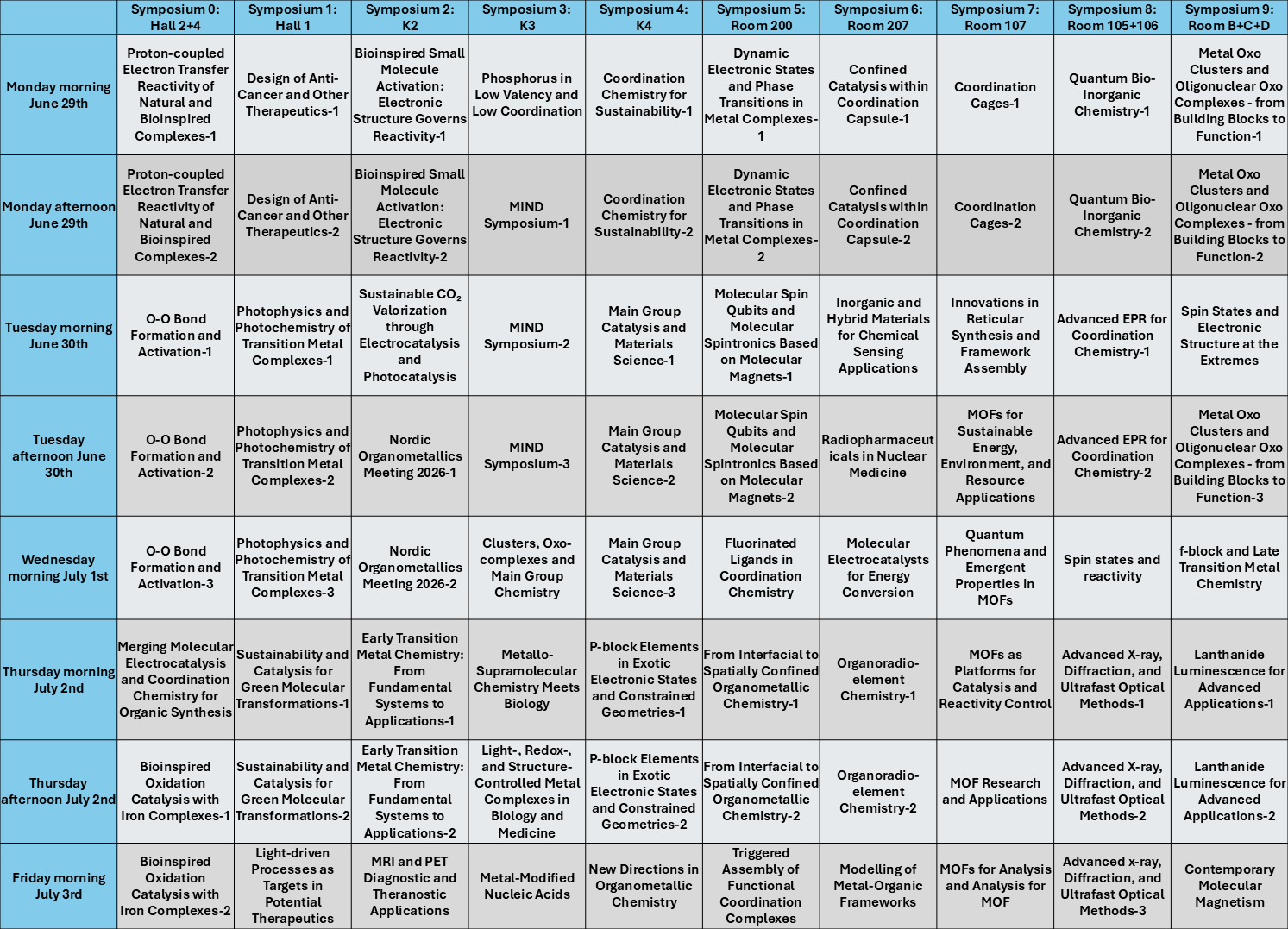
Themes and symposium titles
Coordination compounds for energy and sustainability applications
- Coordination Chemistry for Sustainability
- Recent Advances in the Photophysics and Photochemistry of Transition Metal Complexes
- Sustainability-Driven Coordination Compounds and Catalytic Systems for Green Molecular Transformations
- Molecular electrocatalysts for energy conversion
- Inorganic and hybrid materials for chemical sensing applications
Catalysis and bond activation
- Nordic Organometallic chemistry
- Bioinspired Oxidation Catalysis with Iron Complexes
- Bioinspired Small Molecule Activation: Electronic Structure Governs Reactivity
- Confined Catalysis within Coordination Capsule
- Frontiers in Early Transition Metal Chemistry: From Fundamental Systems to Practical Applications
- Merging Molecular Electrocatalysis and Coordination Chemistry for Organic Synthesis
- O-O Bond Formation and Activation
- Proton-coupled electron transfer (PCET) reactivity promoted by natural and bioinspired metal complexes
- Sustainable CO₂ Valorization through Electrocatalysis and Photocatalysis
Coordination chemistry in biology and medical applications
- Metal ions in Neurodegenerative Disease (MIND)
- Advances in the design of anti-cancer and other therapeutics
- Inorganic chemistry for radiopharmaceuticals in nuclear medicine
- Metallo-supramolecular chemistry meets biology
- Metal-Modified Nucleic Acids
- Novel Approaches to MRI and PET Diagnostic and Theranostic Applications
- Light-driven processes as targets in potential therapeutics
Electronic and molecular structure – methods and modeling
- Advanced EPR for coordination chemistry
- Modelling of Metal-Organic Frameworks
- Probing coordination complex electronic structure and photochemistry with advanced x-ray and ultrafast optical methods
- Quantum Bio-Inorganic Chemistry
Spin states and reactivity - Spin-State Switching: Mechanisms and Emerging Applications
4f/5f-elements
- Contemporary Molecular Magnetism
- Lanthanide Luminescence for Advanced Applications
Main group elements
- Main Group Catalysis and Materials Science
- P-block elements in exotic electronic states and constrained geometries
- Phosphorus in Low Valency and Low Coordination
Supramolecular chemistry and 3D materials
- Coordination Cages
- Innovations in Reticular Synthesis and Framework Assembly
- MOFs as Platforms for Catalysis and Reactivity Control
- MOFs for Analysis and Analysis for MOF
MOFs for Sustainable Energy, Environment, and Resource Applications - Quantum Phenomena and Emergent Properties in MOFs
New Directions in Coordination Chemistry
- Chemistry and Applications of Oligonuclear Oxo-Complexes
- Dynamic Electronic States and Phase Transitions in Metal Complexes
- Fluorinated Ligands in Coordination Chemistry
- Metal-Oxo Clusters: From Building Blocks to Function
- Molecular Spin Qubits and Molecular Spintronics Based on Molecular Magnets
- New Frontiers in the Triggered Assembly of Functional Coordination Complexes
- Organoradioelement chemistry
- Synthesis and Catalysis in 2D and 3D: From Interfacial to Spatially Confined Organometallic Chemistry
- The Potential of Small Crystals for Structure Analysis